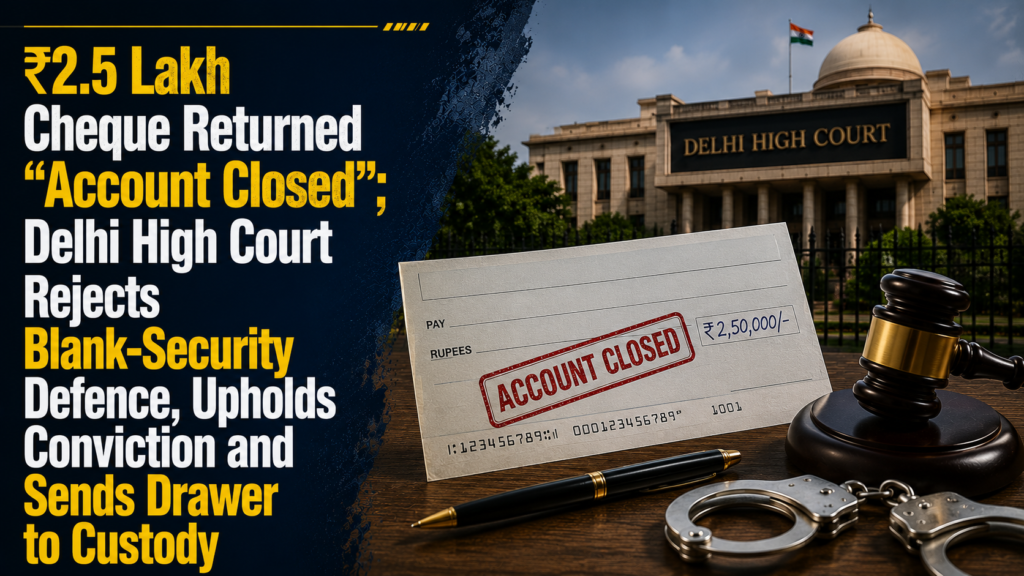
Borrower Admitted Signing Cheque but Claimed It Secured a ₹50,000 Loan Already Repaid; Delhi High Court Finds No Proof and Upholds Section 138 Conviction
Facts
- The complainant alleged that he advanced a friendly loan of ₹2.5 lakh to Pardeep Kumar in December 2017, comprising:
- ₹2 lakh in cash; and
- ₹50,000 through another mode referred to in the proceedings.
- For repayment, Pardeep Kumar issued cheque No. 717458 dated 4 May 2019 for ₹2.5 lakh, drawn on the State Bank of India, Jhajjar Chungi, Rohtak.
- The cheque was presented for payment but was returned unpaid on 7 May 2019 with the remark “Account Closed.”
- The complainant issued a statutory legal notice dated 4 June 2019 demanding payment.
- Pardeep Kumar admitted receiving the legal notice. However, he neither replied to it nor paid the cheque amount within the prescribed 15-day period.
- The complainant consequently instituted proceedings under Section 138 of the Negotiable Instruments Act, 1881.
- Pardeep Kumar admitted that:
- The cheque belonged to him;
- It carried his signature; and
- He had received the statutory legal notice.
- His defence was that:
- He had borrowed only ₹50,000;
- He had repaid approximately ₹1 lakh, including interest, through daily instalments;
- The cheque was handed over as a signed blank security cheque; and
- The complainant subsequently misused it by filling in ₹2.5 lakh.
- The Trial Court found that Pardeep Kumar did not produce:
- Receipts showing repayment;
- Bank or transaction records;
- Evidence of daily instalments;
- Correspondence demanding return of the security cheque; or
- A police complaint alleging misuse of the cheque.
- On 7 July 2023, the Metropolitan Magistrate convicted him under Section 138 of the NI Act.
- By the sentence order dated 22 July 2023, he was directed to:
- Undergo three months’ simple imprisonment;
- Pay ₹3.5 lakh to the complainant; and
- Undergo a further two months’ simple imprisonment in default of payment.
- On 22 December 2023, the Additional Sessions Judge dismissed his criminal appeal and affirmed both the conviction and sentence.
- Pardeep Kumar then filed a revision petition under Section 397 CrPC before the Delhi High Court.
Issues
- Whether the complainant proved the statutory requirements of Section 138 of the NI Act.
- Whether admission of the cheque and signature triggered the presumptions under Sections 118 and 139 of the NI Act.
- Whether Pardeep Kumar’s claim that the cheque was a blank security cheque rebutted the statutory presumption.
- Whether his unsubstantiated assertion that he had repaid the actual ₹50,000 loan through daily instalments constituted a probable defence.
- Whether the complainant was required to produce receipts, books of account, income-tax returns and evidence of financial capacity for the ₹2 lakh cash component.
- Whether the complainant’s later advancement of an additional ₹18,000 created a reasonable doubt concerning the earlier loan.
- Whether the concurrent findings of the Trial Court and Appellate Court disclosed any illegality, infirmity or perversity warranting interference under Section 397 CrPC.
Petitioner’s Arguments
- The complainant did not produce any documentary evidence showing that ₹2 lakh was advanced in cash.
- There was no:
- Loan agreement;
- Receipt;
- Entry in books of account;
- Income-tax return; or
- Bank record supporting the cash transaction.
- The complainant did not establish his financial capacity or disclose the source from which he allegedly arranged the ₹2 lakh.
- Therefore, the cheque could not be treated as having been issued against a legally enforceable debt of ₹2.5 lakh.
- The petitioner had borrowed only ₹50,000 and repaid approximately ₹1 lakh, including interest, through daily payments.
- The cheque was given blank and signed only as security. The complainant later filled it in and misused it.
- The complainant allegedly advanced a further ₹18,000 through cheque No. 040147 dated 14 December 2019.
- According to the petitioner, it was improbable that the complainant would advance further money if ₹2.5 lakh remained unpaid.
- The complainant also failed to establish the alleged friendship that supposedly explained why an interest-free friendly loan was given.
- These circumstances were sufficient to rebut the presumptions under Sections 118 and 139 of the NI Act.
Respondents’ Arguments
- The complainant proved every statutory requirement through:
- The original cheque;
- The dishonour memo dated 7 May 2019;
- The legal notice dated 4 June 2019;
- The registered-post receipt; and
- The postal tracking report.
- The petitioner admitted issuing the cheque, signing it and receiving the legal notice.
- These admissions activated the statutory presumptions that the cheque was issued for consideration and in discharge of a legally enforceable debt.
- The petitioner produced no documentary or reliable oral evidence supporting his claim of repayment.
- He did not explain why he failed to:
- Obtain repayment receipts;
- Seek return of the alleged security cheque;
- Issue stop-payment instructions; or
- File a complaint alleging misuse.
- Once the petitioner failed to rebut the statutory presumption, questions regarding the complainant’s financial capacity, income-tax returns or accounting records became immaterial.
- The revisional jurisdiction of the High Court was narrow and could not be used to substitute another view for concurrent, reasoned findings of the courts below.
Analysis of the Law
Ingredients of Section 138
For an offence under Section 138 of the NI Act, the following must be proved:
- The accused drew a cheque on an account maintained by him.
- The cheque was issued for discharge, wholly or partly, of a legally enforceable debt or liability.
- The cheque was presented within its validity period.
- It was returned unpaid for insufficiency of funds, closure of account or another legally recognised reason.
- The payee issued a written demand notice within 30 days of receiving information about dishonour.
- The drawer failed to make payment within 15 days of receiving the notice.
The Court found that each of these requirements was proved.
Presumptions under Sections 118 and 139
- Section 118 presumes that a negotiable instrument was made or drawn for consideration.
- Section 139 presumes that the holder received the cheque in discharge, wholly or partly, of a debt or liability.
- Once execution and signature are admitted, the Court must raise these presumptions.
- The presumptions are rebuttable, but the accused must produce a probable defence through evidence or reliable circumstances.
- A bare denial or unsupported alternative account is insufficient.
Security cheque defence
- Merely describing a cheque as a “security cheque” does not by itself rebut liability.
- The accused must establish that:
- No legally enforceable debt existed on the presentation date; or
- The underlying debt had already been discharged.
- Pardeep Kumar produced no proof that he had repaid the alleged ₹50,000 loan or that the cheque was liable to be returned.
Financial capacity of the complainant
- A challenge to the lender’s financial capacity may become relevant where the accused first raises a credible and probable defence.
- In the present case, the petitioner failed to discharge even the initial evidentiary burden of rebutting the statutory presumption.
- Consequently, the absence of income-tax returns, cash receipts or books of account did not outweigh the admitted cheque and the statutory presumptions.
Revisional jurisdiction
- A criminal revision is not a second appeal.
- The High Court interferes only where the challenged decision suffers from:
- Patent illegality;
- Material irregularity;
- Jurisdictional error;
- Perversity; or
- Manifest miscarriage of justice.
- Concurrent findings based on a reasonable appreciation of the evidence cannot be reopened merely because another view might be possible.
Precedent Analysis
- John K. Abraham v. Simon C. Abraham, (2014) 2 SCC 236
- The petitioner relied on this decision to argue that the complainant had to establish the source of funds and financial capacity to advance the loan.
- The High Court found that the factual setting was materially different.
- In the present case, the petitioner admitted issuing and signing the cheque, and there was no discrepancy regarding its execution.
- Since the statutory presumption was not rebutted, the decision did not assist the petitioner.
- Irshad Ahmed v. Sukhe Singh, 2023 SCC OnLine Del 7811
- This judgment was cited to challenge the proof of the cash transaction and the complainant’s financial capacity.
- The High Court held that such questions did not become decisive when the petitioner failed to produce any credible evidence rebutting the statutory presumption.
- Kulvinder Singh v. Kafeel Ahmed, 2013 SCC OnLine Del 34
- The petitioner relied on this decision to question whether the complainant had proved the underlying loan.
- The Court found that the admitted signed cheque, dishonour documents, legal notice and absence of rebuttal distinguished the present case.
- Rohitbhai Jivanlal Patel v. State of Gujarat, (2019) 18 SCC 106
- Once the presumption under Sections 118 and 139 arises, the burden shifts to the accused to establish a probable defence.
- A bare denial does not amount to rebuttal.
- Unless the accused discharges that burden, questions concerning the complainant’s source of income or cash records do not defeat the prosecution.
- The Court applied this principle against Pardeep Kumar.
- Kishan Rao v. Shankargouda, (2018) 8 SCC 165
- Admission of the cheque and signature activates the presumption that it was issued towards a legally enforceable debt.
- The accused must rebut the presumption through credible material.
- Pardeep Kumar’s unsupported claim of repayment did not meet that requirement.
- Barun Kumar v. State of NCT of Delhi, 2021 SCC OnLine Del 3498
- Non-disclosure of a transaction in income-tax returns does not, by itself, rebut the statutory presumption under the NI Act.
- The accused must first present a credible defence concerning the absence of debt.
- The petitioner’s income-tax argument was therefore rejected.
- Johar v. Mangal Prasad, (2008) 3 SCC 423
- Revisional jurisdiction is limited and cannot be exercised like a regular appeal to reassess evidence merely because another view is possible.
- Interference is justified only where the findings are illegal, perverse or produce a miscarriage of justice.
- Medha Patkar v. V.K. Saxena, 2025 SCC OnLine Del 5089
- The Delhi High Court reiterated the narrow scope of criminal revision.
- A revisional court should not substitute its own appreciation for concurrent findings unless a clear jurisdictional or legal defect is demonstrated.
- No such defect was found in the petitioner’s conviction.
Court’s Reasoning
- The petitioner admitted that:
- The cheque belonged to him;
- He had signed it; and
- He had received the statutory legal notice.
- The complainant produced the cheque, dishonour memo, legal notice, postal receipt and tracking report.
- The petitioner did not respond to the legal notice or pay the amount within 15 days.
- These facts satisfied the statutory elements of Section 138 and activated the presumptions under Sections 118 and 139.
- The petitioner’s defence rested on two assertions:
- The actual loan was only ₹50,000; and
- That amount had already been repaid with interest through daily instalments.
- Neither assertion was supported by a receipt, bank record, transaction statement, witness or any other reliable evidence.
- The petitioner also took no steps to recover the alleged security cheque after repayment.
- There was no complaint to the police or communication alleging that the complainant had retained or misused the cheque.
- The alleged subsequent advancement of ₹18,000 did not establish that the earlier ₹2.5 lakh debt did not exist.
- Since the petitioner failed to rebut the statutory presumption, the complainant was not required to independently reconstruct every detail of the loan transaction through books of account, tax returns and proof of financial capacity.
- Both the Trial Court and Appellate Court had given detailed and reasoned findings.
- The High Court found no error, illegality, infirmity or perversity warranting interference under Section 397 CrPC.
Conclusion
The Delhi High Court held that the admitted signed cheque, dishonour memo, statutory notice and failure to pay established the requirements of Section 138 of the Negotiable Instruments Act.
Pardeep Kumar’s claim that the cheque was a blank security cheque for a ₹50,000 loan already repaid was unsupported by any documentary or reliable evidence. He therefore failed to rebut the statutory presumptions under Sections 118 and 139.
The Court accordingly:
- Dismissed the revision petition;
- Upheld the conviction under Section 138 of the NI Act;
- Upheld the sentence of three months’ simple imprisonment;
- Upheld the direction to pay ₹3.5 lakh to the complainant;
- Upheld the default sentence of two additional months’ simple imprisonment; and
- Directed that Pardeep Kumar be sent to judicial custody to serve the remaining sentence.
Case Details
Case: Pardeep Kumar v. State (NCT of Delhi) and Another
Court: High Court of Delhi at New Delhi
Case Number: Criminal Revision Petition No. 271 of 2024, with Criminal M.A. No. 6083 of 2024 and Criminal M. (Bail) No. 349 of 2024
Underlying Complaint: C.C. No. 25171 of 2019
Appellate Case: Criminal Appeal No. 436 of 2023
Judge: Justice Saurabh Banerjee
Reserved on: 9 July 2026
Pronounced on: 22 July 2026
Result: Revision dismissed; conviction and sentence affirmed; petitioner directed to judicial custody to serve the remaining sentence.