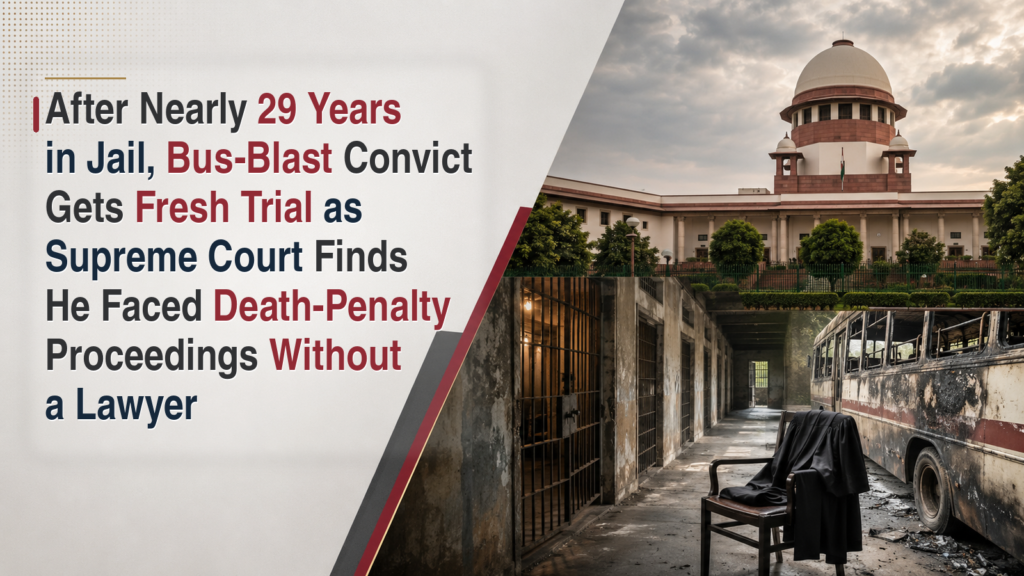
Fourteen People Were Killed in 1996 Samleti Bus Bombing; Supreme Court Finds Accused Was Denied Fair Trial and Orders Retrial
Facts
On 22 May 1996, a Rajasthan State Road Transport Corporation bus bearing Registration Number RJ-07-P-1038 was travelling from Agra to Bikaner with approximately 49–50 passengers.
Two young men boarded the bus at Agra and purchased tickets for Jaipur. However, they unexpectedly got off at Mahwa and returned their tickets to the conductor, asking him to give them to needy passengers.
After the bus travelled approximately three to four kilometres from Mahwa and reached Samleti village, a powerful explosion occurred inside it.
The explosion:
- Killed 14 passengers;
- Injured 37 others;
- Blew apart the bus’s roof, windows and gate; and
- Caused substantial damage to public property.
The conductor gave his statement to the police, resulting in registration of First Information Report Number 148 of 1996 at Mahwa Police Station, District Dausa.
The case was registered for offences under:
- Sections 302, 307 and 120-B of the Indian Penal Code, 1860, concerning murder, attempt to murder and criminal conspiracy;
- Sections 4 and 5 of the Explosive Substances Act, 1908; and
- Section 3 of the Prevention of Damage to Public Property Act, 1984.
The Forensic Science Laboratory concluded that approximately 2.5 kilograms of Research Department Explosive, commonly known as RDX, had been used. The explosive device was believed to have been placed under Seats 17 and 18, directly in front of Seats 22 and 23 occupied by the two suspected passengers.
The investigation was subsequently expanded to examine an alleged wider conspiracy involving the Jammu and Kashmir Islamic Front and Harkat-ul-Ansar. Multiple accused were arrested at different times.
Proceedings Against Dr. Abdul Hameed
Dr. Abdul Hameed was arrested in the present case on 26 June 1997. The prosecution alleged that:
- His appearance matched a sketch prepared from eyewitness descriptions;
- He was one of the two passengers who occupied Seats 22 and 23;
- He and another person left the bus at Mahwa shortly before the explosion;
- He had behaved nervously during the journey;
- He had objected when another passenger attempted to move a suitcase allegedly belonging to him; and
- He left the suitcase behind when he got off the bus.
The prosecution relied upon eyewitness identification, test-identification proceedings, returned bus tickets, forensic reports, alleged disclosure statements and the purported confession of a co-accused.
During the trial, the prosecution examined 99 witnesses, produced 197 documents and exhibited eight material articles.
Despite the complexity and gravity of the case, Dr. Abdul Hameed was not represented by a lawyer during the trial. He personally cross-examined the prosecution witnesses and conducted his defence.
On 29 September 2014, the Trial Court convicted him and sentenced him to death for murder, along with other sentences for the remaining offences.
The death sentence was imposed on the same day as the conviction, when no defence counsel was present.
On 30 April 2015, the Rajasthan High Court remanded the sentencing issue because Dr. Abdul Hameed had not been represented and had not been given a meaningful opportunity to present mitigating circumstances.
On 17 December 2015, after an amicus curiae was appointed for the sentencing stage, the Trial Court again imposed the death penalty.
On 22 July 2019, the Rajasthan High Court confirmed the conviction and death sentence.
By the time the matter was decided by the Supreme Court, Dr. Abdul Hameed had remained incarcerated for nearly 29 years and had faced the death sentence for approximately 12 years.
Proceedings Against Pappu Alias Salim
Pappu alias Salim was initially arrested in connection with the Jaipur Stadium bomb-blast case on 28 July 1997.
A confessional statement was recorded from him under Section 164 of the Code of Criminal Procedure, 1973 on 9 September 1997 in that case.
Another confession was recorded in the Samleti case on 21 October 2002. After objections regarding its legality, the Trial Court directed that the statement be recorded afresh.
Further statements were recorded in January and February 2011. During the February 2011 proceedings, Pappu alias Salim categorically disowned his earlier statements, denied having voluntarily acted as an approver and disputed the circumstances in which the confessions had been recorded.
The pardon granted to him was withdrawn, and he was separately prosecuted.
On 7 March 2017, the Trial Court convicted him of conspiracy, murder, attempt to murder, giving false evidence and offences under the explosives and public-property laws. He was sentenced, among other punishments, to imprisonment for life.
On 22 July 2019, the High Court affirmed his conviction.
In September 2020, the High Court granted him permanent parole after considering that he had spent more than 23 years in custody and had satisfactorily complied with earlier parole conditions.
Proceedings Against the Other Accused
The Trial Court had convicted Javed Khan, Abdul Goni, Lateef Ahmad Baja, Mohammad Ali Bhatt, Mirza Nisar Hussain and Raees Baeg principally for their alleged participation in the wider conspiracy.
The Rajasthan High Court acquitted all six on 22 July 2019. It found that the evidence relied upon against them concerned other criminal cases, general associations and uncorroborated confessions rather than the Samleti bus bombing.
The State of Rajasthan challenged those acquittals before the Supreme Court.
Issues
- Whether Dr. Abdul Hameed’s trial was constitutionally valid when he faced capital charges without a defence lawyer or legal-aid counsel.
- Whether denial of effective legal representation required his acquittal or a fresh trial.
- Whether Dr. Abdul Hameed’s death-sentence conviction could be sustained on the evidentiary record created during an unfair trial.
- Whether the repeatedly recorded and subsequently retracted confessions of Pappu alias Salim were voluntary, reliable and sufficiently corroborated.
- Whether any independent evidence or recovery connected Pappu alias Salim with the Samleti bus bombing.
- Whether the State had established grounds for overturning the High Court’s acquittal of six other accused.
- Whether confessions recorded in other criminal cases, prior associations and identification of locations could establish participation in the Samleti bombing.
- Whether the State’s challenge to the permanent parole granted to Pappu alias Salim survived after the determination of his appeal.
Appellants’ Arguments
Dr. Abdul Hameed
Dr. Abdul Hameed argued that he had faced the entire trial without effective legal representation despite being exposed to the death penalty.
No private lawyer represented him, no legal-aid counsel was appointed, and the Trial Court never offered the services of an amicus curiae. He was compelled to cross-examine numerous witnesses and conduct a highly complex capital trial himself.
He contended that this violated his fundamental rights under Articles 21 and 22 of the Constitution of India and rendered the entire trial constitutionally invalid.
On the merits, he argued that:
- The case was based on an incomplete chain of circumstantial evidence;
- The confession of Pappu alias Salim was retracted and could not constitute substantive evidence against a co-accused;
- The test-identification proceedings were compromised because he had allegedly been shown to witnesses beforehand;
- Some witnesses identified him in court after a delay of several years without having participated in the identification parade;
- Independent witnesses stated that certain identification documents were prepared at the police station rather than at the relevant location;
- There were contradictory accounts concerning the source and recovery of the returned bus tickets;
- No reliable connection was established between the tickets and the ticket books used by the conductor;
- Documents concerning the alleged purchase of a book appeared doubtful and possibly altered;
- Only the portion of a disclosure leading to the discovery of a relevant fact could be admitted under Section 27 of the Indian Evidence Act, 1872; and
- The investigation was selective, procedurally flawed and directed toward a predetermined theory.
Pappu Alias Salim
Pappu alias Salim argued that:
- No explosive substance, weapon, document or incriminating object was recovered from him;
- No direct evidence connected him with the bombing;
- No witness saw him participate in a conspiracy, transport explosives or provide logistical assistance;
- The entire prosecution case was based upon disputed and retracted confessions;
- The confessions were recorded repeatedly over several years and were not voluntary;
- The prosecution failed to establish a complete chain of circumstances;
- No motive was proved; and
- Suspicion could not substitute proof beyond reasonable doubt.
He also defended the High Court’s order granting permanent parole, relying upon his long incarceration and satisfactory conduct.
Acquitted Accused
The six acquitted accused argued that the High Court had correctly found no evidence connecting them with the Samleti bombing.
The confessional statement of Javed Khan primarily concerned movements and transportation of materials relating to other incidents. It did not mention the Samleti attack or attribute any specific role to the accused in that bombing.
Mere association, travel or involvement in other criminal cases could not establish participation in the specific offence under consideration.
Respondent’s Arguments
Against Dr. Abdul Hameed
The State argued that the Trial Court and High Court had concurrently found Dr. Abdul Hameed guilty on the basis of oral, documentary, circumstantial and forensic evidence.
It relied upon:
- Identification by the bus conductor and other passengers;
- Dr. Abdul Hameed’s alleged nervous conduct;
- His premature exit at Mahwa despite holding a ticket to Jaipur;
- The returned tickets;
- His alleged concern regarding the suitcase and leaving it inside the bus;
- Scientific evidence establishing the use of approximately 2.5 kilograms of RDX;
- The confession of Pappu alias Salim; and
- Alleged links with the wider terrorist conspiracy.
The State maintained that these circumstances formed a complete chain pointing exclusively toward guilt.
It further contended that the calculated bombing of a public bus, causing 14 deaths and 37 injuries, fell within the “rarest of rare” category warranting the death penalty.
Against Pappu Alias Salim
The State argued that Pappu alias Salim had initially received pardon upon agreeing to make a complete and truthful disclosure. He later resiled from those statements and consequently forfeited the protection of the pardon.
According to the State, the confessions contained detailed information about the larger conspiracy, procurement and transportation of explosives and the roles of various accused.
The State relied upon recoveries from other alleged conspirators, forensic evidence and transportation records as corroboration.
It also challenged the grant of permanent parole, citing the gravity of the alleged terrorist offences.
Against the Acquitted Accused
The State argued that the six accused were members of a coordinated terrorist network and that their movements, associations, confessions and involvement in other bomb-blast cases established a continuing nexus with the wider conspiracy.
It requested restoration of the convictions imposed by the Trial Court.
Analysis of the Law
Right to Legal Representation and a Fair Trial
The Supreme Court held that the right to a fair trial is an inseparable part of the protection of life and personal liberty under Article 21.
It includes:
- The right to be defended by a lawyer of the accused’s choice;
- The right to competent legal aid where the accused cannot engage counsel;
- A meaningful opportunity to understand and challenge the prosecution evidence; and
- Effective assistance in cross-examining witnesses, raising legal objections and presenting a defence.
Physical presence of the accused in court is not sufficient. The representation must be real, meaningful and effective.
The obligation becomes more stringent where:
- The charge carries the possibility of death;
- The evidence is voluminous or scientifically complex; and
- The accused is incapable of effectively navigating the proceedings alone.
The record showed that Dr. Abdul Hameed was never represented during the evidentiary stage. No conscious and informed waiver of his right to counsel was recorded.
The Supreme Court interacted with him through video conferencing. He confirmed that he had neither engaged a lawyer nor received legal aid. The State produced no record disproving that assertion.
Appropriate Remedy for an Unfair Trial
The Court considered three possible courses:
- Acquit Dr. Abdul Hameed because the trial was unconstitutional;
- Order a fresh trial with proper legal representation; or
- Independently reappreciate the evidence recorded during the defective trial.
The third option was rejected because it would perpetuate the constitutional violation. The evidentiary record itself had been created without effective legal assistance or meaningful cross-examination.
The Court also declined immediate acquittal because the allegations concerned an exceptionally grave bombing that killed 14 people. Ending the prosecution without allowing the charges to be examined in a constitutionally valid trial would disregard the rights of the victims and society.
It therefore ordered a de novo, or completely fresh, trial.
Retracted Confession
A confession derives its evidentiary value from its voluntary character.
Where a confession is:
- Recorded repeatedly over several years;
- Surrounded by procedural irregularities;
- Subsequently retracted by its maker; and
- Unsupported by independent evidence,
it cannot safely form the foundation of a conviction.
The Court noticed that the statutory warning on Pappu alias Salim’s 1997 confession appeared to have been inserted later in a different handwriting. However, it expressly refrained from deciding the validity of that confession for the Jaipur Stadium case because that issue was not directly before it.
For the Samleti case, the repeated recording, express retraction and absence of corroboration made the confessions unsafe.
Confession of a Co-Accused
A confession made by one accused is not substantive evidence against another accused.
It may only lend assurance to a conclusion already reached on the basis of independent and legally admissible evidence. It cannot itself supply the foundation for conviction.
Once Pappu alias Salim’s confession was found unreliable, it could not be used against Raees Baeg or the other accused.
Disclosure Statements Under Section 27
Only the portion of information furnished by an accused that distinctly leads to the discovery of a relevant fact is admissible under Section 27 of the Indian Evidence Act.
Merely identifying a mosque, building or location already known to the investigating agency is not a discovery unless it leads to previously unknown incriminating evidence connected with the offence.
A panchnama or memorandum is not substantive evidence by itself. Its contents must be proved through reliable oral evidence, and the alleged discovery must have a direct nexus with the crime.
Interference With Acquittal
An appellate court has the power to reassess evidence in an appeal against acquittal. However, an acquitted accused enjoys a double presumption of innocence:
- The ordinary presumption that every person is innocent until proved guilty; and
- The reinforced presumption arising from the acquittal.
Where two reasonable views are possible, the view favouring the accused must prevail. Acquittal should be disturbed only when the findings are palpably wrong, manifestly erroneous or demonstrably unsustainable.
Precedent Analysis
Sharad Birdhichand Sarda v. State of Maharashtra
This judgment laid down the five essential principles governing conviction on circumstantial evidence. Every circumstance must be fully proved, consistent only with guilt and form a complete chain excluding every reasonable hypothesis of innocence.
Pulukuri Kottaya v. King-Emperor
Only the portion of information supplied by an accused that distinctly relates to a discovered fact is admissible under Section 27 of the Indian Evidence Act.
Mere identification of a place without discovery of incriminating evidence is insufficient.
Kashmira Singh v. State of Madhya Pradesh
The confession of a co-accused is not substantive evidence. It can only provide limited assurance to independent evidence that already establishes guilt.
Haricharan Kurmi v. State of Bihar
This decision reaffirmed that a co-accused’s confession cannot be the foundation of conviction and must be used only with great caution.
Suk Das v. Union Territory of Arunachal Pradesh
The denial of free legal aid to an accused who cannot afford representation violates the constitutional guarantee of a fair trial and may vitiate the proceedings.
Tyron Nazareth v. State of Goa
The Court recognised that a retrial may be ordered where denial of legal representation fundamentally compromises the original trial.
Mohd. Hussain v. State (Government of National Capital Territory of Delhi)
The Supreme Court held that a de novo trial can be ordered under Section 386(b) of the Code of Criminal Procedure in exceptional cases where it is indispensable to prevent failure of justice.
The court must balance the accused’s right to a fair trial against the gravity of the offence, the rights of victims and the public interest in a lawful determination of guilt.
Naveen v. State of Madhya Pradesh
A fair trial requires a real and meaningful hearing, not a formal or stage-managed process. Fairness protects the accused, victims and society alike.
Murli v. State of Rajasthan
A panchnama or memorandum is not substantive evidence. The substantive evidence is the oral testimony of the witness proving the information and the resulting discovery.
Sheo Swarup v. King-Emperor
An appellate court may review an acquittal but must respect the presumption of innocence and exercise caution before reversing it.
Ramesh Babulal Doshi v. State of Gujarat
An acquittal should not be disturbed unless the findings are palpably wrong, manifestly erroneous or demonstrably unsustainable.
Chandrappa v. State of Karnataka
An acquitted accused enjoys a double presumption of innocence. Where two reasonable conclusions are possible, the appellate court should not interfere with the acquittal.
Court’s Reasoning
Dr. Abdul Hameed
The Supreme Court found that Dr. Abdul Hameed’s trial was fundamentally unconstitutional.
The following circumstances were decisive:
- He faced charges carrying the death penalty.
- The prosecution examined numerous witnesses and relied upon complex scientific, documentary and identification evidence.
- He was not represented by a lawyer during the evidentiary stage.
- He personally cross-examined the prosecution witnesses.
- No legal-aid lawyer or amicus curiae was appointed.
- The Trial Court never recorded that he had knowingly and voluntarily waived his right to counsel.
- The High Court itself had earlier found the sentencing proceedings defective because no lawyer was present.
- Legal representation was provided for the first time only after the High Court remanded the sentencing issue.
The Court held that the constitutional defect could not be cured by reassessing the existing record. The conviction and death sentence therefore had to be set aside.
However, because the allegation concerned a planned bombing that killed 14 innocent passengers and injured 37 others, the Court refused to terminate the prosecution through outright acquittal.
It ordered a fresh trial without expressing any opinion on Dr. Abdul Hameed’s guilt or innocence.
Directions for Fresh Trial
The Supreme Court directed that:
- The Acting Chief Justice of the Rajasthan High Court must designate a Special Court at Jaipur.
- The Special Court must be presided over by an officer of the Rajasthan Higher Judicial Service with at least seven years’ experience in conducting Sessions trials.
- The fresh trial should be completed within one year from assignment of the case.
- The trial must recommence from the stage of prosecution evidence.
- All prosecution witnesses must be summoned again, as far as possible.
- Dr. Abdul Hameed must receive a full opportunity to cross-examine every witness.
- He may engage a lawyer of his choice.
- If he cannot engage counsel, the Rajasthan State Legal Services Authority must appoint:
- A lead defence lawyer with at least ten years’ standing at the Bar; and
- An assisting lawyer with at least seven years’ standing.
- All prosecution documents must be supplied without delay.
- The trial should proceed on a day-to-day basis, as far as practicable, without unnecessary adjournments.
- Dr. Abdul Hameed will remain in judicial custody during the fresh trial but may apply for bail before the Special Court.
- Any bail application must be decided independently and without relying upon the convictions that were set aside.
- The judgment must be translated into Hindi and supplied to Dr. Abdul Hameed.
Pappu Alias Salim
The Supreme Court found that Pappu alias Salim’s conviction rested almost entirely upon the disputed confessions.
The confessions were unsafe because:
- They were recorded repeatedly over a prolonged period;
- Their voluntariness was seriously disputed;
- Pappu alias Salim expressly disowned them;
- Procedural compliance under Section 164 was doubtful;
- No incriminating article was recovered from him;
- No witness established his participation in conspiratorial meetings;
- No documentary, scientific or forensic evidence connected him with the bombing; and
- No complete chain of circumstances was proved.
Once the confessions were excluded or treated with the legally required caution, the entire prosecution case collapsed.
The Supreme Court therefore acquitted him of all charges and directed his immediate release unless required in another case.
Six Acquitted Accused
The alleged confession of Javed Khan did not mention the Samleti bombing or attribute any specific role to him or the other accused in that incident.
The evidence showed, at most, that certain accused travelled together, knew one another or were allegedly connected with other criminal activities.
The Court held that:
- Association is not proof of conspiracy;
- Involvement in another case is not evidence of guilt in the present case;
- A meeting of minds concerning the specific offence must be proved;
- No recovery connected the accused with the Samleti bombing;
- Identification of locations did not amount to discovery under Section 27; and
- Pappu alias Salim’s unreliable confession could not be used against Raees Baeg.
The High Court’s view was reasonable and supported by the record. The State failed to overcome the reinforced presumption of innocence arising from the acquittals.
Conclusion
The Supreme Court disposed of the connected appeals as follows:
Dr. Abdul Hameed
- His appeals were partly allowed.
- His conviction and death sentence were set aside.
- He was not acquitted.
- A fresh trial was ordered before a Special Court at Jaipur.
- The fresh trial should be completed within one year.
- He must receive effective legal representation throughout.
- He will remain in judicial custody but may apply for bail.
Pappu Alias Salim
- His appeal was allowed.
- His conviction and life sentences were set aside.
- He was acquitted of all charges.
- His immediate release was ordered unless required in another case.
- The State’s challenge to his permanent parole became infructuous and was dismissed.
Six Other Accused
The State’s appeals challenging the acquittal of the following accused were dismissed:
- Javed Khan;
- Abdul Goni;
- Lateef Ahmad Baja;
- Mohammad Ali Bhatt;
- Mirza Nisar Hussain; and
- Raees Baeg.
Their acquittals consequently remained undisturbed.
Case Details
Case: Dr. Abdul Hameed v. State of Rajasthan with connected appeals, 2026 Indian Supreme Court 734
Court: Supreme Court of India
Case Numbers: Criminal Appeal Numbers 1827–1829 of 2019; Criminal Appeal Number 1830 of 2019; and connected appeals arising from Special Leave Petition (Criminal) Numbers 621 of 2020, 571 of 2020, 681 of 2020, 143 of 2020 and 3531 of 2021
Judges: Justice Vikram Nath, Justice Sanjay Karol and Justice Sandeep Mehta
Date: 21 July 2026
Result: Dr. Abdul Hameed’s conviction and death sentence set aside with a fresh trial ordered; Pappu alias Salim acquitted and ordered to be released; State appeals against six acquittals dismissed.