


Court’s Decision
The Supreme Court allowed the appeal and set aside the Karnataka High Court’s order, which had held that the applications under Section 34 of the Arbitration and Conciliation Act, 1996 were barred by limitation.
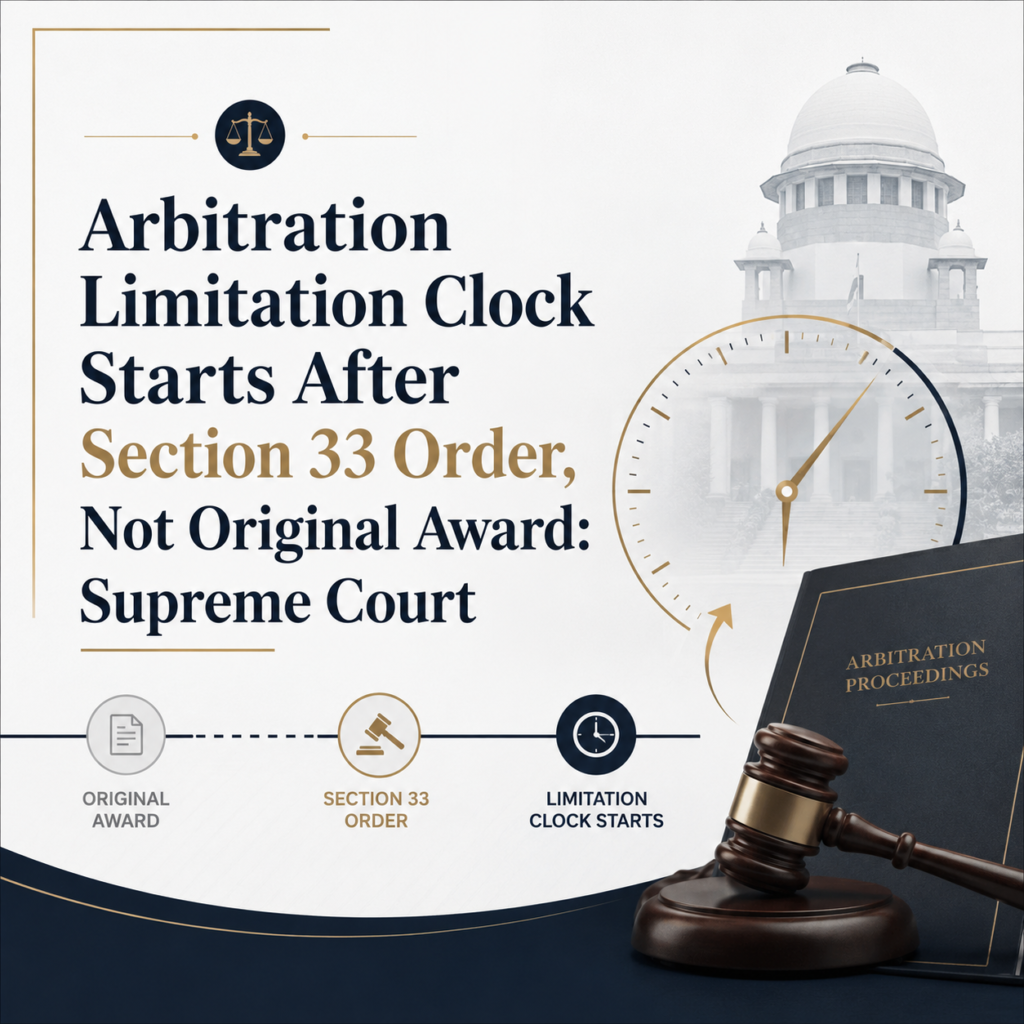
The Court restored the order of the Principal District and Sessions Judge, Ballari, which had condoned the delay in filing the Section 34 applications. The Supreme Court held that once a formal application under Section 33 is filed and entertained by the Arbitral Tribunal, the limitation for filing a Section 34 application begins from the date on which the Section 33 application is disposed of, not from the original arbitral award.
Facts
The dispute arose from acquisition of land for a national highway project. A preliminary notification was issued under the National Highways Act, 1956, and the land vested in the Central Government. Compensation was first determined by the competent authority.
Thereafter, arbitration was invoked under Section 3G(5) of the National Highways Act. The Arbitrator passed an award, which was later set aside by the High Court and the matter was remitted for fresh consideration.
After remand, the Arbitrator passed a fresh award on 03.02.2022, granting certain benefits under the Land Acquisition Act, 1894. The acquiring authority filed an application under Section 33(1)(a) seeking correction of the award, while the landowner also filed an application under Section 33(4) seeking an additional award. Both applications were dismissed by a common order dated 04.07.2022. The certified copy of that order was received by the acquiring authority on 15.09.2022.
Thereafter, Section 34 applications were filed to challenge the arbitral award. The District Court condoned the delay, but the High Court interfered and held that the Section 34 applications were time-barred. The matter reached the Supreme Court.
Issues
The main issue before the Supreme Court was:
When an application under Section 33 of the Arbitration Act is filed, does the limitation for filing a Section 34 challenge begin from the original arbitral award, or from the date on which the Section 33 application is disposed of?
A connected question was whether the benefit of limitation under Section 34(3) is available only when the Section 33 application is maintainable or allowed.
Appellant’s Arguments
The appellant argued that both parties had filed applications under Section 33 before the Arbitrator. Therefore, the Section 34 challenge could not practically be filed until the Section 33 applications were disposed of.
It was submitted that the High Court wrongly refused to exclude the time spent in disposal of the Section 33 applications. The appellant also argued that the Section 33 application was not a review of the award but a correction application, and that the issue was covered by Supreme Court precedent.
Respondent’s Arguments
The respondent argued that the appellant’s Section 33 application was not a genuine correction application. According to the respondent, it was an attempt to review or modify substantive findings in the arbitral award, which is outside the limited scope of Section 33.
It was further argued that only a maintainable Section 33 application can extend or defer limitation for filing a Section 34 petition. Since the appellant’s application was allegedly not maintainable, limitation should have been counted from the original award, and the Section 34 applications were therefore time-barred.
Analysis Of The Law
The Supreme Court examined Sections 33 and 34(3) of the Arbitration and Conciliation Act, 1996.
Section 33 allows a party to request the Arbitral Tribunal to correct computation errors, clerical or typographical errors, or similar errors. It also permits interpretation of a specific part of the award and, in certain cases, an additional award.
Section 34(3) provides the limitation period for challenging an arbitral award. It states that a Section 34 application must be made within three months from the date of receipt of the award, or, if a request has been made under Section 33, from the date on which that request is disposed of by the Arbitral Tribunal.
The Supreme Court held that Section 34(3) does not distinguish between Section 33 applications that are allowed, dismissed, or later held not maintainable. The Court observed that if the legislature wanted to restrict the benefit only to maintainable or successful Section 33 applications, it would have said so expressly.
The Court stated:
“The Court cannot read into the provision a restriction which the legislature itself has not consciously incorporated.”
Precedent Analysis
The respondent relied on State of Arunachal Pradesh v. Damani Construction Co., but the Supreme Court held that reliance on that judgment was misplaced.
The Court clarified that in that case, there was no formal Section 33 application invoking the jurisdiction of the Arbitral Tribunal. There was only a letter seeking review or clarification beyond Section 33. Therefore, it could not provide a fresh starting point for limitation.
In the present case, however, formal Section 33 applications were filed by both sides within time, entertained by the Arbitrator, and disposed of by a common order.
The Supreme Court also relied on Geojit Financial Services Ltd. v. Sandeep Gurav, Ved Prakash Mithal and Sons v. Union of India, and USS Alliance v. State of U.P., holding that once Section 33 jurisdiction is formally invoked, limitation under Section 34 starts from the disposal of the Section 33 application.
Court’s Reasoning
The Court reasoned that once Section 33 proceedings are initiated and entertained, the award remains subject to the limited jurisdiction of the Arbitral Tribunal for correction, interpretation, or supplementation.
Therefore, parties cannot be forced to file Section 34 proceedings during the pendency of Section 33 proceedings merely as a precaution. Doing so would create unnecessary multiplicity of proceedings and procedural uncertainty.
The Court held:
“The parties cannot be compelled to institute proceedings under Section 34 merely as a matter of abundant caution.”
However, the Court also added a caution. If Section 33 applications are sham, frivolous, mala fide, or filed only to defeat limitation, courts may impose exemplary and punitive costs.
Conclusion
The Supreme Court held that the Section 34 limitation period began from the date on which the Section 33 applications were disposed of.
Since the certified copy of the order disposing of the Section 33 applications was received on 15.09.2022, and the Section 34 applications were filed thereafter within the permissible period, the challenge was not time-barred.
The Supreme Court restored the District Court’s order condoning delay and directed that the Section 34 applications be decided on merits in accordance with law.
Key Takeaway
This judgment clarifies an important arbitration limitation principle:
If a formal Section 33 application is filed and entertained by the Arbitral Tribunal, the clock for filing a Section 34 challenge starts from the date the Section 33 application is disposed of — not from the original award.
But parties cannot misuse Section 33 only to extend time. If the application is fake or mala fide, courts can impose heavy costs.