


1. Court’s decision
The Bombay High Court upheld the arrest of a municipal town planning officer by the Directorate of Enforcement in a money laundering investigation linked to illegal construction activities and corruption in a municipal corporation.
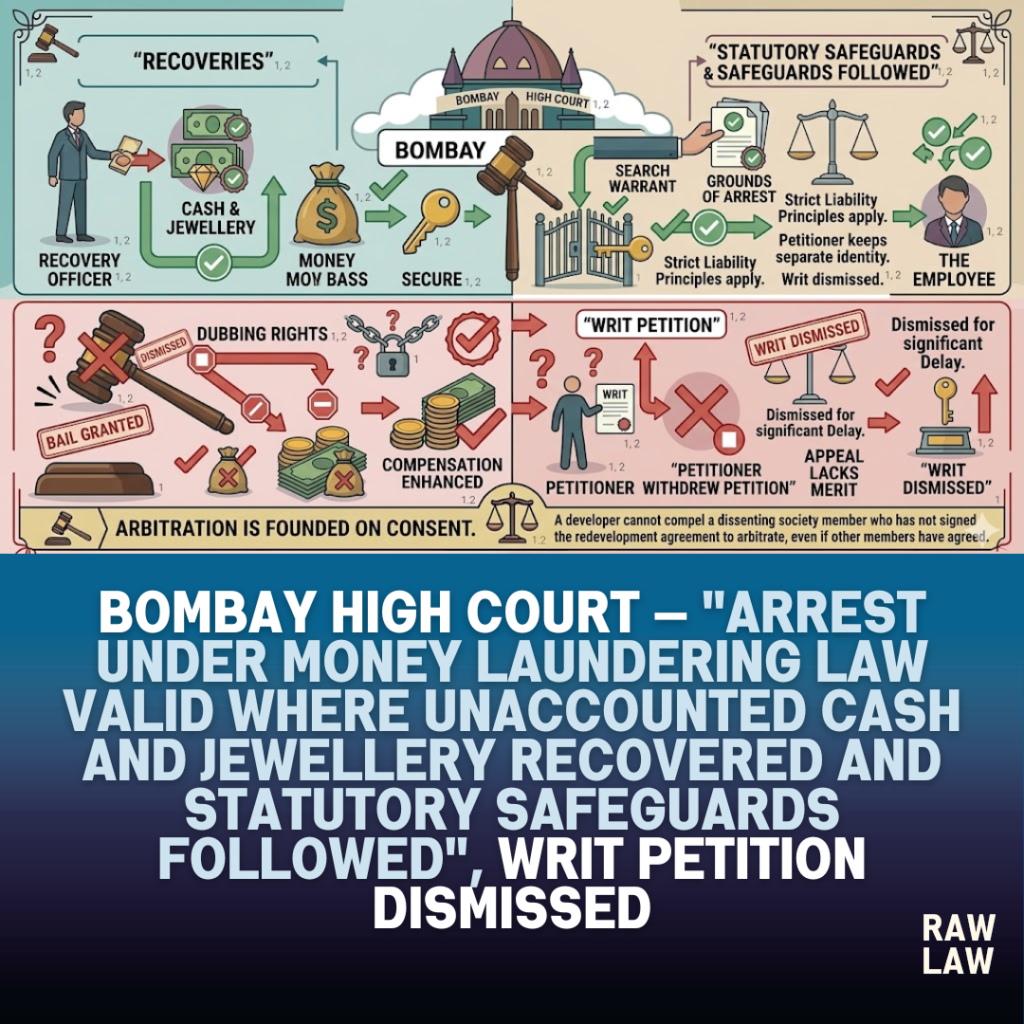
The Court ruled that the arrest was made in compliance with statutory safeguards under the Prevention of Money Laundering Act and was supported by tangible material collected during investigation. It held that judicial review of arrests under special statutes must be exercised cautiously and only in cases of manifest illegality.
Finding no violation of statutory requirements or fundamental rights, the Court dismissed the writ petition seeking declaration of illegal arrest and release from custody.
2. Facts
The petitioner was serving as Deputy Director of Town Planning in the Vasai–Virar City Municipal Corporation.
Several criminal cases had been registered between 2019 and 2023 relating to illegal construction of 41 buildings allegedly carried out using forged permissions and fabricated documents on land reserved for public infrastructure.
Subsequently, the High Court ordered demolition of these illegal structures, affecting thousands of families.
Following the demolition, the Directorate of Enforcement registered an Enforcement Case Information Report based on the earlier police cases relating to fraud and illegal construction.
During the investigation, search operations were conducted at the petitioner’s residences. Authorities recovered unaccounted cash amounting to approximately ₹8.23 crore and diamond jewellery valued at over ₹23 crore.
Based on this material, a separate corruption case was registered against the petitioner under the Prevention of Corruption Act.
3. Issues
The principal issue before the High Court was whether the petitioner’s arrest under the Prevention of Money Laundering Act was illegal and violated his fundamental rights.
The Court also examined whether the absence of earlier criminal charges against the petitioner in the initial police cases invalidated the money laundering investigation.
Another issue considered was whether the Directorate of Enforcement could initiate proceedings without first establishing a predicate offence directly against the petitioner.
4. Petitioner’s arguments
The petitioner argued that his arrest was unlawful because he was not named as an accused in the earlier police cases relating to illegal construction.
It was contended that the offence of money laundering requires the existence of a predicate scheduled offence attributable to the accused. Since the petitioner was not implicated in the initial cases, the jurisdictional foundation for the money laundering investigation was allegedly absent.
The petitioner further argued that the alleged proceeds of crime had not been identified at the time of arrest and were quantified only later in the enforcement agency’s counter-affidavit.
It was also submitted that the petitioner had cooperated with the investigation on multiple occasions and that there was therefore no necessity to arrest him.
5. Respondent’s arguments
The Directorate of Enforcement opposed the petition, arguing that the arrest had been carried out strictly in accordance with statutory provisions.
The agency submitted that investigation revealed a large network involving developers, municipal officials, architects, and intermediaries engaged in illegal construction activities.
According to the agency, the petitioner played a central role in granting development permissions and allegedly collected illegal commissions in return.
The enforcement agency relied on seized documents, digital records, witness statements, and coded communications to demonstrate the petitioner’s involvement in laundering proceeds of crime.
It was also argued that the writ petition was an attempt to bypass the strict bail conditions applicable under the Prevention of Money Laundering Act.
6. Analysis of the law
The Court examined the statutory framework governing arrests under the Prevention of Money Laundering Act.
It noted that Section 19 permits arrest where an authorized officer has “reasons to believe” based on material in possession that a person is guilty of money laundering.
The Court emphasized that the existence of such material and the recording of reasons are the key requirements at the stage of arrest.
The Court also relied on judicial precedents holding that courts should not evaluate the sufficiency or adequacy of evidence at the stage of investigation.
7. Precedent analysis
The Court referred to decisions of the Supreme Court clarifying the scope of judicial review in cases involving arrest under special economic statutes.
These precedents emphasize that courts must exercise restraint and intervene only where there is clear violation of statutory safeguards or manifest arbitrariness.
The Court also relied on jurisprudence explaining that money laundering is an independent offence connected with the handling of proceeds of crime derived from scheduled offences.
8. Court’s reasoning
The Court held that the enforcement agency had followed the procedure prescribed under the Prevention of Money Laundering Act.
The petitioner had been informed of the grounds of arrest and the reasons for believing that he was involved in money laundering.
The Court noted that substantial material had been recovered during search operations, including large quantities of unaccounted cash and jewellery.
It held that such recoveries, along with witness statements and digital evidence, provided sufficient foundation for the arresting officer to form a prima facie belief regarding commission of the offence.
The Court also rejected the argument that a person must first be named in the predicate offence before action under the money laundering statute can be taken.
9. Conclusion
The High Court concluded that the petitioner had failed to demonstrate any illegality in the arrest process or any violation of statutory safeguards.
It held that the arrest was supported by material evidence and had been carried out in accordance with the Prevention of Money Laundering Act.
Accordingly, the Court dismissed the writ petition challenging the arrest and refused to interfere with the remand orders passed by the trial court.
10. Implications
The judgment reinforces the principle that judicial review of arrests under special economic statutes such as the Prevention of Money Laundering Act is limited.
Courts will not ordinarily interfere with investigative actions where authorities have recorded reasons to believe based on material evidence.
The ruling also clarifies that money laundering is an independent offence and that the accused need not necessarily be named in the original predicate offence for investigation to proceed.
Case Law References
1. Vijay Madanlal Choudhary v. Union of India
The Supreme Court held that money laundering is an independent offence involving processes connected with proceeds of crime derived from scheduled offences.
2. Radhika Agarwal v. Union of India
The Supreme Court emphasized that judicial review of arrests under special statutes must be exercised sparingly and only where statutory safeguards are violated.
3. Arvind Kejriwal v. Directorate of Enforcement
The Court examined the legal framework governing arrest and investigation under the Prevention of Money Laundering Act.
4. Anilkumar Khanderao Pawar v. Directorate of Enforcement
The Bombay High Court discussed circumstances where lack of incriminating material may justify interference with investigative actions.
FAQs
1. Can a person be arrested under the Prevention of Money Laundering Act without being named in the original criminal case?
Yes. Courts have held that money laundering is an independent offence. A person may be investigated and arrested if there is material linking them to proceeds of crime derived from a scheduled offence.
2. What is the requirement for arrest under Section 19 of the Prevention of Money Laundering Act?
An authorized officer must record “reasons to believe” based on material evidence that the person is guilty of money laundering and must inform the accused of the grounds of arrest.
3. Can courts review the evidence relied upon for arrest under the money laundering law?
Courts generally do not evaluate the sufficiency of evidence at the stage of investigation and intervene only where there is clear violation of statutory safeguards.