


1. Court’s decision
The Bombay High Court at Goa disposed of a writ petition concerning alleged irregularities in the issuance of quasi-judicial orders by a revenue authority.
The Court noted that the petitioner had already filed revision applications before the Administrative Tribunal challenging the impugned orders. Instead of adjudicating the legality of the orders directly, the Court permitted the petitioner to amend the revision applications to include challenges to the subsequently supplied reasoned orders.
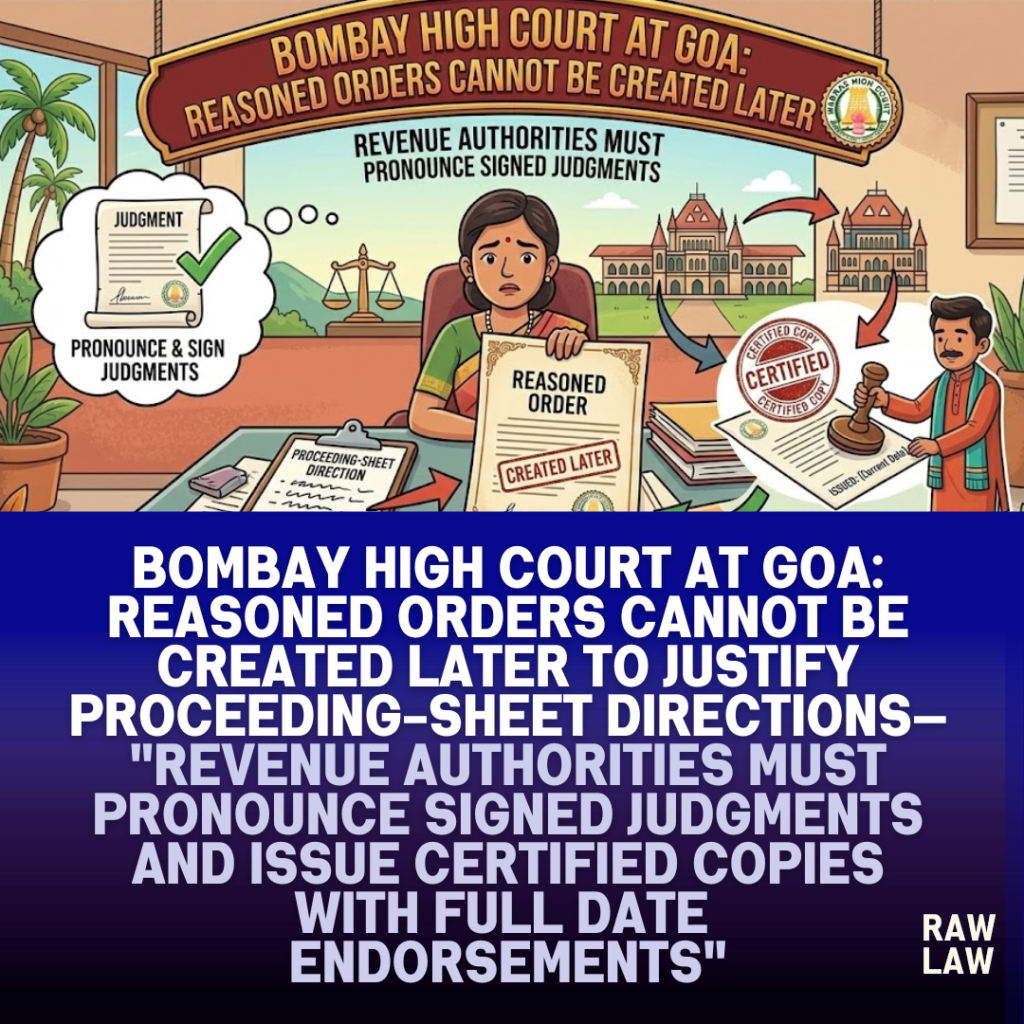
The Court also issued comprehensive procedural directions to streamline how revenue authorities pronounce orders and issue certified copies to litigants.
2. Facts
The petitioner, a 71-year-old widow, had earlier obtained an order from the Mamlatdar allowing her application to purchase a dwelling house under Section 16 of the Goa, Daman and Diu Mundkars (Protection from Eviction) Act, 1975.
Respondents challenged that order by filing an appeal before the Deputy Collector along with applications seeking leave to appeal and a stay of the Mamlatdar’s decision.
On 16 December 2023, the Deputy Collector allowed the applications and stayed the Mamlatdar’s order. However, the petitioner received only the proceeding-sheet entry reflecting the operative part of the order and not a reasoned judgment explaining the decision.
3. Issues
The Court considered several questions arising from the dispute.
The first issue was whether the Deputy Collector could issue a detailed reasoned order after initially recording only the operative part of the order in the proceeding sheet.
The second issue was whether the procedure adopted by the authority in issuing certified copies and communicating the order complied with established principles governing quasi-judicial decision-making.
A broader issue concerned systemic irregularities in the functioning of revenue authorities exercising quasi-judicial powers.
4. Petitioner’s arguments
The petitioner argued that the Deputy Collector had initially passed an unreasoned order recorded in the proceeding sheet and later attempted to supply reasons by issuing a separate judgment dated the same day.
It was submitted that this later document appeared to have been created after the petitioner filed revision proceedings, allegedly to cure the absence of reasoning in the original order.
The petitioner also highlighted procedural irregularities, including delays in issuing certified copies and the absence of official stamps indicating when the copies were applied for, prepared, or delivered.
5. Respondent’s arguments
The government authorities argued that there was no conclusive evidence demonstrating that the reasoned order had been created at a later date.
An enquiry conducted by the Collector concluded that there had been procedural lapses in issuing certified copies but found no definitive proof of manipulation of records.
The government also informed the Court that disciplinary action in the form of a formal censure had been issued to the Deputy Collector for failing to comply with procedural requirements relating to certified copies.
6. Analysis of the law
The Court examined the legal framework governing quasi-judicial orders and the issuance of certified copies.
Under the Indian Evidence Act, records maintained by public authorities exercising judicial or quasi-judicial functions constitute public documents. Certified copies of such records must therefore be issued according to statutory procedures to maintain their evidentiary value.
The Court emphasized that when orders are challenged in appellate or revisional proceedings, accurate recording of dates relating to certified copies becomes essential because limitation periods often exclude the time required to obtain copies.
7. Precedent analysis
The Court referred to an earlier judgment of the High Court in Pradeep K.R. Sangodker v. State of Goa, which had issued guidelines for timely pronouncement of judgments and issuance of certified copies by courts and quasi-judicial authorities.
Those guidelines required that orders be pronounced in open court and that certified copies be supplied promptly to parties who apply for them.
The Court also relied on the Supreme Court’s decision in Registrar General, High Court of Karnataka v. M. Narsimha Prasad, which emphasized the importance of transparency and procedural fairness in judicial administration.
8. Court’s reasoning
The Court observed that the circumstances surrounding the issuance of the reasoned order raised legitimate concerns regarding procedural propriety.
Although an inquiry had been conducted and disciplinary action taken against the officer involved, the Court concluded that the legality of the orders themselves should be examined by the Administrative Tribunal where revision proceedings were already pending.
At the same time, the Court considered it necessary to address broader systemic problems affecting quasi-judicial functioning of revenue authorities, particularly delays in issuing orders and irregularities in the certification process.
9. Conclusion
The Court disposed of the writ petition by directing that the petitioner be allowed to amend the pending revision applications before the Administrative Tribunal to challenge both the operative order and the later reasoned order dated 16 December 2023.
The Tribunal was directed to decide the revisions on merits within three months.
The Court also issued procedural directions requiring revenue authorities to pronounce signed orders in open court, maintain proper pagination of records, and issue certified copies with clear endorsements of relevant dates.
10. Implications
The judgment highlights serious procedural concerns in the functioning of revenue authorities exercising quasi-judicial powers.
By mandating clearer procedures for pronouncing orders and issuing certified copies, the Court aimed to ensure transparency and prevent disputes about when orders were actually passed.
The ruling also underscores the importance of maintaining accurate administrative records, particularly where statutory limitation periods depend on the timing of communication and receipt of certified copies.
Case Law References
- Registrar General, High Court of Karnataka v. M. Narsimha Prasad (Supreme Court)
The Court emphasized judicial accountability and the importance of procedural integrity in the functioning of judicial and quasi-judicial authorities. - Pradeep K.R. Sangodker v. State of Goa (Bombay High Court at Goa)
The High Court issued guidelines requiring courts and quasi-judicial authorities to pronounce orders promptly and supply certified copies within prescribed timelines.
FAQs
1. Can a quasi-judicial authority add reasons to an order after announcing the operative part?
Courts generally require that reasoned orders be prepared and available when the decision is pronounced. Supplying reasons later may raise serious procedural concerns.
2. Why are certified copy procedures important in legal proceedings?
Certified copies establish official proof of orders and determine limitation periods for appeals or revisions. Accurate documentation of dates is therefore crucial.
3. What directions did the court issue to revenue authorities in this case?
The court directed that orders must be pronounced in open court, placed in files with pagination, and that certified copies must include endorsements of all relevant dates related to their preparation and delivery.