


HEADNOTE
Kalyan Dombivli Municipal Corporation v. Nandkishor Govind Sane & Ors.
(Along with connected LPAs)
Court: Bombay High Court
Jurisdiction: Civil Appellate Jurisdiction
Bench: Justices G.S. Kulkarni & Aarti Sathe
Date of Judgment: January 16, 2026
Citation: 2026:BHC-AS:1893-DB
Laws / Sections Involved:
Industrial Disputes Act, 1947 – Section 18(1), Section 18(3)(d);
MRTU & PULP Act, 1971 – Section 28, Schedule IV Item 9
Keywords: Industrial settlement, conciliation proceedings, binding effect, non-union workers, limitation, unfair labour practice
Summary
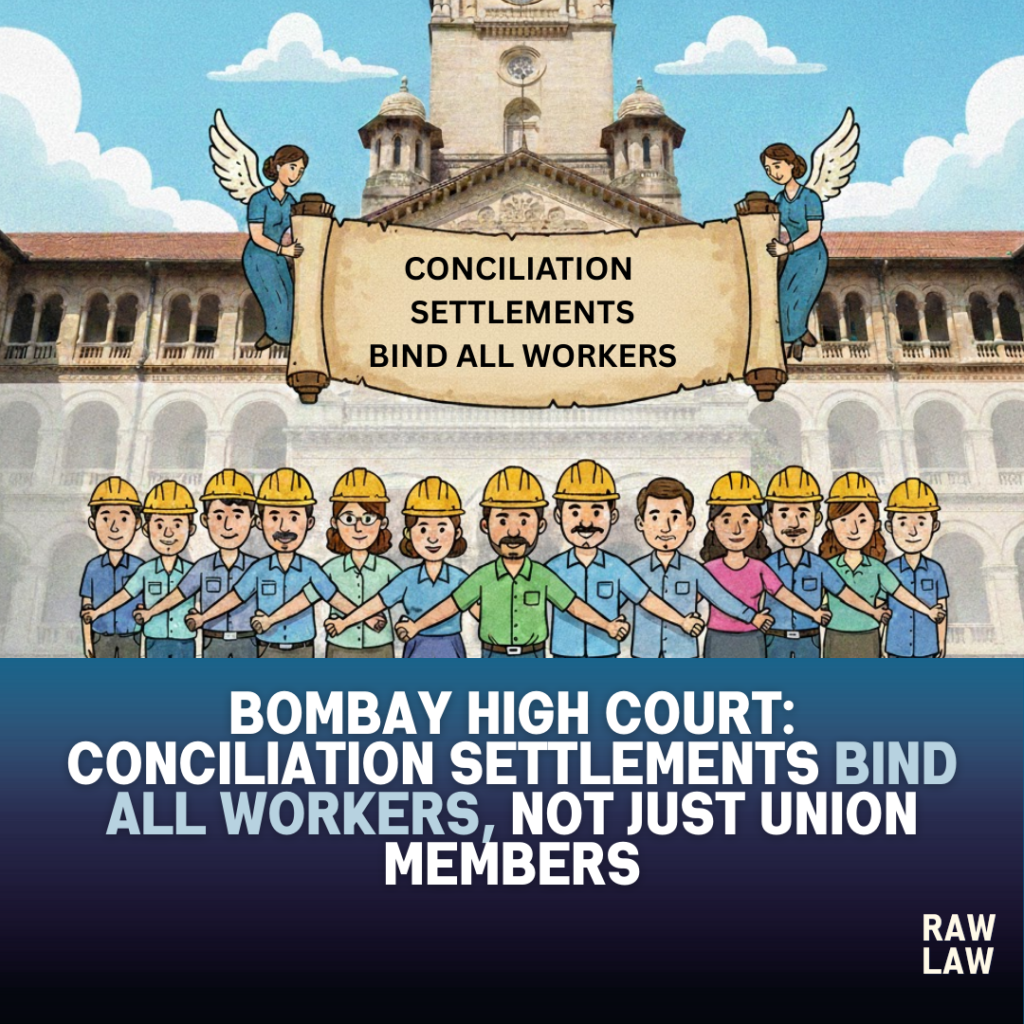
The Bombay High Court dismissed a batch of Letters Patent Appeals filed by the Kalyan Dombivli Municipal Corporation (KDMC), affirming that a settlement arrived at during conciliation proceedings is binding on all employees, including non-members of the signatory unions. The Court upheld concurrent findings of the Industrial Court and Single Judge that KDMC committed unfair labour practice by failing to implement a 1996 settlement providing for wage revision based on the Fifth Pay Commission. Rejecting KDMC’s objections on maintainability and limitation, the Division Bench held that such settlements have extended statutory force under Section 18(3)(d) of the Industrial Disputes Act and give rise to a continuing cause of action until implemented.
Court’s decision
The Division Bench of the Bombay High Court dismissed the Letters Patent Appeals filed by KDMC and upheld the judgments of the Industrial Court and the learned Single Judge. The Court held that the settlement dated 3 January 1996, having been arrived at during conciliation proceedings, was binding on all employees of KDMC, including those who were not members of the signatory unions. It further ruled that non-implementation of such a settlement constituted an unfair labour practice under Item 9 of Schedule IV of the MRTU & PULP Act.
Facts
The respondent workmen were employees of KDMC who filed complaints alleging failure to implement a settlement dated 3 January 1996 entered into between KDMC and two recognised labour unions. The settlement provided for revision of wages in line with the Fifth Pay Commission. Despite the settlement remaining valid and subsisting, KDMC failed to extend its benefits to the complainants. The Industrial Court allowed the complaints and directed implementation of the settlement, which was upheld by a Single Judge, leading KDMC to file the present appeals.
Issues
The principal issues were whether a settlement reached during conciliation proceedings binds employees who are not members of the signatory unions, and whether complaints filed years later seeking enforcement of such a settlement were barred by limitation under Section 28 of the MRTU & PULP Act.
Appellant’s arguments
KDMC contended that the settlement was binding only on parties to the agreement under Section 18(1) of the Industrial Disputes Act, as the complainants were not union members. It further argued that the settlement had lost relevance due to subsequent awards and parity reports governing service conditions. KDMC also raised a limitation objection, asserting that the complaints filed in 2008 were barred, having been instituted nearly twelve years after the settlement.
Respondents’ arguments
The workmen argued that the settlement was arrived at during conciliation proceedings and therefore attracted Section 18(3)(d) of the Industrial Disputes Act, making it binding on all employees. They submitted that the settlement was never withdrawn or superseded and remained unimplemented, giving rise to a continuing cause of action. It was also pointed out that KDMC had extended benefits of the settlement to certain categories of employees, demonstrating its continued validity.
Analysis of the law
The Court analysed Section 18 of the Industrial Disputes Act and distinguished between settlements arrived at during conciliation proceedings and those concluded otherwise. It held that settlements reached with the assistance and concurrence of the Conciliation Officer have extended statutory binding force on all present and future employees of the establishment. The legislative intent behind Section 18(3)(d) was emphasised as promoting parity, fairness, and industrial peace.
Precedent analysis
The Bench relied on settled jurisprudence including Bata Shoe Co. (P) Ltd. v. D.N. Ganguly, P. Virudhachalam v. Management of Lotus Mills, and Walchandnagar Industries Ltd. v. Dattusingh Pardeshi, which recognise that conciliation settlements bind even non-signatory workers. These precedents were applied to reject KDMC’s restrictive interpretation of Section 18(1).
Court’s reasoning
The Court found that the settlement explicitly recorded conciliation proceedings and bore the signature of the Conciliation Officer, leaving no doubt about its legal character. It held that KDMC could not selectively implement the settlement or deny benefits to certain employees. On limitation, the Court ruled that failure to implement a subsisting settlement constitutes a continuing unfair labour practice, entitling employees to seek enforcement at any time until compliance.
Conclusion
The Letters Patent Appeals were dismissed, and the directions of the Industrial Court to implement the settlement dated 3 January 1996 were confirmed. The Court found no perversity or legal infirmity in the concurrent findings against KDMC.
Implications
This judgment reinforces that conciliation settlements have wide binding force and cannot be circumvented by employers on technical grounds of union membership or delay. It strengthens enforcement of collective bargaining outcomes and affirms continuing causes of action in cases of non-implementation, offering robust protection to workers’ rights.
Case law references
• Bata Shoe Co. (P) Ltd. v. D.N. Ganguly (AIR 1961 SC 1158)
Holding: Settlements during conciliation must have the Conciliation Officer’s concurrence to bind all workers.
Application: Applied to characterise the 1996 settlement as binding under Section 18(3).
• P. Virudhachalam v. Management of Lotus Mills (1998 II LLJ 389)
Holding: Conciliation settlements bind all workmen, including non-union members.
Application: Relied upon to reject KDMC’s maintainability objection.
• Walchandnagar Industries Ltd. v. Dattusingh Pardeshi (2005 6 BCR 733)
Holding: Settlements bind even non-member workers.
Application: Used to affirm extended binding force of settlements.
FAQs
Q1. Are conciliation settlements binding on non-union workers?
Yes. Settlements reached during conciliation proceedings bind all employees under Section 18(3)(d) of the Industrial Disputes Act.
Q2. Can enforcement be sought years later?
Yes. Non-implementation creates a continuing cause of action until the settlement is implemented.
Q3. What unfair labour practice was found?
Failure to implement a valid settlement was held to be an unfair labour practice under Item 9 of Schedule IV of the MRTU & PULP Act.