


1. Court’s decision
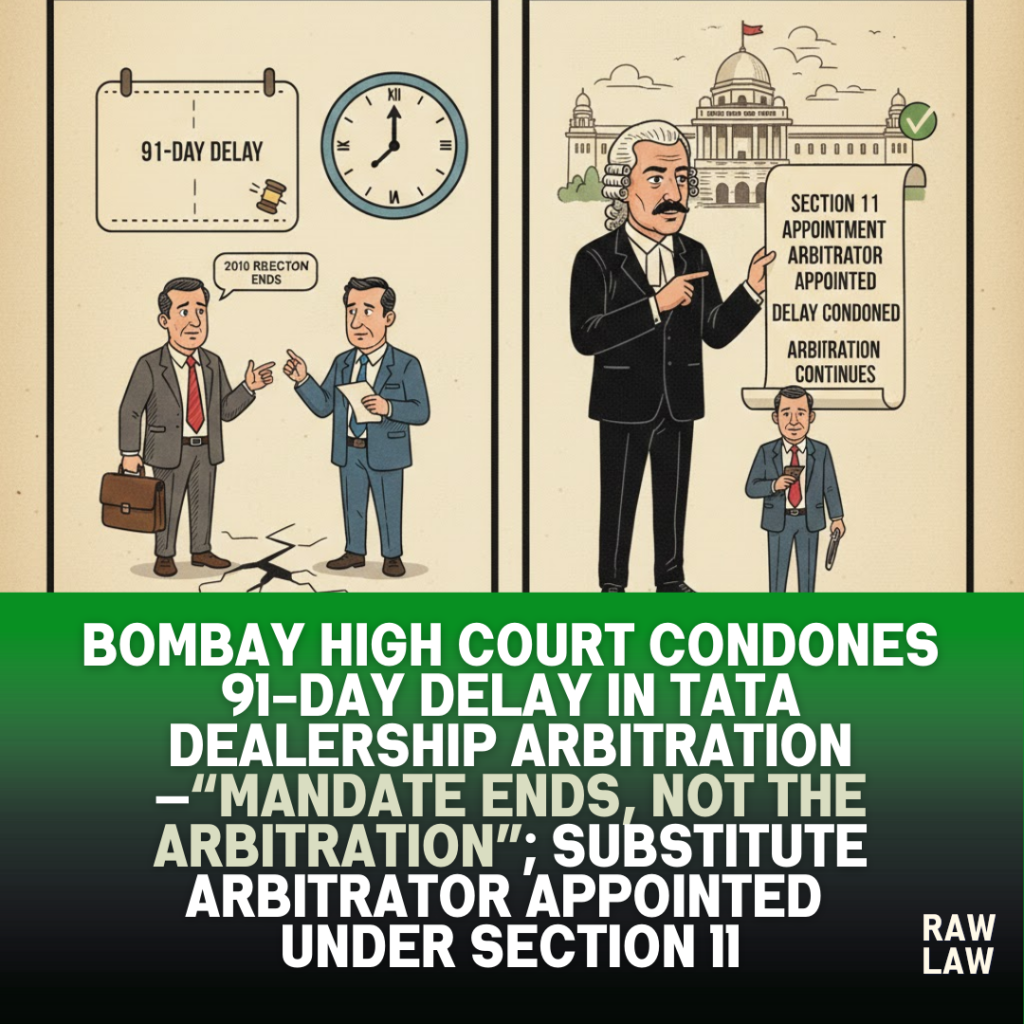
The Bombay High Court allowed two Commercial Arbitration Applications filed under Section 11 of the Arbitration and Conciliation Act, 1996, and appointed a substitute sole arbitrator to continue arbitral proceedings arising out of dealership agreements.
The core issue was whether the applications were barred by limitation after the original arbitrator withdrew in March 2021. The Court held that although Article 137 of the Limitation Act applies even to substitute appointments, the delay of 76 and 91 days deserved condonation under Section 5. Emphasising that termination of an arbitrator’s mandate does not terminate arbitral proceedings, the Court appointed a former High Court judge as substitute arbitrator.
2. Facts
Tata Motors Passenger Vehicles Ltd. and its successor entity had entered into dealership agreements dated 26 December 2012 and 9 July 2013 with the respondent dealer for sale of passenger vehicles and spare parts. Disputes arose over alleged outstanding dues exceeding ₹20 crore.
Arbitration was invoked in February 2016 in accordance with Clause 43.2(b), which provided for arbitration under the Rules of Arbitration and Conciliation of the Bombay Chamber of Commerce & Industry (BCCI), with Mumbai as the seat.
A sole arbitrator was appointed and proceedings commenced. However, due to the Covid-19 pandemic and subsequent ill health, the arbitrator withdrew from the reference on 18 March 2021.
Despite repeated requests, BCCI failed to appoint a substitute arbitrator. The applicants first pursued remedies under Sections 29A, 14 and 15. By order dated 2 July 2025, the Court directed them to pursue the remedy under Section 11 instead. The present applications followed.
3. Issues
The Court framed three principal issues:
• Whether termination of the arbitrator’s mandate resulted in termination of arbitral proceedings.
• Whether Article 137 of the Limitation Act applies to applications for appointment of substitute arbitrators under Section 11 read with Sections 14 and 15.
• Whether the delay in filing the present applications could be condoned under Section 5 of the Limitation Act.
4. Petitioners’ arguments
The applicants argued that withdrawal of the arbitrator under Section 14 does not terminate arbitral proceedings under Section 32. Only the mandate ends; the reference survives. They relied on Supreme Court precedent to contend that substitution is mandatory under Section 15(2).
They further submitted that limitation principles applicable to fresh Section 11 petitions should not strictly apply to substitution in a live reference. Alternatively, even if Article 137 applied, the delay was condonable under Section 5.
Reliance was placed on judgments recognising that courts may condone delay in Section 11 applications even without a formal condonation application. The applicants emphasised that they had continuously pursued remedies and were not negligent.
5. Respondents’ arguments
The respondents contended that the applications were hopelessly time-barred. According to them, the right to apply accrued upon withdrawal of the arbitrator on 18 March 2021 or at least upon invocation dated 31 March 2021.
They relied on the Supreme Court’s ruling in M/s Arif Azim Co. Ltd. v. M/s Aptech Ltd., which held that Article 137 applies to Section 11 petitions, prescribing a three-year limitation period.
The respondents argued that subsequent correspondence or pursuit of incorrect remedies did not extend limitation. They also objected to maintainability on the ground that the applicant entity was not an original signatory, an objection the Court rejected.
6. Analysis of the law
The Court undertook a detailed statutory analysis of Sections 14, 15 and 32 of the Arbitration Act. Relying on Dani Wooltex Corporation v. Sheil Properties Pvt. Ltd., it reiterated that termination of an arbitrator’s mandate does not automatically terminate arbitral proceedings. Only a final award or order under Section 32 can do so.
Under Section 15(2), a substitute arbitrator “shall” be appointed according to the same rules applicable to the original appointment. Therefore, the “same rules” governing Section 11 apply even to substitution.
The Court accepted that Article 137 applies to substitute appointments as well. However, it clarified that limitation could be condoned under Section 5, as recognised in HPCL Bio-Fuels Ltd. v. Shahaji Bhanudas Bhad.
7. Precedent analysis
The Court relied on:
• M/s Arif Azim Co. Ltd. v. M/s Aptech Ltd. – Held Article 137 applies to Section 11 applications.
• Dani Wooltex Corporation v. Sheil Properties Pvt. Ltd. – Termination of mandate does not end arbitral proceedings.
• Shailesh Dhairyawan v. Mohan Balkrishna Lulla – Substitute arbitrator must be appointed unless expressly excluded.
• HPCL Bio-Fuels Ltd. v. Shahaji Bhanudas Bhad – Delay in Section 11 applications can be condoned under Section 5 without formal application.
The Court distinguished Fedbank Financial Services Ltd., noting that case involved termination under Section 29A, not voluntary withdrawal.
8. Court’s reasoning
The Court observed that the applicants had actively pursued remedies before BCCI and the High Court. The peculiar circumstances—withdrawal of the arbitrator and institutional inaction—contributed to delay.
Limitation expired on 28 February 2025 after accounting for Covid extensions. However, excluding time spent bona fide prosecuting Section 29A and Section 14/15 proceedings, the net delay was 76 and 91 days.
Given that arbitration had already commenced and the objective was merely to fill a vacancy, the Court held that technicalities should not defeat substantive adjudication. The delay was therefore condoned.
Justice R.Y. Ganoo (former Judge of the Bombay High Court) was appointed as substitute arbitrator.
9. Conclusion
The High Court condoned the delay and appointed a substitute arbitrator to continue arbitration arising from the dealership agreements. It reaffirmed that arbitration agreements survive expiry of mandate and that courts must facilitate continuation of arbitral proceedings.
10. Implications
This ruling clarifies three important principles in Indian arbitration law:
• Article 137 applies even to substitute arbitrator appointments.
• Termination of mandate ≠ termination of arbitral proceedings.
• Courts retain discretion to condone delay under Section 5 in Section 11 applications.
For commercial entities, especially in long-running dealership and distribution disputes, the judgment reinforces judicial commitment to preserving arbitral continuity over procedural technicalities.
Case Law References
M/s Arif Azim Co. Ltd. v. M/s Aptech Ltd. – Article 137 applies to Section 11 petitions.
Dani Wooltex Corporation v. Sheil Properties Pvt. Ltd. (2024) 7 SCC 1 – Termination of arbitrator’s mandate does not terminate arbitral proceedings.
Shailesh Dhairyawan v. Mohan Balkrishna Lulla (2016) 3 SCC 619 – Substitute arbitrator must be appointed under Section 15.
HPCL Bio-Fuels Ltd. v. Shahaji Bhanudas Bhad (2024 SCC OnLine SC 3190) – Delay in Section 11 applications is condonable under Section 5.
FAQs
1. Does withdrawal of an arbitrator terminate arbitration?
No. It terminates only the arbitrator’s mandate under Section 14, not the arbitral proceedings under Section 32.
2. Is there limitation for filing a Section 11 application?
Yes. Article 137 of the Limitation Act prescribes three years from accrual of the right to apply.
3. Can delay in filing a Section 11 petition be condoned?
Yes. Courts can condone delay under Section 5 of the Limitation Act, even without a formal condonation application.