


Court’s decision
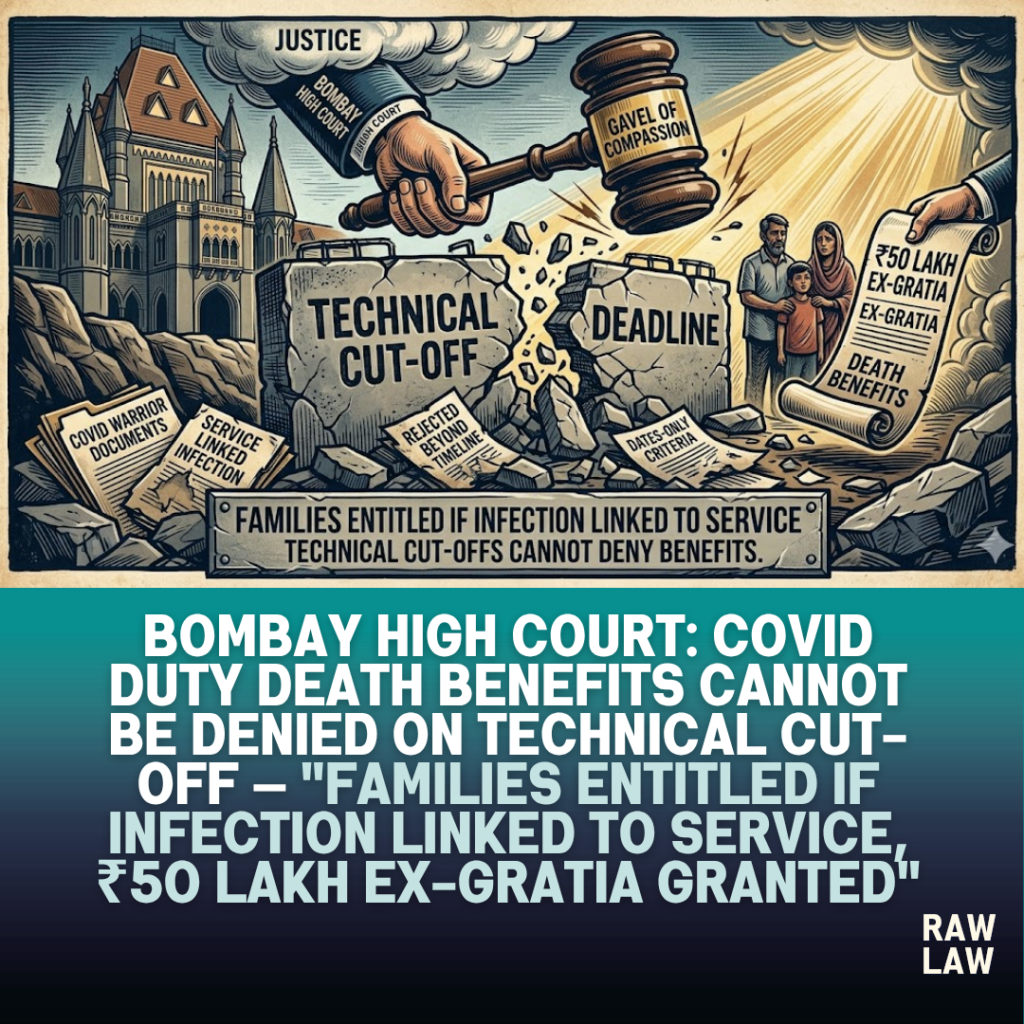
The Bombay High Court allowed the writ petition and directed the State to grant ₹50 lakh ex-gratia compensation to the legal heirs of a deceased court employee who died due to COVID-19. The Court held that rigid reliance on the cut-off date of 30 June 2021 was unjustified where the infection was clearly linked to official duty. It quashed the rejection order and directed payment within six weeks.
Facts
The petitioners were the legal heirs of a junior clerk employed in the Civil Court at Chiplun, who died on 3 July 2021 due to COVID-19 infection.
The deceased had been on duty until 31 May 2021. Shortly thereafter, he developed symptoms, tested positive on 14 June 2021, and was hospitalized before succumbing to the illness.
The family applied for ex-gratia compensation under Government Resolutions issued during the COVID-19 pandemic, which provided ₹50 lakh to employees who died due to COVID-19 while performing official duties.
However, the State rejected the claim on the ground that the death occurred after the cut-off date of 30 June 2021.
Aggrieved, the petitioners approached the High Court seeking enforcement of their entitlement.
Issues
The key issue was whether ex-gratia compensation could be denied solely because the employee’s death occurred after the prescribed cut-off date.
The Court also examined whether the policy should be interpreted strictly or purposively, especially in cases where infection occurred during active service.
Another issue was whether the deceased’s case satisfied the eligibility criteria under the Government Resolutions.
Petitioner’s arguments
The petitioners argued that the deceased contracted COVID-19 due to official duties and therefore squarely fell within the scope of the Government Resolution.
They contended that the relevant criterion was whether the employee was on duty within 14 days prior to infection or hospitalization, which was satisfied in the present case.
It was submitted that denying compensation based on a rigid cut-off date would defeat the purpose of the scheme, which was to support families of frontline workers.
Reliance was placed on precedent where similar benefits were extended despite marginal deviation from the cut-off date.
Respondent’s arguments
The State argued that the Government Resolution dated 25 April 2022 clearly restricted benefits to employees who died on or before 30 June 2021.
Since the deceased passed away on 3 July 2021, the petitioners were not eligible.
It was contended that the policy must be applied strictly and the Court should not extend benefits beyond its express terms.
Analysis of the law
The Court analyzed the Government Resolutions issued during the COVID-19 pandemic, particularly the Resolution dated 29 May 2020 and its subsequent extensions.
It noted that the scheme was intended to support families of employees who risked their lives while performing COVID-related duties.
The Court emphasized that the primary eligibility condition was whether the employee was on duty within 14 days prior to hospitalization or death.
It found that the later cut-off date introduced in subsequent resolutions could not override the substantive eligibility criteria.
The Court adopted a purposive interpretation, prioritizing the object of the scheme over rigid technicalities.
Precedent analysis
The Court relied on:
- Vijaya Yashwant Jadhav v Block Development Officer (2025)
Held that benefits cannot be denied merely because death occurred after the cut-off date if infection was linked to duty.
The Court applied this precedent to hold that strict adherence to the cut-off date would be contrary to fairness and constitutional values.
Court’s reasoning
The Court found that the deceased was on duty until 31 May 2021 and was hospitalized within 14 days of falling ill, thereby satisfying the core eligibility criteria.
It held that the cut-off date of 30 June 2021 could not be treated as absolute, especially when the infection clearly arose during service.
The Court emphasized that the purpose of the scheme was to recognize and support the sacrifice of government employees during the pandemic.
It observed that denying compensation in such circumstances would be contrary to justice, fairness, and societal conscience.
The Court concluded that the rejection of the claim was arbitrary and unsustainable.
Conclusion
The Bombay High Court quashed the rejection order and directed the State to grant ₹50 lakh ex-gratia compensation to the petitioners within six weeks.
Implications
This judgment reinforces a humanitarian and purposive approach in interpreting welfare schemes.
It ensures that technical cut-off dates do not defeat substantive rights of families affected during the pandemic.
The ruling is significant for similarly placed families whose claims were denied due to minor deviations from policy timelines.
It also strengthens judicial oversight against arbitrary administrative decisions in welfare matters.
Case law references
- Vijaya Yashwant Jadhav v Block Development Officer (2025)
Cut-off dates cannot defeat entitlement where duty-related infection is established.
FAQs
1. Can Covid compensation be denied due to a cut-off date?
Not if the infection is clearly linked to official duty and eligibility conditions are otherwise satisfied.
2. What is the key eligibility for Covid ex-gratia schemes?
Typically, the employee must have been on duty within a specified period (e.g., 14 days) before hospitalization or death.
3. Can courts override government policy conditions?
Courts can interpret policies purposively and strike down arbitrary application of conditions.