


Court’s decision
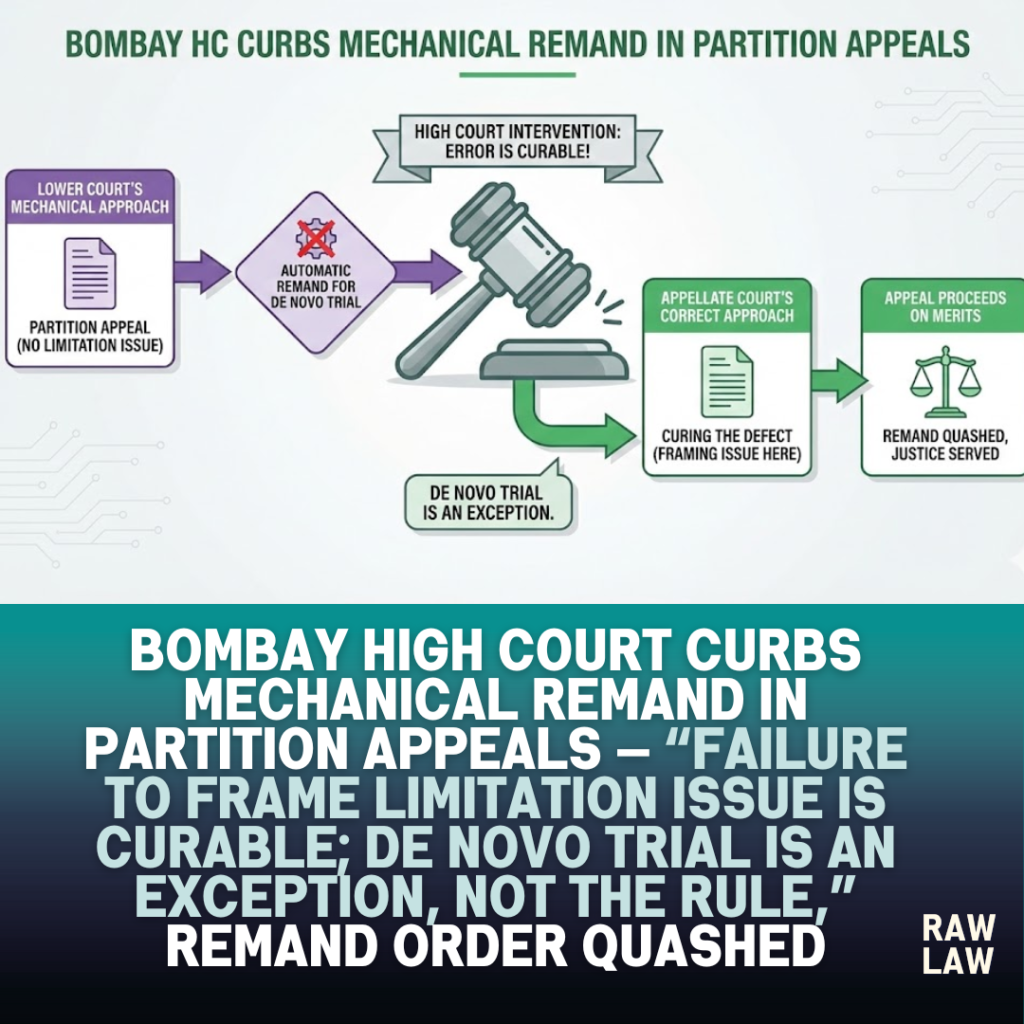
The Bombay High Court has allowed an appeal from order and set aside a sweeping remand directed by the first appellate court in a long-pending partition suit. The Court held that merely because the trial court did not frame a specific issue on limitation, the entire decree could not be set aside and the suit remanded for a fresh trial. Emphasising that remand under Order XLI Rule 23A of the Code of Civil Procedure is an exceptional power, the Court ruled that appellate courts must first examine existing evidence and findings and, if necessary, adopt narrower statutory options such as deciding the issue themselves or calling for findings under Order XLI Rule 25. The matter was sent back to the first appellate court for decision on merits on the existing record.
Facts
The litigation arose from a partition suit filed in 2012 (later renumbered in 2014) by one of the sons of a deceased patriarch, seeking partition and separate possession of ancestral and joint family properties situated in Pune district. The plaintiff claimed a one-sixth share as the son through the first wife, while the contesting defendants were sons through the second wife. The suit also sought recovery of past rental income and a permanent injunction against alienation.
The defendants resisted the suit primarily on the ground that an oral partition had already taken place in 1980 during the lifetime of the father, pursuant to which the plaintiff was allegedly given possession of his separate share. On this basis, limitation was specifically pleaded, along with a contention that some properties were self-acquired. After recording oral and documentary evidence, the trial court partly decreed the suit in 2020, granting the plaintiff a one-sixth undivided share in certain schedules of property and issuing consequential directions for partition.
Issues
The principal issue before the High Court was whether the first appellate court was justified in setting aside the partial partition decree and remanding the entire suit for fresh adjudication solely because a specific issue on limitation had not been framed by the trial court. Ancillary issues included whether parties had already led evidence on limitation, whether any prejudice was demonstrated due to non-framing of a formal issue, and what is the correct scope of appellate powers of remand under Order XLI of the Code of Civil Procedure in such circumstances.
Petitioner’s arguments
The appellant-plaintiff argued that the appellate court committed a serious jurisdictional error by ordering a wholesale remand. It was contended that limitation had been expressly pleaded by the defendants, evidence had been led by both sides on the alleged oral partition of 1980, and the trial court had decided the suit on merits after full trial. Relying on settled Supreme Court authority, the appellant submitted that non-framing of an issue does not vitiate proceedings unless prejudice is shown. At the highest, the appellate court could have framed an additional issue and decided it itself, or adopted the limited course under Order XLI Rule 25, instead of nullifying the entire trial and enabling parties to fill lacunae. It was further argued that in partition suits, the cause of action is recurring so long as joint status subsists.
Respondents’ arguments
The respondents supported the remand, asserting that the suit was hopelessly barred by limitation because the oral partition of 1980 had been acted upon for decades. They argued that the absence of a formally framed issue on limitation deprived them of a proper opportunity to lead focused evidence. It was also pointed out that the plaintiff had earlier filed and withdrawn an injunction suit in the late 1980s and remained inactive for years thereafter, reinforcing the plea of limitation. According to the respondents, the appellate court correctly exercised its power to remand after identifying serious infirmities in the trial court judgment.
Analysis of the law
The High Court analysed the statutory scheme of Order XLI of the Code of Civil Procedure, reiterating that appellate courts possess wide powers but must exercise them judiciously. Remand under Rule 23A is permissible only when the decree is liable to be reversed and a retrial is genuinely necessary, such as where the suit has been disposed of on a preliminary issue without evidence. The Court highlighted Section 99 CPC, which mandates that decrees shall not be reversed for procedural irregularities unless prejudice is established.
The Court further noted that where parties are aware of the controversy and have led evidence, omission to frame a specific issue is a curable defect. The Code provides calibrated remedies—deciding the issue on the existing record, or calling for findings—before resorting to the drastic step of de novo trial.
Precedent analysis
Relying on authoritative Supreme Court decisions, the Court reiterated that remand is not to be ordered mechanically. Judgments such as Corporation of Madras v. M. Parthasarathy, Zarif Ahmad v. Mohd. Farooq, and Sirajudheen v. Zeenath were invoked to underline that appellate courts must avoid unnecessary prolongation of litigation. On non-framing of issues, precedents like Uttara Thool, Kunju Kesavan, Sayeda Akhtar, and Nedunuri Kameswaramma were applied to reaffirm that absence of a formal issue does not vitiate a trial where evidence covers the field. On limitation in partition suits, the Court noted the doctrine of recurring cause of action recognised in Syed Shah Ghulam.
Court’s reasoning
Applying these principles, the High Court found that the appellate court had failed to examine whether the trial court’s findings were perverse or unsupported by evidence. It had not assessed prejudice, nor considered deciding limitation on the existing record. Instead, it ordered a wholesale remand merely because an issue was not framed. The Court observed that the defendants had pleaded limitation, led evidence on oral partition, and yet failed to establish a clear denial of the plaintiff’s rights. In such circumstances, a complete retrial would only duplicate proceedings and allow parties to fill gaps in evidence. The impugned remand order was therefore held to suffer from non-application of mind.
Conclusion
The appeal from order was allowed. The High Court quashed the remand order dated 1 February 2024 and directed that the appeal be restored to the file of the first appellate court. The appellate court was directed to decide the appeal on merits after appreciating the entire evidence already on record and, if necessary, to frame and determine the issue of limitation either itself or by adopting the limited course under Order XLI Rule 25. All contentions on merits were kept open.
Implications
This judgment reinforces procedural discipline in appellate practice. It cautions courts against routine remands that prolong already old civil disputes, particularly partition suits. The ruling clarifies that non-framing of an issue is not a licence for de novo trials and that appellate courts must exhaust narrower statutory options first. For litigants, the decision underscores that evidence already led cannot be lightly discarded; for courts, it reaffirms that remand is an exception justified only by necessity, not convenience.
Case law references
- Corporation of Madras v. M. Parthasarathy: Explained proportional use of appellate powers under Order XLI; applied to restrict wholesale remand.
- Zarif Ahmad v. Mohd. Farooq: Held that remand is not a healthy or routine practice; relied upon to set aside de novo trial.
- Uttara Thool v. Praveen Thool: Clarified that non-framing of issues does not vitiate proceedings absent prejudice.
- Syed Shah Ghulam v. Syed Shah Ahmed: Recognised recurring cause of action in partition suits; noted in limitation context.
FAQs
Q1. Can an appellate court remand a case just because an issue was not framed?
No. The Bombay High Court has held that non-framing of an issue, by itself, does not justify a de novo trial unless prejudice is shown.
Q2. What are the alternatives to remand under the Code of Civil Procedure?
An appellate court may decide the issue itself on existing evidence or frame an additional issue and call for findings under Order XLI Rule 25.
Q3. Is limitation a recurring issue in partition suits?
Yes. Courts recognise that the cause of action in partition suits can be recurring so long as joint status subsists.