


1. Court’s decision
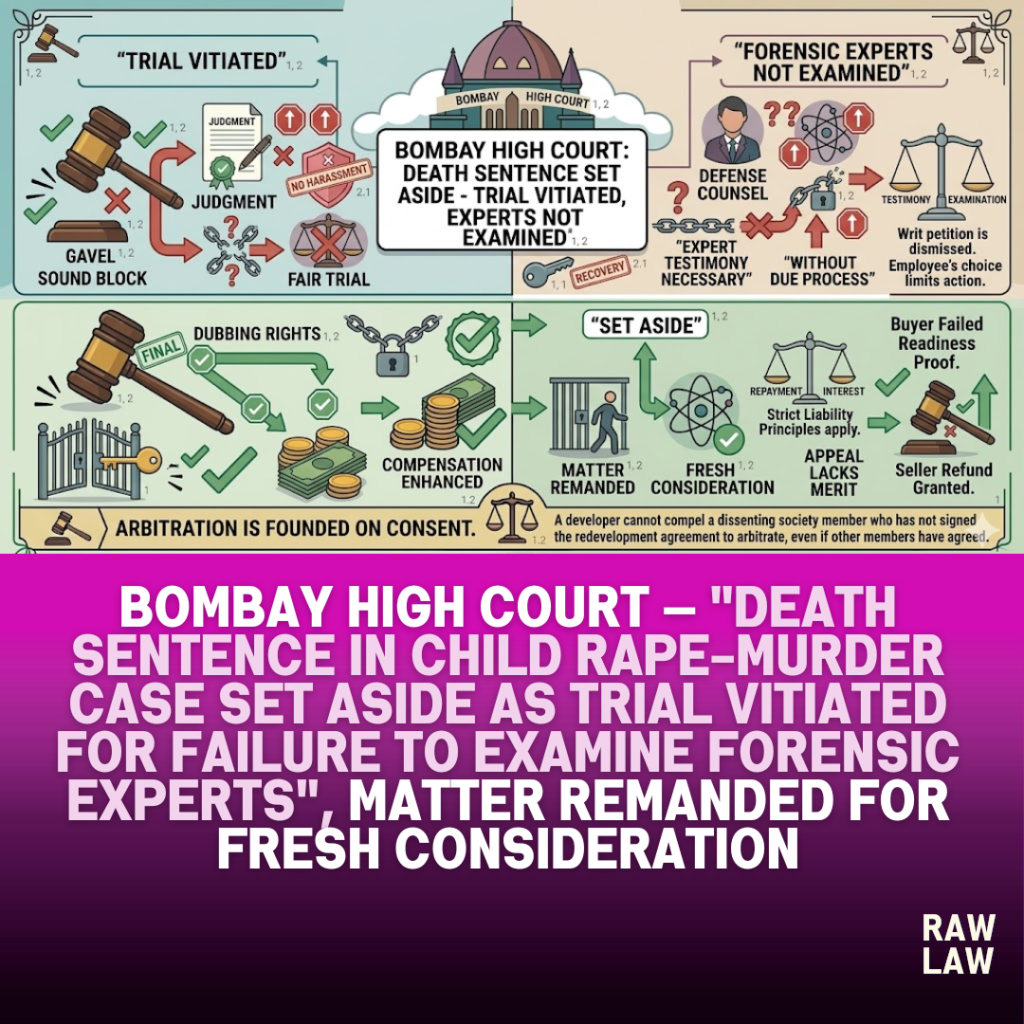
The Bombay High Court set aside a death sentence imposed in a case involving rape and murder of a minor girl, holding that the trial stood vitiated due to procedural irregularities concerning forensic evidence.
The Court found that the Sessions Court relied heavily on chemical analyser and DNA reports while convicting the accused, but failed to summon the forensic experts who authored those reports.
Observing that denial of an opportunity to cross-examine such crucial witnesses violated the principles of a fair trial, the Court quashed the conviction and remanded the matter to the Sessions Court for limited reconsideration of the evidence.
2. Facts
The case involved allegations that the primary accused had committed brutal sexual assault and murder of a minor girl aged approximately six years and ten months.
According to the prosecution, the victim was a child from the neighbourhood who was subjected to aggravated penetrative sexual assault and sustained fatal throat injuries. The prosecution alleged that the accused’s mother assisted him in concealing the body of the victim.
Following investigation, charges were filed under multiple provisions of the Indian Penal Code relating to kidnapping, rape, aggravated sexual assault, murder, and destruction of evidence, along with offences under the Protection of Children from Sexual Offences Act.
After trial, the Sessions Court convicted the primary accused and imposed the death penalty for certain offences, while sentencing the co-accused mother to imprisonment for destruction of evidence and related offences.
3. Issues
The High Court considered whether the conviction and death sentence imposed by the Sessions Court were legally sustainable.
The central issue before the Court was whether the trial was vitiated because forensic reports relied upon by the prosecution were admitted without examining the scientific experts who prepared them.
The Court also examined whether the statements of the accused recorded during the trial complied with the legal requirements under criminal procedure.
4. Petitioner’s arguments
The accused argued that the trial suffered from serious procedural defects because the prosecution introduced multiple chemical analyser and DNA reports without summoning the experts who prepared them.
It was submitted that the reports were produced during the testimony of the investigating officer and were directly marked as exhibits without giving the defence an opportunity to cross-examine the authors.
The defence also argued that the accused were not properly confronted with the contents of these reports during their statements recorded under the relevant procedural provisions.
According to the defence, these irregularities violated the right to a fair trial and required the conviction to be set aside.
5. Respondent’s arguments
The State contended that the conviction was based on substantial evidence and that the accused had not objected to the admission of the forensic reports during the trial.
However, the prosecution acknowledged that the scientific experts who prepared the reports had not been examined during the trial proceedings.
The State further submitted that courts have adopted a consistent approach in such situations by remanding the matter to the trial court for examination of the relevant experts.
6. Analysis of the law
The High Court examined the legal framework governing the admissibility of forensic evidence in criminal trials.
The Court emphasized that where scientific reports such as DNA analysis and chemical examination are relied upon for conviction, the authors of such reports should ordinarily be examined as witnesses.
This ensures that the accused has the opportunity to challenge the methodology, reliability, and interpretation of the forensic findings through cross-examination.
The Court noted that failure to follow this procedure may result in denial of a fair trial, particularly in cases involving serious punishments such as the death penalty.
7. Precedent analysis
The Court relied on Supreme Court precedents addressing similar situations where convictions were based on forensic reports without examination of the relevant experts.
In those cases, the Supreme Court held that failure to examine scientific experts while relying on their reports could lead to miscarriage of justice.
The Court also referred to previous decisions of the Bombay High Court where similar procedural defects resulted in setting aside convictions and remanding cases to the trial court for limited reconsideration.
These precedents guided the Court in determining the appropriate remedy in the present case.
8. Court’s reasoning
The High Court observed that the Sessions Court had relied heavily on multiple chemical analyser reports and DNA reports while recording the conviction.
However, the forensic experts who prepared these reports were not summoned as witnesses, and their reports were admitted directly through the investigating officer.
The Court held that such a procedure deprived the accused of the opportunity to cross-examine the experts, thereby undermining the fairness of the trial.
Additionally, the Court found that the statements of the accused were recorded improperly because questions were put jointly to both accused rather than individually.
These procedural defects, according to the Court, resulted in failure of justice and vitiated the trial proceedings.
9. Conclusion
The High Court concluded that the conviction and death sentence imposed by the Sessions Court could not be sustained due to procedural irregularities affecting the fairness of the trial.
The Court therefore quashed the trial court judgment and remanded the case to the Sessions Court for limited reconsideration.
The trial court was directed to summon the relevant forensic experts, permit cross-examination by the defence, and thereafter record fresh statements of the accused before deciding the case afresh.
10. Implications
The judgment underscores the importance of procedural safeguards in criminal trials, particularly in cases involving capital punishment.
It reiterates that courts must ensure that forensic evidence relied upon for conviction is tested through examination of the relevant experts.
The decision also highlights the judiciary’s responsibility to ensure fair trial standards even where the prosecution case involves serious and disturbing allegations.
Case Law References
1. Irfan alias Bhayu Mevati v. State of Madhya Pradesh
The Supreme Court held that where DNA evidence is relied upon for conviction, failure to examine the scientific experts who prepared the report can vitiate the trial.
2. State of Maharashtra v. Sanjay Baban Katkar
The Bombay High Court followed the Supreme Court’s approach and remanded a case where forensic experts were not examined despite reliance on their reports.
3. Sanjay Deopuri Puri v. State of Maharashtra
The Court reiterated that reliance on forensic reports without examining the authors can lead to failure of justice and justify remand of the case.
FAQs
1. Can a conviction be set aside if forensic experts are not examined in court?
Yes. Courts have held that if forensic reports such as DNA or chemical analysis are relied upon for conviction, the authors of those reports should normally be examined so that the defence can cross-examine them.
2. Why did the Bombay High Court set aside the death sentence in this case?
The Court found that the trial court relied on forensic reports without examining the experts who prepared them, which deprived the accused of the opportunity to challenge the evidence.
3. What happens after a case is remanded by the High Court?
When a case is remanded, the trial court must conduct further proceedings as directed—such as examining witnesses or recording fresh statements—before delivering a new judgment.