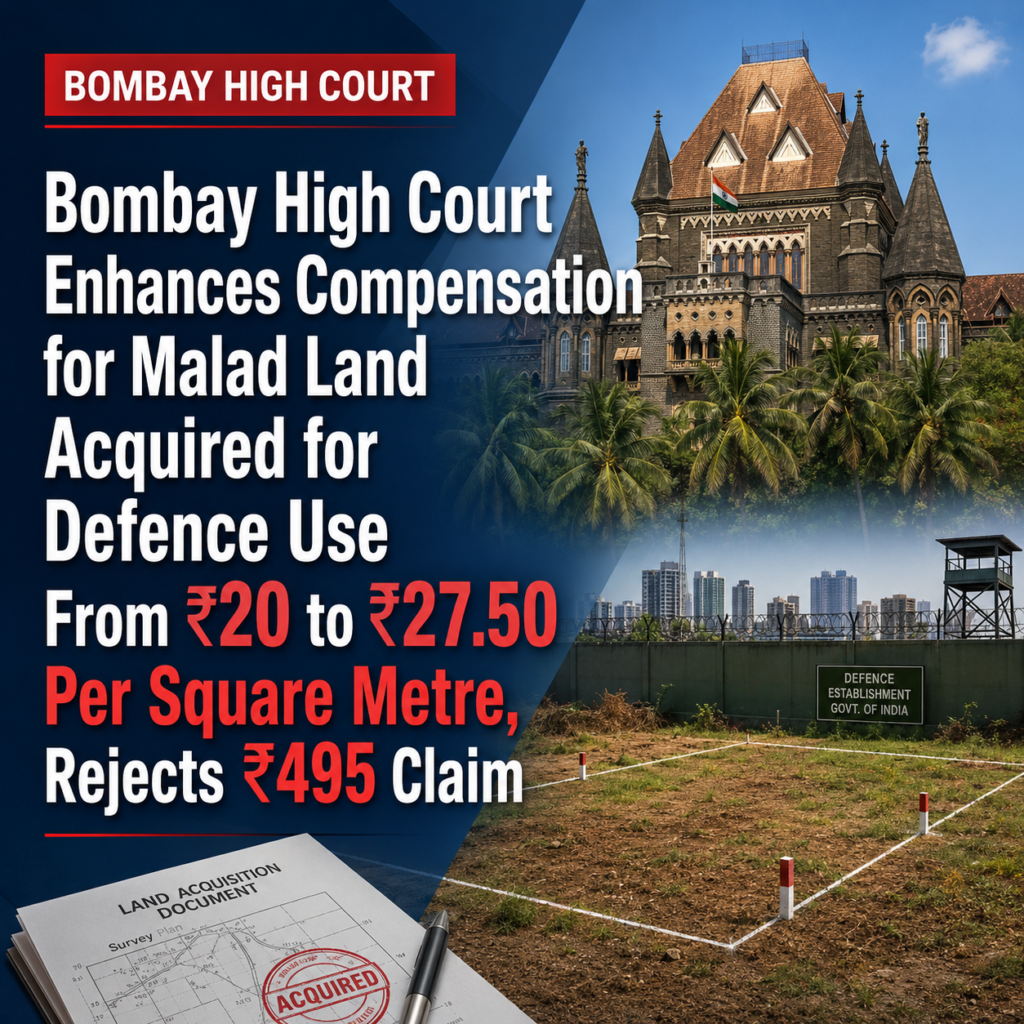
Compensation for 11,565 Sq. Metres of Malad Land Enhanced to ₹27.50 Per Sq. Metre: Bombay High Court
The Bombay High Court has partly allowed a land acquisition reference concerning approximately 11,565 square metres of land at Malad that had remained under requisition and in possession of the Defence authorities since 1942.
Justice Farhan P. Dubash enhanced the market value of the acquired land from ₹20 per square metre, as awarded by the Special Land Acquisition Officer, to ₹27.50 per square metre.
The Court rejected the claim for compensation at ₹495.20 per square metre for want of reliable valuation evidence but held that the original rate of ₹20 per square metre also failed to adequately reflect the land’s location, non-agricultural potential and surrounding valuation material.
Facts
The proceedings arose from the acquisition of land bearing Survey No. 91 and Survey No. 91 (part), situated at Village Malad, Taluka Borivali, Mumbai Suburban District.
The acquired property measured approximately 11,565 square metres and included a bungalow or structure standing upon it.
The land had been requisitioned around 1942 and placed in the possession of the Ministry of Defence. It was used for the Central Ordnance Depot for storing and distributing motor transport parts, tyres, tubes and other defence-related material.
In 1943, the Collector fixed monthly compensation in favour of Smt. Fatimabai for the bungalow standing on the requisitioned property. An agreement regarding compensation or rent for the land and trees was executed in 1944.
The land was situated in an unsurveyed Khoti village. Since it remained in the possession of the Defence authorities, proper surveys and records of rights were not prepared for a considerable period.
A portion of adjoining land from Survey No. 91 had earlier been acquired pursuant to a Section 4 notification dated 28 July 1972. Compensation in that earlier acquisition was awarded at ₹12 per square metre.
For the present acquisition, a notification under Section 4 of the Land Acquisition Act, 1894 was dated 24 October 1975 and published in the Government Gazette on 4 December 1975.
Smt. Fatimabai was stated to have gifted the remaining property to Mohd. Iqbal Abdul Hamid by way of hiba on 16 November 1975. The Collector later accepted the declaration and directed payment of recurring compensation to him.
During the acquisition proceedings, Mohd. Iqbal Abdul Hamid claimed compensation at ₹90 per square metre, apart from compensation for the bungalow and trees.
By an award dated 23 September 1986, subsequently amended on 26 November 1986, the Special Land Acquisition Officer fixed compensation at ₹20 per square metre and awarded a total amount of approximately ₹6.59 lakh.
Because rival family members disputed title to the acquired land, the amount was deposited in Court.
Mohd. Iqbal Abdul Hamid sought a reference under Section 18 of the Land Acquisition Act for enhancement of compensation. After his death, his legal heirs continued the proceedings.
The reference had initially included an apportionment dispute under Section 30. That dispute was resolved by consent terms in 2006. The only surviving issue was enhancement of compensation under Section 18.
The claimants ultimately sought valuation at ₹495.20 per square metre and also raised claims regarding the bungalow, trees and an alleged additional area of approximately 1,360 square metres.
Issues
The principal issues before the Court were:
- Whether the compensation of ₹20 per square metre awarded by the Special Land Acquisition Officer was just and adequate.
- Whether the claimants had proved entitlement to compensation at ₹495.20 per square metre.
- Whether earlier sale transactions and acquisition awards could be treated as reliable comparable instances.
- Whether the land’s urban location, proximity to railway stations and development potential justified enhancement.
- Whether long-standing requisition and restricted possession by the Defence authorities reduced the market value of the land.
- Whether the claimants could seek compensation beyond the ₹90 per square metre originally claimed before the Special Land Acquisition Officer.
- Whether the Reference Court could award compensation for an alleged additional 1,360 square metres not included in the acquisition notification or award.
- Whether separate enhancement could be granted for the bungalow, structures and trees.
- What statutory benefits were payable on the enhanced compensation.
Petitioner’s Arguments
The claimants argued that ₹20 per square metre was grossly inadequate and did not reflect the market value of land in Malad as of 4 December 1975.
They submitted that the land was situated in a developed urban locality within Mumbai Suburban District and was within walking distance of Malad and Kandivali railway stations.
The claimants contended that the land had substantial non-agricultural and development potential and could not be valued as ordinary undeveloped land.
They pointed out that material before the Special Land Acquisition Officer referred to a rate of ₹27.50 per square metre for another acquisition in 1970. According to them, awarding only ₹20 per square metre for a later acquisition in 1975 was irrational.
It was argued that the Special Land Acquisition Officer had mechanically relied upon an earlier award concerning adjoining land and granted only a nominal escalation.
The claimants submitted that the earlier award itself recorded that developed plots in the vicinity could fetch ₹45 per square metre.
They relied upon five sale instances from 1973 and 1974 showing rates ranging from approximately ₹25.11 to ₹59.80 per square metre.
According to them, those transactions demonstrated that land prices in Malad and surrounding areas were substantially above the rate awarded.
The claimants argued that the absence of sale instances between 1973 and 1975 could not be used against them because the market had been affected by several external circumstances, including:
- the 1971 India-Pakistan War;
- the 1972 Maharashtra drought;
- the declaration of Emergency in 1975;
- land-related regulatory legislation; and
- the impending Urban Land Ceiling law.
They further argued that the land’s requisition by Defence authorities did not extinguish its inherent market value or future development potential.
The claimants also asserted that joint measurements showed an area of approximately 12,925 square metres, whereas the award covered only 11,565 square metres. They sought compensation for the alleged balance area of approximately 1,360 square metres.
They contended that the Reference Court was not restricted to the ₹90 per square metre claimed before the Special Land Acquisition Officer and was legally empowered to award just compensation based upon the evidence.
Reliance was placed upon decisions concerning:
- the Court’s power to award compensation above the amount originally claimed;
- development potential as a relevant valuation factor;
- surrounding amenities and infrastructure;
- annual escalation in land values; and
- the duty to award fair and just compensation.
Respondent’s Arguments
The acquiring body argued that the claimants had failed to discharge the burden of proving that the award of ₹20 per square metre was inadequate.
It submitted that the land had been under requisition and in the possession of the Defence authorities since 1942.
According to the acquiring body, the property was not freely available in the open market for sale, occupation or development and therefore could not be valued in the same manner as unrestricted land.
It was argued that the Special Land Acquisition Officer had considered the earlier acquisition of adjoining land, the nature and use of the property and the available valuation material.
The acquiring body relied upon the earlier award in which adjoining land from Survey No. 91 had been valued at ₹12 per square metre.
It submitted that the increase to ₹20 per square metre in the present acquisition was fair and reasonable.
The acquiring body contended that the claimants had failed to prove the five sale transactions as comparable instances.
According to it, the claimants had not established:
- the exact location of those lands;
- their proximity to the acquired land;
- their size and nature;
- similarity of development potential;
- genuineness of the transactions; or
- comparability with the large acquired parcel.
It was further argued that the claimant who gave evidence had never personally visited the acquired land and lacked personal knowledge of its location, surroundings and market value.
The acquiring body opposed the claim for ₹495.20 per square metre as an exaggerated afterthought unsupported by any expert valuation report, comparable sale deed or reliable computation.
It also contended that the legal representatives could not seek an amount beyond the ₹90 per square metre originally claimed.
The claim for the alleged additional 1,360 square metres was said to be beyond the jurisdiction of the Reference Court because Section 18 permitted determination of compensation only for land actually covered by the acquisition award.
Separate compensation for the bungalow, trees and structures was also opposed on the ground that their nature, condition, extent and value had not been proved.
Analysis of the Law
Scope of a Reference Under Section 18
The Court held that a reference under Section 18 is in the nature of an original proceeding.
The burden lies initially upon the claimants to establish that the compensation awarded by the Special Land Acquisition Officer is inadequate.
However, the Reference Court is also required to independently determine fair and just compensation on the basis of the evidence and material placed before it.
The Court is not bound by the conclusions in the acquisition award, but it cannot grant an enhanced amount unsupported by evidence.
Relevant Date for Determining Market Value
The Court held that the relevant date for determining market value was 4 December 1975, when the Section 4 notification was published in the Government Gazette.
All valuation evidence and surrounding circumstances had to be assessed with reference to that date.
Claim Beyond the Amount Originally Demanded
The Court rejected the contention that the claimants were restricted to the ₹90 per square metre claimed before the Special Land Acquisition Officer.
After the statutory amendment, the Reference Court is not mechanically barred from awarding an amount higher than the sum originally claimed.
However, this does not relieve the claimants of the obligation to prove the higher market value through reliable evidence.
The claim of ₹495.20 per square metre therefore had to be independently established.
Comparable Sale Method
The Court observed that comparable sale transactions are generally an accepted method of determining market value.
However, before a sale can be adopted as an exemplar, the Court must be satisfied that:
- the transaction is genuine;
- it is reasonably close to the date of the acquisition notification;
- the land is situated near the acquired property;
- the land is similar in nature and potential;
- the size of the exemplar is comparable; and
- relevant advantages and disadvantages are accounted for.
The five sale instances relied upon by the claimants were not treated as reliable comparables.
They involved different areas, dates and circumstances. Some were based upon agreements entered into earlier but registered later. One land was reserved for a garden and another was tenanted.
The acquired land was a large parcel of 11,565 square metres, whereas the sale instances concerned much smaller areas.
The witness who produced the documents was not a valuation expert and did not establish the geographical or factual comparability of those properties.
The Court therefore discarded the five sale transactions as direct comparable instances.
Plus and Minus Factors
The Court applied the settled method of considering positive and negative factors affecting market value.
The relevant positive factors included:
- location in Malad;
- proximity to railway stations;
- access to the Western Express Highway;
- urban and non-agricultural potential; and
- surrounding development.
The relevant negative factors included:
- the large size of the acquired land;
- requisition since 1942;
- restricted possession by the Defence authorities;
- lack of immediate access to the open market;
- absence of immediate development rights; and
- lack of reliable valuation evidence supporting the claimed rate.
Additional 1,360 Square Metres
The Court held that it had no jurisdiction in the Section 18 reference to adjudicate the claim concerning the alleged additional 1,360 square metres.
The acquisition notification and award covered only 11,565 square metres.
The Reference Court could determine compensation only for land actually acquired under the award.
The claimants were left free to pursue other remedies, including a civil suit or an appropriate writ petition, concerning any land allegedly occupied without acquisition.
Bungalow, Structures and Trees
The Court declined to enhance compensation for the bungalow, structures or trees.
No reliable expert valuation or evidence had been produced regarding their nature, condition and value as on the relevant date.
Precedent Analysis
Ashok Kumar v. State of Haryana
The Supreme Court held that after the amendment to the Land Acquisition Act, the Reference Court is not restricted by the amount originally claimed by the landowner.
Its duty is to determine just compensation on the evidence before it.
The Bombay High Court applied this decision to reject the argument that the claimants could not seek more than ₹90 per square metre.
At the same time, it clarified that the higher amount still had to be proved through cogent evidence.
P.R. Reddy v. Land Acquisition Officer
The Supreme Court recognised that the building and development potential of land is a relevant consideration while determining its market value.
The Court accepted that the Malad land possessed non-agricultural and development potential despite being under Defence requisition.
Deputy Collector, Land Acquisition v. Madhubhai Gobarbhai
The Supreme Court held that proximity to roads, railway stations, schools, hospitals and other civic amenities is relevant while assessing market value and future potential.
This principle supported consideration of the acquired land’s urban location and transport access.
M. Kabra v. State of Maharashtra
The decision recognised that reasonable annual escalation may be granted where an earlier acquisition or sale instance is used for valuing land acquired at a later date.
The Court accepted the principle but held that escalation must be supported by the facts and evidence of the particular case.
Shaji Kuriakose v. Indian Oil Corporation
The Supreme Court laid down the requirements for relying upon comparable sale transactions.
The exemplar must be genuine, proximate in time, geographically close and comparable in nature, size and potential.
Applying this decision, the Court rejected the claimants’ five sale instances because foundational comparability had not been established.
Chimanlal Hargovinddas v. Special Land Acquisition Officer
The Supreme Court directed courts to assess market value by balancing relevant plus and minus factors.
The Bombay High Court applied that framework to balance the land’s location and development potential against its large size, Defence occupation and restricted marketability.
Syed Maqbool Ali v. State of Uttar Pradesh
The Supreme Court recognised that claims concerning land allegedly occupied without lawful acquisition may be pursued through appropriate civil or constitutional remedies.
The Court relied upon this decision while holding that the claim regarding the additional 1,360 square metres could not be determined in the present Section 18 reference.
Court’s Reasoning
The Court found that the claimants had not proved entitlement to compensation at ₹495.20 per square metre.
There was no expert valuation report, reliable comparable sale instance or cogent computation justifying such a steep enhancement.
The five transactions produced by the claimants could not be adopted because their location, similarity and comparability with the acquired land had not been established.
At the same time, the Court held that ₹20 per square metre was also inadequate.
The earlier award had itself recorded that developed plots in the vicinity could fetch around ₹45 per square metre.
The acquired land had locational advantages and substantial non-agricultural potential. It was situated in an urban area near railway stations and important transport infrastructure.
The Court therefore found that the acquisition award did not fully account for the property’s location and surrounding valuation material.
However, the land had remained requisitioned since 1942 and was in restricted possession of the Defence authorities.
It was not freely available for immediate sale, occupation or development. Its large size also required moderation when compared with smaller developed plots.
The Court observed that the evidence presented two extremes:
- the claim of ₹495.20 per square metre was unsupported and exaggerated; while
- the award of ₹20 per square metre undervalued the land.
Balancing the positive and negative factors, the Court fixed the fair market value at ₹27.50 per square metre as of 4 December 1975.
This rate was held to reflect the urban potential and locational advantages of the land while accounting for long-standing requisition, restricted possession, large area and absence of immediate free-market development.
Conclusion
The Bombay High Court partly allowed the land acquisition reference.
The market value of the acquired land measuring 11,565 square metres was enhanced from ₹20 per square metre to ₹27.50 per square metre.
The claimants were also held entitled to:
- an additional amount at 12% per annum under Section 23(1-A) from the date of notification until possession, as applicable;
- solatium at 30% under Section 23(2);
- interest under Sections 28 and 34 until realisation; and
- adjustment of amounts already paid under the original award.
The Special Land Acquisition Officer was directed to calculate the balance amount payable.
The claimants were required to submit their computation within two weeks, and the acquiring authorities were directed to pay the balance compensation with statutory benefits within four weeks thereafter.
The claims relating to:
- compensation at ₹495.20 per square metre;
- the alleged additional 1,360 square metres;
- enhanced compensation for the bungalow, structures and trees,
were not accepted in the present reference.
The reference was disposed of without costs.
Case: Special Land Acquisition Officer (4), Mumbai Suburban District v. Smt. Shamsida, Widow of Mohd. Iqbal Abdul Hamid & Ors.
Court: High Court of Judicature at Bombay
Case Number: Land Acquisition Reference No. 11 of 1990
Judge: Justice Farhan P. Dubash
Date: 23 June 2026
Result: Reference partly allowed; compensation for 11,565 square metres of Malad land enhanced from ₹20 to ₹27.50 per square metre with statutory additional amount, solatium and interest, while the higher claim of ₹495.20 per square metre and other unproved claims were rejected.