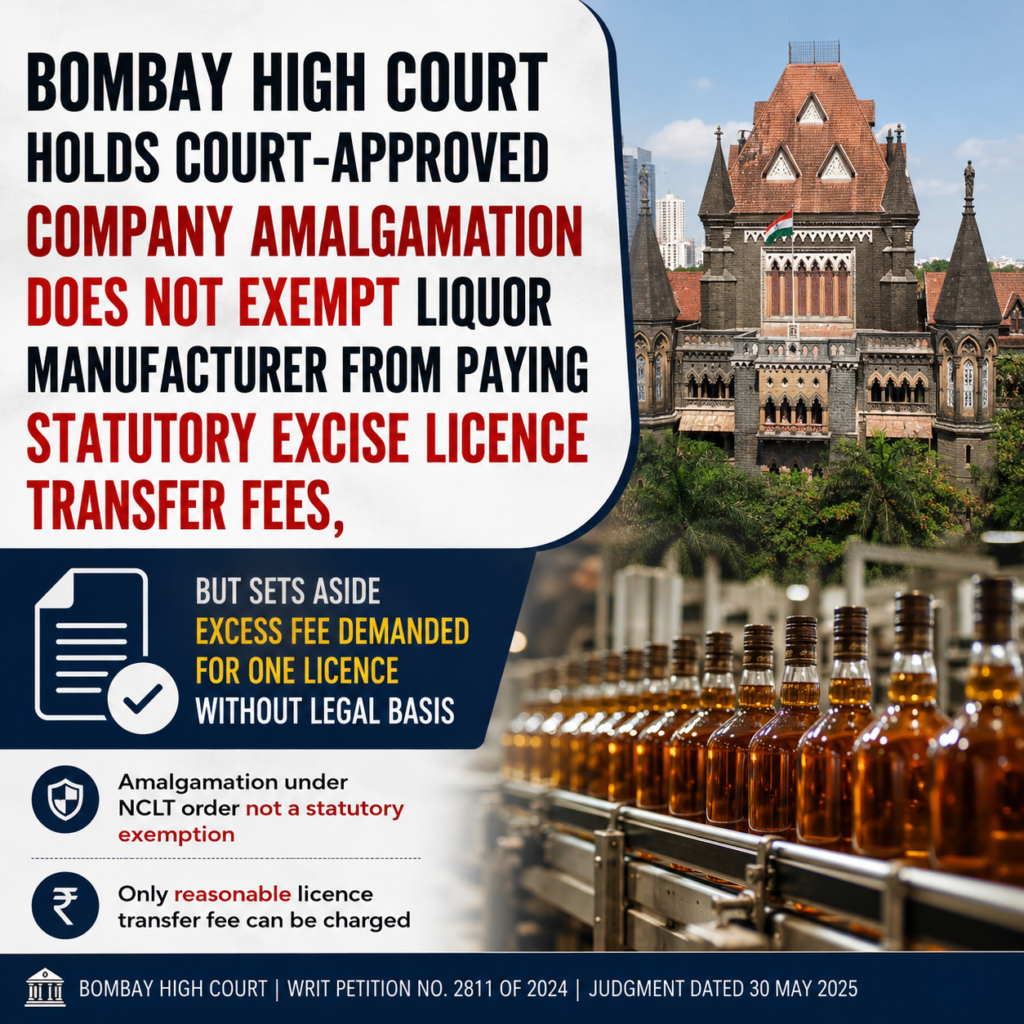
Company Merger Does Not Exempt Liquor Manufacturer From Paying Statutory Excise Licence Transfer Fees, Bombay High Court Holds
Facts
John Distilleries Private Limited purchased the entire shareholding of Chitali Distillery Limited, a company previously owned by the Government of Maharashtra, under a Share Purchase Agreement dated 10 July 2008 for approximately ₹28.75 crore.
Chitali Distillery Limited held several excise licences, including:
- a Form ‘I’ licence for distillation of spirit;
- a Form ‘PLL’ licence for manufacture of potable liquor;
- a Form ‘DS-I’ licence for denaturation and sale of denatured spirit; and
- certain other ancillary licences.
Following the share purchase, Chitali Distillery Limited became a wholly owned subsidiary of the petitioner. A Scheme of Arrangement providing for its amalgamation with the petitioner was subsequently sanctioned by the Bombay High Court and the Karnataka High Court under Sections 391 to 394 of the Companies Act, 1956.
Under the sanctioned Scheme, all assets, liabilities, statutory licences, permits, approvals and other rights of Chitali Distillery Limited stood transferred to and vested in the petitioner with effect from the appointed date, 1 October 2010, without any further act or instrument.
On 22 March 2011, the petitioner applied to the State Excise authorities for changing the name appearing on the licences from “Chitali Distillery Limited” to “John Distilleries Private Limited.”
The State Government permitted the change but treated it as a transfer of licences under Rule 5 of the Bombay Prohibition (Privileges Fees) Rules, 1954. It consequently demanded:
- ₹1,21,78,500 for transfer of the PLL licence;
- ₹29,28,000 for transfer of the Form ‘I’ licence; and
- ₹10,000 for transfer of the DS-I licence.
The petitioner paid the demanded amounts and challenged the levy before the Minister of State Excise. By an order dated 23 August 2018, the Minister dismissed the appeal and confirmed the demands. The petitioner thereafter approached the Bombay High Court under Articles 226 and 227 of the Constitution.
Issues
- Whether changing the name on the excise licences pursuant to a court-sanctioned amalgamation amounted to a “transfer of licence from one name to another” under Rule 5 of the Bombay Prohibition (Privileges Fees) Rules, 1954.
- Whether the privilege fee was payable by the petitioner when the licences originally stood in the name of Chitali Distillery Limited.
- Whether the applicable transfer fee had to be calculated under Rule 5 as it stood on the date of the 2008 Share Purchase Agreement or under the amended Rule prevailing when the petitioner applied for the name change in March 2011.
- Whether the sanctioned Scheme of Arrangement exempted the petitioner from payment of statutory transfer fees under the Maharashtra Prohibition Act and the applicable Rules.
- Whether the demand of ₹10,000 for transfer of the DS-I licence was supported by any statutory provision.
Petitioner’s Arguments
The petitioner argued that Rule 5 imposed liability upon the “licensee.” Until the names were formally changed, Chitali Distillery Limited remained the recorded licensee. Therefore, even assuming that a transfer fee was payable, the liability could not be imposed upon the petitioner.
It was further contended that the relevant date for determining the applicable fee was 10 July 2008, when the Share Purchase Agreement was executed. At that time, Rule 5 prescribed only the ordinary fee chargeable for grant, renewal or continuance of a licence and did not require payment of five times the licence fee.
According to the petitioner, the 2010 amendment enhancing the fee to five times the grant or renewal fee could not retrospectively apply to rights acquired under the 2008 transaction.
The petitioner also relied on the sanctioned Scheme of Arrangement. It argued that all licences automatically vested in the petitioner by operation of the Companies Act and the orders of the Company Courts. The Excise authorities were merely required to amend their records, and the exercise did not involve a substantive transfer requiring payment of privilege fees.
It was submitted that only a nominal amendment fee of ₹10 was payable for recording the change in name.
Regarding the DS-I licence, the petitioner contended that the prescribed transfer fee was only ₹2,000 and that the demand of ₹10,000 had no statutory basis.
Respondent’s Arguments
The State contended that licences for manufacturing and dealing in liquor constitute privileges granted by the Government and that no person has a fundamental right to carry on liquor business.
It argued that Rule 5 expressly authorised recovery of fees when a licence was transferred from one name to another. The petitioner had itself applied on 22 March 2011 for changing the licences from the name of Chitali Distillery Limited to its own name. This request constituted a transfer within the meaning of Rule 5.
The State distinguished the 2008 transfer of shares from the 2011 transfer of licences. In 2008, only the shareholding of the company had changed, and therefore no privilege fee was recovered. The licences continued to remain in the name of Chitali Distillery Limited.
The statutory event attracting Rule 5 occurred only when the petitioner applied in March 2011 to have the licences entered in its own name. By that time, the amended Rule requiring payment of five times the applicable licence fee had already come into force.
The respondents further argued that although the amalgamation had been sanctioned under the Companies Act, it did not exempt the petitioner from complying with the independent requirements of the Maharashtra Prohibition Act and the Rules framed under it.
Analysis of the Law
Meaning of “transfer” under Rule 5
The Court held that Rule 5 could not be interpreted solely by focusing on the word “licensee.” The Rule had to be read as a whole, with particular attention to the statutory event that attracted the fee—the privilege of obtaining a transfer of a licence from one name to another.
The petitioner had applied for the licences to be recorded in its own name and sought the benefit of such transfer. It could not avoid the financial consequence of the statutory process merely because the licences continued to stand in the transferor company’s name until the application was decided.
The person seeking the transfer was therefore liable to comply with the conditions attached to that transfer.
Relevant date for determining the fee
The Court distinguished between:
- the transfer of shares in July 2008; and
- the request for transfer of the licences in March 2011.
When the shareholding was transferred in 2008, the licences continued in the name of Chitali Distillery Limited. The State had itself clarified at that stage that there was no transfer of licences and therefore no privilege fee was payable.
The liability under Rule 5 arose only when the petitioner submitted its application on 22 March 2011 seeking to have the licences recorded in its own name.
Consequently, the law prevailing on the date of the application governed the transaction. Since amended Rule 5 was already in force, the Excise authorities were entitled to calculate the transfer fee at five times the fee chargeable for grant, renewal or continuance of the PLL and Form ‘I’ licences.
Effect of the sanctioned amalgamation
The Court accepted that, under the sanctioned Scheme, the assets, rights and statutory licences of Chitali Distillery Limited vested in the petitioner without any further instrument.
However, it held that the Scheme operated under the Companies Act, whereas the levy of privilege fees was governed by the Maharashtra Prohibition Act and the Bombay Prohibition (Privileges Fees) Rules.
These enactments operated in different fields. The sanctioned Scheme established the petitioner’s entitlement to the licences, but it did not confer an exemption from statutory liabilities imposed under the excise law.
A Company Court’s order sanctioning an amalgamation could not, in the absence of an express statutory provision, extinguish fees or obligations imposed under another enactment.
State’s power over liquor trade
The Court accepted the settled principle that there is no fundamental right to manufacture or deal in liquor. The State may regulate the trade, impose conditions and recover fees for granting or transferring the privilege.
However, this power is not unlimited. Any fee demanded must have a clear statutory foundation and must remain within the limits prescribed by the applicable Rules.
The State’s general power to regulate liquor business could not validate a demand unsupported by the statutory framework.
DS-I licence fee
The Court treated the demand concerning the DS-I licence separately.
The petitioner asserted that the applicable statutory fee was ₹2,000. The respondents failed to identify any provision authorising recovery of ₹10,000.
Since a statutory authority cannot levy an amount beyond what the governing Rules permit, the demand of ₹10,000 was held unsustainable. The State could recover only the amount legally prescribed under the Rules applicable to the DS-I licence.
Precedent Analysis
The judgment did not turn upon an extensive analysis of specific judicial precedents. Its conclusion was principally based upon:
- the language and object of Rule 5 of the Bombay Prohibition (Privileges Fees) Rules, 1954;
- the distinction between a transfer of corporate shareholding and a subsequent transfer of statutory licences;
- the independent operation of the Companies Act and the Maharashtra Prohibition Act; and
- the settled principle that the liquor trade is a State-controlled privilege rather than a fundamental right.
The Court also applied the established rule of fiscal and administrative law that a statutory authority can levy a fee only when the levy is expressly authorised by the governing statute or Rules. This principle was decisive in setting aside the excess demand relating to the DS-I licence.
Court’s Reasoning
The Court identified the petitioner’s application dated 22 March 2011 as the crucial event.
The transfer of shares in 2008 did not result in a change in the name of the licensee. The State had correctly treated that transaction as a transfer of shares rather than a transfer of licences.
The legal position changed when, after the amalgamation, the petitioner requested the Excise authorities to enter the licences in its own name. This request initiated a statutory process under the excise law and attracted Rule 5 as it existed on that date.
The Court rejected the argument that the petitioner was not liable because it was not the recorded licensee. The petitioner was the party seeking the benefit of the transfer and was therefore subject to the statutory conditions attached to it.
It also rejected the contention that the 2008 version of Rule 5 applied. The transfer of shares and transfer of licences were separate legal events with distinct consequences. Since the application for transfer of the licences was made after the amended Rule came into force, the enhanced fee was applicable.
Although the Scheme of Arrangement automatically vested the licences in the petitioner, it did not exempt the petitioner from complying with the excise law. The State was therefore justified in invoking Rule 5 for the PLL and Form ‘I’ licences.
However, the Court found no statutory justification for demanding ₹10,000 for the DS-I licence. The State could retain only the transfer fee legally payable under the specific Rules governing that licence.
Conclusion
The Bombay High Court partly allowed the writ petition.
It upheld the application of amended Rule 5 of the Bombay Prohibition (Privileges Fees) Rules, 1954 to the petitioner’s request for transfer of the PLL and Form ‘I’ licences. The challenge to the privilege fees imposed for those licences was rejected.
The Court partly set aside the Minister’s order dated 23 August 2018 and the underlying orders dated 6 May and 11 May 2011 only to the extent that they confirmed the demand of ₹10,000 for transfer of the DS-I licence.
The State was directed to:
- recover only the amount legally payable under the Rules governing the DS-I licence;
- refund any excess amount already recovered within eight weeks; or
- adjust the excess against future statutory dues, if legally permissible and requested by the petitioner within two weeks.
No order as to costs was passed.
Case: John Distilleries Private Limited, formerly known as John Distilleries Limited v. State of Maharashtra and Others
Court: High Court of Judicature at Bombay, Civil Appellate Jurisdiction
Case Number: Writ Petition No. 2391 of 2019
Judge: Justice Amit Borkar
Date: 30 June 2026
Result: Petition partly allowed; privilege fees for the PLL and Form ‘I’ licences upheld, but the ₹10,000 demand for transfer of the DS-I licence set aside, with refund or adjustment of the excess amount directed.