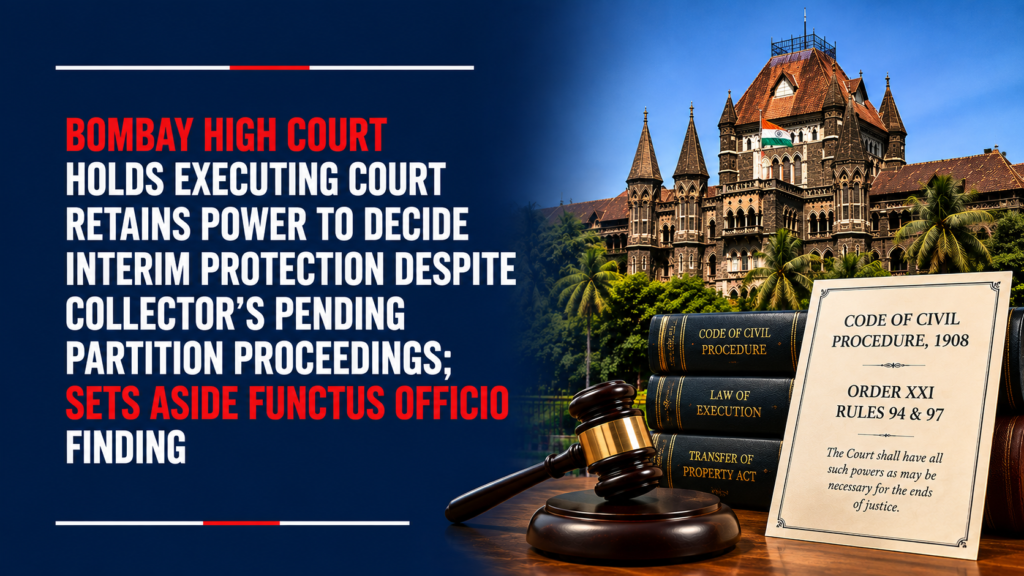
Civil Court Retains Jurisdiction to Preserve Suit Property Until Collector Completes Partition, Holds Bombay High Court
Facts
The dispute arose from a 1968 partition decree passed in a suit for administration of family properties. During execution, the Executing Court sent a precept to the Collector, Nashik under Section 54 CPC for partition of agricultural lands assessed to revenue.
Before the Collector could complete the partition, the decree-holder’s legal representative alleged that several judgment-debtors and transferees were undertaking construction activities on portions of the suit property by creating third-party rights. The decree-holder therefore sought interim relief before the Executing Court, including an injunction restraining further construction until partition by metes and bounds was completed.
The Executing Court rejected the applications solely on the ground that, after sending the precept to the Collector, it had become functus officio and lacked jurisdiction to entertain any further application.
The decree-holder challenged that order before the Bombay High Court.
Issues
- Whether an Executing Court becomes completely functus officio after sending a partition decree to the Collector under Section 54 CPC.
- Whether the Executing Court retains jurisdiction under Section 47 CPC to decide applications seeking preservation of the suit property pending partition.
- Whether the injunction applications ought to have been rejected without examining their merits.
Petitioner’s Arguments
- The petitioner argued that the Executing Court wrongly assumed that it had become functus officio merely because the precept had been sent to the Collector.
- While the Collector alone could effect actual partition, the Civil Court retained jurisdiction over questions relating to execution under Section 47 CPC.
- Since no co-sharer could claim exclusive possession over any specific portion before partition by metes and bounds, ongoing construction would prejudice the rights of all parties.
- Interim protection was therefore necessary to preserve the subject matter until the Collector completed the partition.
Respondent’s Arguments
- The respondents contended that identical relief had earlier been sought in review proceedings and could not be re-agitated.
- They alleged that the petitioner’s own conduct disentitled him to equitable relief, as members of his branch had also transferred portions of the property.
- Several purchasers had already acquired interests, and substantial development had taken place pursuant to permissions granted by planning authorities.
- Once the matter stood transferred to the Collector for partition, the Executing Court no longer possessed jurisdiction to entertain such applications.
Analysis of the Law
The High Court analysed:
- Section 47 CPC;
- Section 54 CPC;
- Order XX Rule 18 CPC governing partition decrees relating to revenue-paying lands.
The Court explained that the statutory scheme creates a clear division of functions:
- the Civil Court determines the rights and shares of the parties; and
- the Collector carries out the actual partition and delivery of possession.
However, this division does not completely extinguish the Civil Court’s jurisdiction. Questions concerning preservation of the decree or matters beyond the Collector’s adjudicatory competence continue to remain within the Civil Court’s jurisdiction under Section 47 CPC.
Precedent Analysis
The High Court relied upon:
- Shub Karan Bubna @ Shub Karan Prasad Bub v. Sita Saran Bubna — execution of partition decrees relating to revenue lands.
- Abdul Rejak Laskar v. Mafizur Rahman — Civil Court retains jurisdiction over issues beyond the Collector’s competence.
- Nawab John v. V.N. Subramanian.
- Ningappa Balappa v. Abashkhan.
- Kisan Bhikaji Dalvi v. Krishnabai Maruti Dalvi.
- Bhagwansingh v. Babu Shiv Prasad.
The Court reconciled these authorities by holding that although the Collector has exclusive authority regarding the manner of partition, the Civil Court continues to possess jurisdiction over ancillary issues not entrusted to the Collector.
Court’s Reasoning
The High Court drew an important distinction between two categories of disputes.
First, matters concerning actual partition, division by metes and bounds, adjustment of shares and delivery of possession fall exclusively within the Collector’s jurisdiction after a precept is issued.
Secondly, disputes arising during the interval between the decree and actual partition, particularly those relating to preservation of the suit property or protection of parties’ rights, fall outside the Collector’s adjudicatory powers and may still be decided by the Civil Court under Section 47 CPC.
The Court found that the Executing Court never examined whether the injunction application was maintainable on merits. Instead, it rejected the applications solely because it believed it had become functus officio. That approach was legally incorrect because the functus officio principle cannot be applied so broadly as to leave parties remediless where the Collector lacks jurisdiction to adjudicate the dispute.
Conclusion
The Bombay High Court partly allowed the writ petitions and set aside the Executing Court’s order.
It restored the injunction applications to the file of the Executing Court for fresh consideration on merits after hearing all parties. The High Court clarified that it had expressed no opinion on the merits of the injunction request and confined its decision to the question of jurisdiction. It held that the Executing Court does not become functus officio for all purposes merely because a partition decree has been forwarded to the Collector under Section 54 CPC.
Case Details
Case: Akbarsaheb Amirsaheb Kokani (since deceased) through LRs Jilani A. Kokani v. Akbarsaheb Amirsaheb Kokani (since deceased) through LRs Aslam A. Kokani
Court: Bombay High Court
Case Number: Writ Petition Nos. 7588 and 7589 of 2026
Judge: Justice N. J. Jamadar
Date: 4 August 2026
Result: Writ petitions partly allowed; Executing Court’s order set aside and injunction applications restored for fresh adjudication on merits