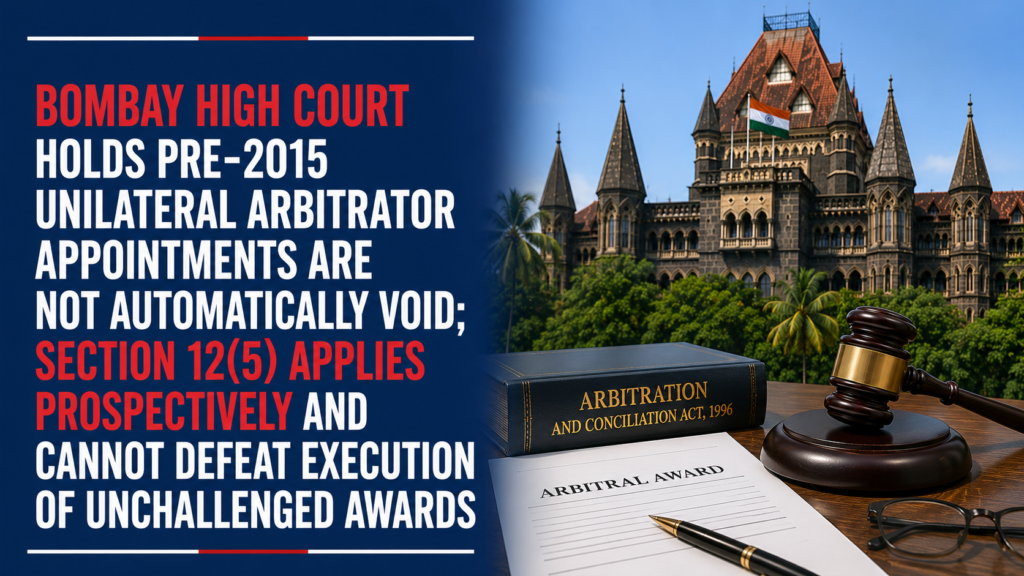
Pre-2015 Arbitral Awards Cannot Be Defeated in Execution by Invoking Bhadra International, Rules Bombay High Court
Facts
Several commercial execution applications were filed by M/s. S. E. Investments Ltd. (now Paisalo Digital Limited) seeking enforcement of arbitral awards passed pursuant to arbitration proceedings invoked prior to 23 October 2015.
The judgment debtors resisted execution by relying upon the Supreme Court’s decision in Bhadra International (India) Pvt. Ltd. v. Airport Authority of India (2026), contending that unilateral appointment of arbitrators is contrary to the basic principles of arbitration and therefore the awards were void for want of jurisdiction.
In view of conflicting submissions, the Bombay High Court framed two important legal questions concerning whether unilateral appointments made before 23 October 2015 became void after the introduction of Section 12(5) of the Arbitration and Conciliation Act, 1996, and whether an executing court could refuse execution of such awards. The Court appointed Mr. Jay Sanklecha as amicus curiae to assist on the issue.
Issues
- Whether unilateral appointment of an arbitrator prior to 23 October 2015 was without jurisdiction and consequently rendered all arbitral proceedings void ab initio.
- Whether an executing court can refuse to execute an arbitral award on the ground that the arbitrator had been unilaterally appointed, despite the award never having been challenged.
- Whether the Supreme Court’s decision in Bhadra International applies retrospectively to arbitrations invoked before the 2015 Amendment.
Petitioner’s Arguments
The decree holder contended that:
- Section 12(5), along with the Fifth and Seventh Schedules, came into force only from 23 October 2015 and operates prospectively.
- Prior to the amendment, unilateral appointments made pursuant to agreed contractual procedures were repeatedly upheld by the Supreme Court.
- The judgment debtors had never challenged either the appointment of the arbitrator or the arbitral awards under Sections 13, 16, 34 or 37 of the Act.
- Having failed to invoke statutory remedies, they could not raise the objection for the first time during execution proceedings.
- Bhadra International concerned a post-2015 appointment governed by Section 12(5) and therefore had no application to arbitrations invoked before the amendment.
Respondent’s Arguments
The judgment debtors argued that:
- Even before insertion of Section 12(5), the Arbitration Act embodied principles of equality, impartiality and independence through Sections 7, 11, 12 and 18.
- The 2015 amendment merely made explicit what had always been implicit in the statute.
- Consequently, unilateral appointments even before 23 October 2015 were fundamentally illegal.
- Relying heavily on Bhadra International, Dharma Prathishthanam, and several Delhi High Court decisions, they contended that awards rendered pursuant to such appointments were jurisdictionally void and incapable of execution.
Analysis of the Law
The High Court analysed:
- Sections 7, 11, 12, 13, 16, 18 and 21 of the Arbitration and Conciliation Act, 1996;
- Section 12(5) together with the Fifth and Seventh Schedules inserted by the 2015 Amendment;
- the prospectivity of the 2015 amendments; and
- the distinction between contractual appointment procedures and appointments made entirely without contractual authority.
The Court identified three distinct categories of unilateral appointments:
- appointment of an arbitrator who is inherently interested or lacks independence;
- appointment made under a contractual clause authorising one party to appoint an independent arbitrator; and
- appointment made without any contractual authority or consent.
The Court held that these categories cannot be treated alike and that pre-2015 jurisprudence had consistently upheld the second category.
Precedent Analysis
The Court extensively analysed and reconciled numerous Supreme Court authorities, including:
- Bhadra International (India) Pvt. Ltd. v. Airport Authority of India
- Dharma Prathishthanam v. Madhok Construction (P) Ltd.
- Central Organisation for Railway Electrification (CORE) v. ECI-SPIC-SMO-MCML (JV)
- Board of Control for Cricket in India v. Kochi Cricket Pvt. Ltd.
- Aravali Power Co. Ltd. v. Era Infra Engineering Ltd.
- Rajasthan Small Industries Corporation Ltd. v. Ganesh Containers Movers Syndicate
- S.P. Singla Construction Pvt. Ltd.
- Union of India v. Parmar Constructions Co.
- Indian Oil Corporation Ltd. v. Raja Transport Pvt. Ltd.
- Datar Switchgears Ltd. v. Tata Finance Ltd.
The Court held that these authorities consistently establish that Section 12(5) is prospective and that contractual appointment procedures prevailing before 23 October 2015 remain governed by the unamended law. It clarified that Bhadra International cannot be read as retrospectively invalidating every unilateral appointment made before the amendment.
Court’s Reasoning
The Court rejected the submission that all unilateral appointments prior to 23 October 2015 automatically became void after the decision in Bhadra International.
It observed that prior to the 2015 amendment, the Supreme Court had consistently upheld arbitration clauses authorising one party to appoint an arbitrator or naming a particular arbitrator, subject to available statutory challenges for bias or lack of impartiality.
The Court emphasised that the disqualification introduced by Section 12(5) is a new statutory disqualification. It cannot be retrospectively imported into arbitrations commenced before its enactment.
The Court distinguished Dharma Prathishthanam, explaining that it dealt with a situation where one party appointed an arbitrator without any contractual authority, unlike cases where the arbitration agreement itself authorised such appointment.
Accordingly, the Court held that Bhadra International applies only to arbitrations invoked after 23 October 2015, where Section 12(5) governs arbitrator eligibility. It does not invalidate awards rendered pursuant to contractual appointment mechanisms existing before that date.
Conclusion
The Bombay High Court held that unilateral appointments of arbitrators made pursuant to contractual clauses before 23 October 2015 are not rendered void merely because Section 12(5) subsequently introduced statutory ineligibility for certain appointments.
It ruled that the decision in Bhadra International does not retrospectively invalidate such appointments or defeat execution of awards that were never successfully challenged under the Arbitration Act. Only appointments falling within the exceptional category recognised in Dharma Prathishthanam, namely appointments made without contractual authority or consent, would be jurisdictionally void. Consequently, the execution proceedings could not be resisted solely on the basis of the 2015 amendment.
Case Details
Case: M/s. S. E. Investments Ltd. (now known as Paisalo Digital Limited) v. Star Bazaar Pvt. Ltd. & Connected Matters
Court: Bombay High Court
Case Numbers: Interim Application Nos. 2007, 2009, 2011 & 2015 of 2026 in Commercial Execution Application No. 59 of 2016 and connected execution applications
Judge: Justice Jitendra Jain
Date: 4 August 2026
Result: The Bombay High Court held that Section 12(5) of the Arbitration and Conciliation Act operates prospectively and does not retrospectively invalidate arbitrator appointments made pursuant to contractual clauses before 23 October 2015. The Court clarified that Bhadra International does not automatically render such awards void or unenforceable in execution proceedings