


Court’s decision
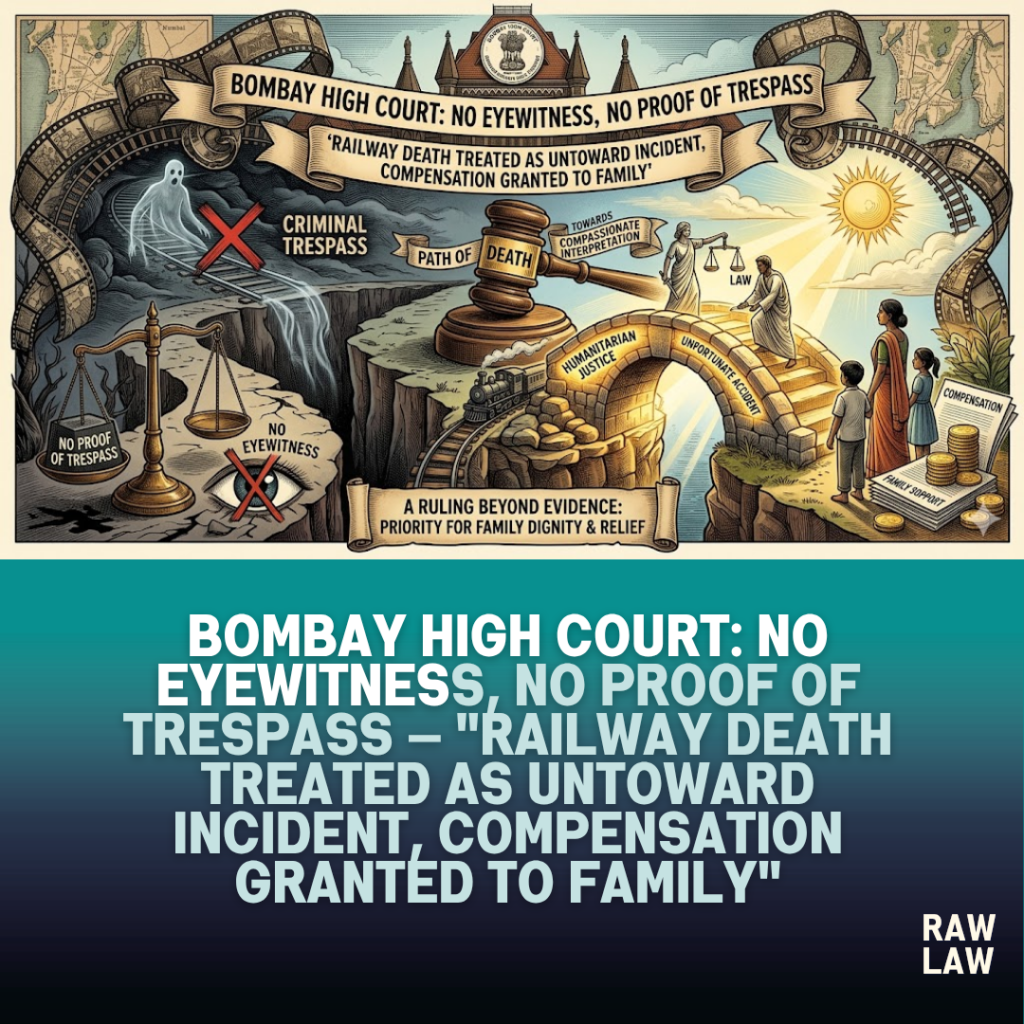
The Bombay High Court allowed the appeal and set aside the Railway Claims Tribunal’s finding that the death was due to trespassing. The Court held that in absence of eyewitness evidence proving trespass, the incident must be treated as an “untoward incident” under the Railways Act. It directed payment of compensation of ₹4,00,000 with interest, emphasizing that claimants cannot be burdened with impossible standards of proof in railway accident cases.
Court’s decision
The Court overturned the Tribunal’s conclusion that the deceased was a trespasser and held that the death qualified as an “untoward incident.” It ruled that speculative conclusions based on police or inquest reports without eyewitness support cannot defeat compensation claims. The appeal was allowed, and compensation with interest was granted to the deceased’s family.
Facts
The deceased, a working professional residing in Naigaon, was travelling to Dadar for work when he died in a railway accident between Naigaon and Bhayander stations.
As recorded on page 2 of the judgment, a valid first-class season ticket was recovered from the deceased, confirming his status as a bona fide passenger.
The Railway Claims Tribunal rejected the compensation claim, holding that the death resulted from trespassing and was therefore not an “untoward incident.”
The family challenged this finding before the High Court, arguing that there was no evidence of trespass and that the Tribunal relied on conjecture rather than proof.
Issues
The primary issue was whether the death constituted an “untoward incident” or was the result of trespassing.
The Court also examined whether absence of eyewitness evidence could justify denial of compensation.
Another issue was whether official reports, not based on direct evidence, could conclusively establish trespassing.
Petitioner’s arguments
The appellants argued that the deceased was a bona fide passenger travelling for work and that the recovery of a valid season ticket supported this claim.
They contended that there was no eyewitness evidence to prove trespassing and that the Tribunal erred in relying on speculative reports.
The appellants emphasized that in railway accident cases, strict proof of boarding or exact manner of death is often impossible and must be assessed realistically.
They also relied on the consistent testimony of the deceased’s wife regarding his routine travel.
Respondent’s arguments
The railway authorities argued that the nature of injuries and records suggested that the deceased was run over while crossing the tracks.
They relied on police reports and inquest findings indicating that the death was caused by being knocked down by a train.
The respondent contended that such circumstances excluded the case from the definition of an “untoward incident.”
Analysis of the law
The Court analyzed the concept of “untoward incident” under the Railways Act, emphasizing its beneficial and social welfare nature.
It held that claimants cannot be expected to produce direct evidence of boarding or the exact manner of accident, especially where incidents occur in isolated locations.
The Court reiterated that absence of evidence of trespass must operate in favour of the claimants.
It also clarified that reports prepared without eyewitness basis cannot be treated as conclusive proof.
Precedent analysis
While the judgment primarily turned on facts, it aligned with established principles that railway compensation law must be interpreted liberally.
Courts have consistently held that benefit of doubt must be given to claimants in absence of clear evidence of self-inflicted injury or trespass.
The reasoning reflects the broader jurisprudence that social welfare legislation must not be defeated by technicalities or speculative findings.
Court’s reasoning
The Court noted that there was no eyewitness to establish that the deceased was crossing the railway track. As highlighted on page 3, absence of such evidence made the theory of trespassing unsustainable.
It held that requiring proof of boarding a train would impose an impossible burden, especially when accidents occur without witnesses.
The Court also rejected reliance on inquest and police reports, observing that these were based on opinion rather than direct evidence.
It emphasized that the Station Master’s report did not identify the cause of the incident, further weakening the trespass theory.
The Court found that the possibility of accidental fall and subsequent injury could not be ruled out and must be preferred in absence of contrary proof.
Conclusion
The High Court allowed the appeal, reversed the Tribunal’s findings, and held that the death was an “untoward incident.”
It directed the railway authorities to pay compensation of ₹4,00,000 with 6% interest from the date of the accident, subject to a cap of ₹8,00,000.
Implications
This judgment strengthens the pro-claimant approach in railway compensation cases.
It clarifies that absence of eyewitness evidence cannot be used to deny legitimate claims.
The ruling limits reliance on speculative official reports and reinforces that benefit of doubt must favour victims’ families.
It also underscores that social welfare legislation must be interpreted liberally to ensure justice rather than defeated by technicalities.
Case law references
- Union of India v. Rina Devi (2019)
Established liberal interpretation of railway compensation claims. - Various High Court precedents on untoward incident
Reinforced that absence of proof of trespass benefits claimants.
FAQs
1. What is an “untoward incident” under railway law?
It includes accidental falls from trains and other unforeseen incidents during travel, entitling victims to compensation.
2. Can compensation be denied without eyewitness evidence?
No. Absence of eyewitnesses cannot be used to deny claims unless there is clear proof of trespassing or self-inflicted injury.
3. Are police or inquest reports conclusive in railway accident cases?
No. Such reports are not conclusive if they are not based on eyewitness or direct evidence.