


1. Court’s decision
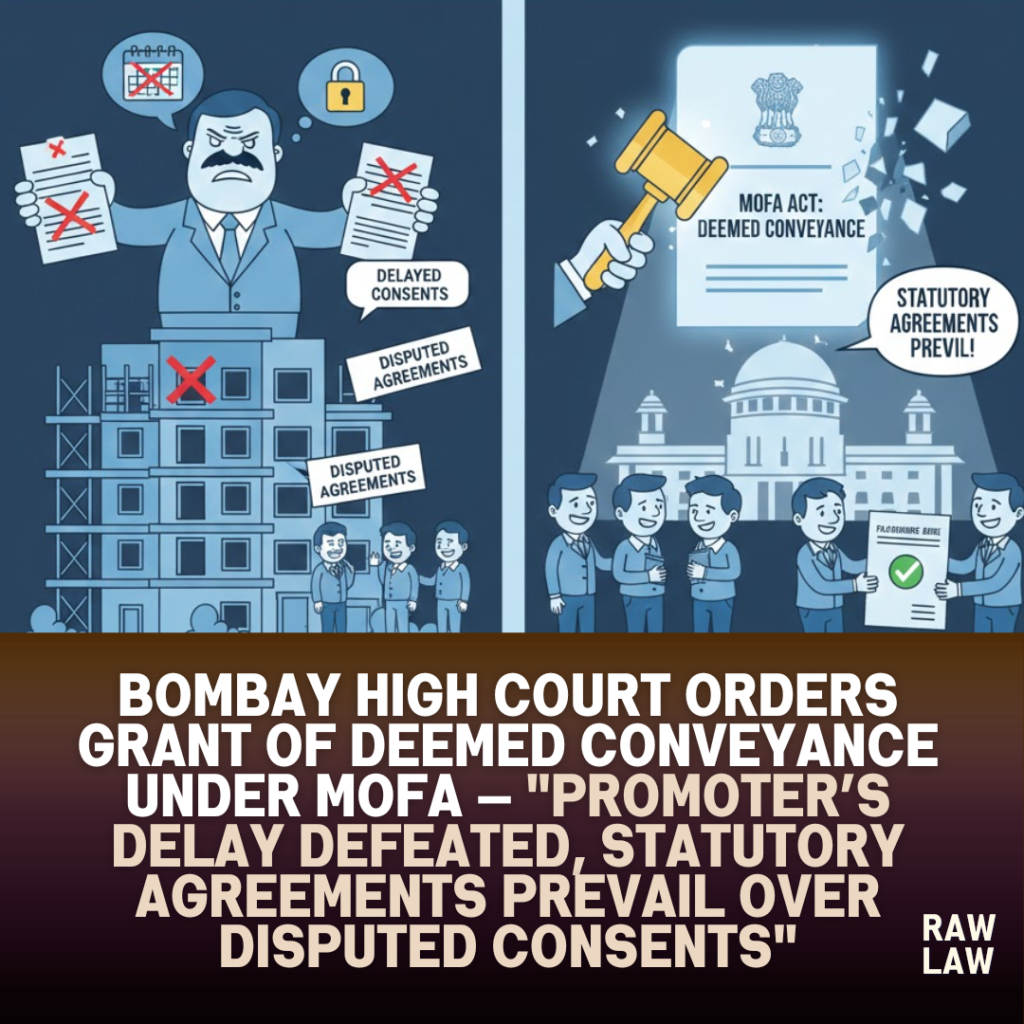
The Bombay High Court allowed a writ petition filed by a co-operative housing society and set aside an order of the Deputy Registrar rejecting its application for deemed conveyance under Section 11 of the Maharashtra Ownership Flats Act, 1963. The Court held that once statutory conditions are satisfied, the Competent Authority cannot deny deemed conveyance on the basis of disputed consents, pending collateral proceedings, or speculative title concerns. It directed the authority to grant deemed conveyance for the land admeasuring 1479.10 square metres — “the statute does not permit promoters to indefinitely retain title once flats are sold.”
2. Facts
The petitioner society was formed by purchasers of flats in a residential building constructed pursuant to a Commencement Certificate dated 13 September 2007 on land bearing CTS Nos. 100, 101 and 103 to 107 at Belapur, Navi Mumbai. An Occupation Certificate was issued on 21 March 2009, confirming full utilisation of permissible Floor Space Index on the said land. Despite sale of flats and execution of agreements under Section 4 of MOFA, the promoters failed to form the society within time or execute conveyance in its favour. The society therefore applied for deemed conveyance, which was rejected by the Deputy Registrar, prompting the present writ petition.
3. Issues
The principal issues were whether the Competent Authority exceeded jurisdiction by rejecting the society’s application for deemed conveyance despite compliance with statutory prerequisites, whether alleged consents and minutes of a meeting could defeat statutory conveyance rights, and whether pending proceedings challenging society registration could justify refusal of deemed conveyance.
4. Petitioner’s arguments
The society argued that proceedings under Section 11 of MOFA are summary and limited in scope. It contended that the authority was required only to examine statutory agreements, municipal approvals, and the Architect’s Certificate to verify sale of flats, identification of land, and failure of the promoter to execute conveyance. It was submitted that reliance on disputed minutes of meetings and alleged consents relating to future development amounted to travelling beyond jurisdiction. The petitioner further argued that pending appeals challenging society registration could not negate its statutory right to seek deemed conveyance.
5. Respondent’s arguments
The promoters opposed the petition on the ground that the society’s registration itself was under challenge and that only a subset of flat purchasers had joined the society. They relied on alleged minutes of a meeting said to record consent of flat owners for further development on adjacent land and argued that conveyance at this stage would prejudice their development rights. It was also contended that the Competent Authority had rightly rejected the application while granting liberty to apply afresh after resolution of pending disputes.
6. Analysis of the law
The Court examined Section 11 of MOFA and reiterated that it creates a statutory remedy for flat purchasers where a promoter fails to execute conveyance despite selling flats. The enquiry before the Competent Authority is prima facie and summary — intended to prevent flat purchasers from being driven into prolonged civil litigation. While the authority may look at relevant documents, it cannot convert Section 11 proceedings into a full-fledged trial on title or future development disputes.
7. Precedent analysis
The Court relied on settled Bombay High Court jurisprudence interpreting MOFA, including principles laid down in Madhuvihar Co-operative Housing Society v. Jayantilal Investments, which emphasise informed consent and restrict dilution of statutory rights by informal arrangements. The Court reiterated that statutory obligations under MOFA override subsequent informal consents unless there is a clear, lawful, and registered modification accepted by all concerned.
8. Court’s reasoning
On facts, the Court found that the agreements under Section 4 of MOFA clearly identified the land to be conveyed, that municipal Commencement and Occupation Certificates corroborated the same survey numbers, and that the Architect’s Certificate aligned with these records. The society sought conveyance strictly for the land described in these documents and not for any adjoining plots. The alleged minutes of meeting neither clearly waived the right to conveyance nor lawfully altered the promoter’s statutory obligation. The Court also held that pending proceedings challenging society registration did not render the society non-existent and could not be used to defeat its statutory remedy.
9. Conclusion
The Court concluded that the Competent Authority erred in rejecting the application for deemed conveyance. It set aside the impugned order and directed the authority to grant deemed conveyance in favour of the petitioner society for the specified land within six weeks. The request for stay of the judgment was rejected.
10. Implications
This judgment reinforces the efficacy of deemed conveyance as a statutory remedy under MOFA and curbs attempts by promoters to delay conveyance through collateral disputes or reliance on disputed consents. It provides clarity that pending challenges to society registration or future development plans cannot frustrate flat purchasers’ right to title over the land on which their building stands.
Case Law References
- Madhuvihar Co-operative Housing Society v. Jayantilal Investments – Held that statutory rights under MOFA cannot be diluted by informal or uninformed consents; applied to reject reliance on disputed meeting minutes.
- MOFA deemed conveyance jurisprudence – Reaffirmed that Section 11 proceedings are summary and focused on statutory compliance rather than adjudication of complex title disputes.
FAQs
Q1. What is deemed conveyance under MOFA?
Deemed conveyance is a statutory mechanism allowing a housing society to obtain title to land and building when the promoter fails to execute conveyance despite selling flats.
Q2. Can disputed consents or meeting minutes defeat deemed conveyance?
No. Informal or disputed consents cannot override statutory agreements and obligations under MOFA unless there is a clear, lawful modification.
Q3. Does a pending challenge to society registration bar deemed conveyance?
No. Until registration is cancelled, the society is entitled to invoke statutory remedies, including deemed conveyance.