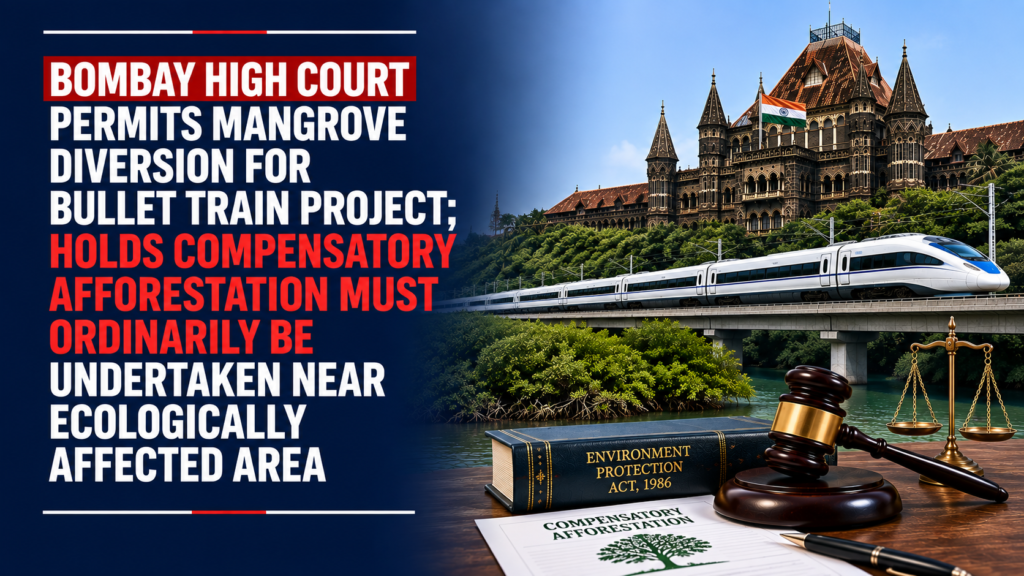
Compensatory Afforestation Should Ordinarily Be Near Project Site, Holds Bombay High Court While Approving Bullet Train Power Line
Facts
The petitioner, Maharashtra State Electricity Transmission Company Ltd. (MSETCL), sought permission to construct a 132 KV transmission line from the existing Dahanu Sub-Station to the proposed Ambesarai Traction Sub-Station in Palghar District. The transmission line was an integral part of the Mumbai–Ahmedabad High-Speed Rail (Bullet Train) Project, intended to provide uninterrupted power supply to the railway corridor.
Execution of the project required diversion of 3.3561 hectares of forest land, including 1.9656 hectares of mangrove forest, involving the felling of 847 mangrove trees and 196 non-mangrove trees. Since the project affected mangrove areas, MSETCL approached the Bombay High Court seeking permission in accordance with earlier directions issued in Bombay Environmental Action Group v. State of Maharashtra.
Issues
- Whether permission should be granted to divert mangrove forest land and cut mangrove trees for construction of the transmission line forming part of the Bullet Train Project.
- Whether the compensatory afforestation proposed at a distant location satisfied the objective of ecological restoration.
- What safeguards should be imposed to ensure effective implementation and monitoring of compensatory afforestation.
Petitioner’s Arguments
- The petitioner submitted that the transmission line was indispensable for the Mumbai–Ahmedabad High-Speed Rail Corridor, a project of national importance.
- It had already obtained:
- Stage-I and Stage-II forest clearances under the Van (Sanrakshan Evam Samvardhan) Adhiniyam, 1980;
- CRZ Clearance from the Maharashtra Coastal Zone Management Authority.
- The petitioner undertook to carry out:
- compensatory mangrove plantation of 26,664 mangrove saplings over 6 hectares;
- compensatory plantation of 7,457 non-mangrove trees over 6.7122 hectares;
- payment of CAMPA charges, Net Present Value and all afforestation costs.
- It assured full compliance with every statutory and judicial condition imposed by the authorities and the Court.
Respondent’s Arguments
The Bombay Environmental Action Group (BEAG) did not dispute the national importance of the project but objected to the proposal of undertaking compensatory afforestation for non-mangrove trees at Solapur, nearly 500 kilometres away from the affected Dahanu-Palghar region.
It argued that:
- plantation at such a distant location could not compensate the ecological loss suffered by the affected locality;
- compensatory afforestation should ordinarily be undertaken close to the project site;
- the Court should ensure strict compliance with earlier environmental directions and maintain continuous judicial supervision over implementation.
Analysis of the Law
The High Court considered:
- the Van (Sanrakshan Evam Samvardhan) Adhiniyam, 1980;
- the CRZ Clearance granted by the Maharashtra Coastal Zone Management Authority;
- the earlier judgments in Bombay Environmental Action Group governing diversion of mangroves;
- environmental principles relating to ecological restoration and compensatory afforestation.
The Court emphasised that compensatory afforestation is not merely a numerical replacement of trees. Its true purpose is restoration of the ecology lost because of the project. Therefore, as a general rule, compensatory afforestation should be undertaken within the same ecological region or, where impossible, at the nearest feasible location rather than hundreds of kilometres away.
Precedent Analysis
The Court relied upon:
- Bombay Environmental Action Group v. State of Maharashtra — prior permission required before diversion of mangroves.
- M.C. Mehta v. Union of India — compensatory afforestation should meaningfully restore ecological balance near the affected area.
- Mumbai Metropolitan Region Development Authority v. Union of India — transparency measures, public portal, monitoring and land-bank directions.
- Brihanmumbai Municipal Corporation v. Union of India — environmental safeguards for projects involving mangrove diversion.
- Court on its Own Motion v. Principal Secretary, Ministry of Environment (Nagpur Bench) — criticism of compensatory plantations at distant locations.
Court’s Reasoning
The High Court found that the project formed an essential component of the Mumbai–Ahmedabad Bullet Train Project, which was undeniably a project of national importance.
The Court accepted the opinion of the statutory expert authorities, noting that all necessary environmental approvals had already been granted after due scrutiny. Since MSETCL had undertaken to comply with all statutory conditions and substantial compensatory measures, permission could be granted.
However, the Court accepted BEAG’s concern regarding plantation at Solapur. It held that ecological restoration cannot ordinarily be achieved by planting trees hundreds of kilometres away because such plantations do not restore the environmental benefits lost by the affected locality.
The Court nevertheless permitted the proposed plantation at Solapur only as an exceptional measure, having regard to:
- the advanced stage of statutory approvals;
- the national importance of the Bullet Train Project; and
- the specific facts of the case.
Importantly, the Court clarified that this permission shall not be treated as a precedent.
The Court also criticised the State Government for failing to comply with earlier directions requiring creation of environmental land banks, public portals and transparent monitoring mechanisms. It therefore directed the authorities to implement those directions within four weeks and ordered bi-annual compliance reports for ten years, warning that failure to file such reports would amount to contempt of court.
Conclusion
The Bombay High Court allowed the writ petition and permitted MSETCL to divert forest land and cut 847 mangrove trees and 196 non-mangrove trees for construction of the transmission line supporting the Mumbai–Ahmedabad Bullet Train Project.
The Court held that while projects of national importance may justify diversion of forest land, compensatory afforestation must ordinarily be undertaken within the same ecological region to achieve genuine ecological restoration. Plantation at distant locations was permitted only as an exceptional case, and the Court imposed extensive safeguards relating to transparency, public disclosure, ecological monitoring and long-term compliance.
Case Details
Case: Maharashtra State Electricity Transmission Company Ltd. v. State of Maharashtra & Others
Court: Bombay High Court
Case Number: Writ Petition No. 11256 of 2025
Judges: Acting Chief Justice Ravindra V. Ghuge and Justice Gautam A. Ankhad
Date: 4 August 2026
Result: Writ Petition allowed; permission granted to divert 3.3561 hectares of forest land and cut 847 mangrove trees and 196 non-mangrove trees for the Bullet Train transmission line, subject to stringent environmental safeguards, compensatory afforestation, transparency measures and continuous judicial monitoring.