


Court’s decision
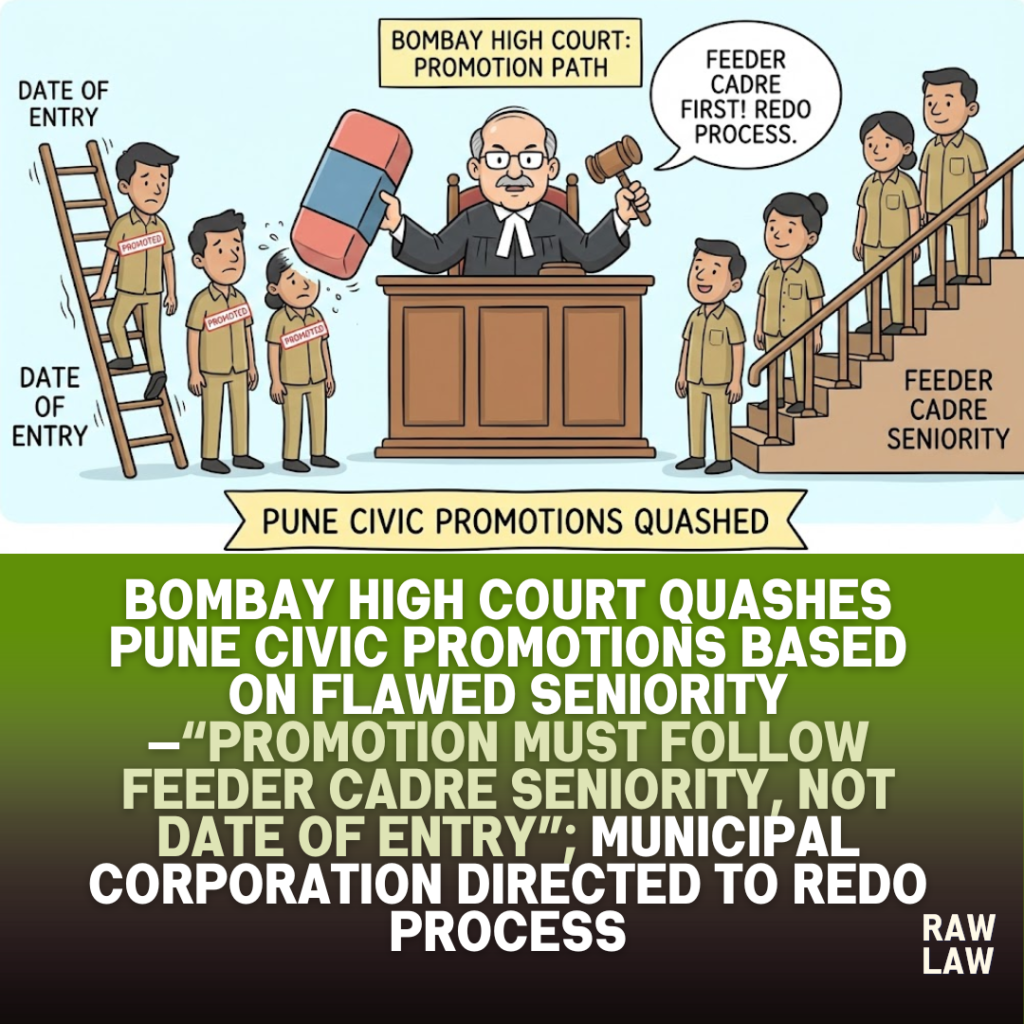
The Bombay High Court (Division Bench) set aside the promotion process undertaken by the Pune Municipal Corporation for the post of Superintending Engineer, holding that the Departmental Promotion Committee acted contrary to statutory service rules and binding government resolutions. The Court ruled that promotions based on the principle of seniority-cum-merit must be determined with reference to seniority in the feeder cadre and not the date of initial appointment in service. It held that the Departmental Promotion Committee’s decision to ignore a final seniority list and instead apply a retrospective benchmark was illegal. Consequently, the impugned order of the Departmental Promotion Committee was quashed, and the Corporation was directed to reconsider promotions in accordance with law.
Facts
The petitioners were degree-qualified civil engineers working as Executive Engineers with the Pune Municipal Corporation. They challenged the promotion process to the post of Superintending Engineer for the year 2025–2026. A final seniority list of Executive Engineers had been published on 11 September 2024, under which the petitioners were placed above several private respondents.
Despite the existence of this final seniority list, the Departmental Promotion Committee decided to determine promotions based on seniority as on 25 May 2004, effectively relying on the date of initial appointment rather than feeder cadre seniority. This resulted in the petitioners being superseded. An earlier coordinate Bench of the High Court had directed the Departmental Promotion Committee to consider representations and pass a reasoned order. However, the Committee reiterated its earlier decision through a brief and non-speaking order dated 11 December 2025, prompting the present writ petition.
Issues
The principal issues before the Court were whether promotions to the post of Superintending Engineer could be based on the date of initial entry into service rather than seniority in the feeder cadre of Executive Engineer, whether the Departmental Promotion Committee was justified in ignoring a final seniority list already in force, and whether the impugned order complied with the requirement of being a reasoned and speaking order as directed earlier by the High Court.
Petitioners’ arguments
The petitioners contended that the impugned promotion process was wholly illegal as it ignored the final seniority list of Executive Engineers dated 11 September 2024. They argued that under the Pune Municipal Corporation Service Rules, 2014 and the Government Resolution dated 1 August 2019, promotions must be governed by the principle of seniority-cum-merit with reference to the feeder cadre.
It was further argued that the Departmental Promotion Committee acted in defiance of the High Court’s earlier directions by passing a cryptic and non-speaking order. The petitioners submitted that reliance on government letters and a later Government Resolution relating to reservation in promotion was misconceived, particularly for open category candidates. They emphasised that once a seniority list has attained finality, it cannot be unsettled retrospectively under the guise of correcting mistakes.
Respondents’ arguments
The Pune Municipal Corporation defended the promotion process by contending that an error had crept into the final seniority list and that promotions ought to be based on the date of initial appointment rather than accelerated promotions resulting from acquisition of qualifications. It was argued that the Corporation was entitled to correct past mistakes prospectively and that the Departmental Promotion Committee acted on guidance issued by the State Government.
The private respondents supported this stand, asserting that length of service from the date of joining should prevail over feeder cadre seniority. They also argued that no vested right accrues merely from placement in a seniority list if the list itself is erroneous.
Analysis of the law
The Court examined the Pune Municipal Corporation Service Rules, 2014, which have statutory force under Article 309 of the Constitution. It noted that Rule 4 mandates promotions on the principle of seniority-cum-merit. The Court also relied on the Government Resolution dated 1 August 2019, which requires the final seniority list of the immediately preceding year to be the basis for promotion.
The Court emphasised that “seniority-cum-merit” requires candidates to first meet the eligibility criteria in the feeder cadre, after which inter se seniority in that cadre determines promotion. In the absence of any statutory rule mandating reliance on the date of initial appointment, the Corporation’s approach was found to be legally unsustainable.
Precedent analysis
The Court relied on Supreme Court precedent holding that where promotions are governed by seniority-cum-merit, seniority in the feeder cadre is decisive. It distinguished judgments dealing with accelerated promotions and merit-based advancement, observing that those principles were inapplicable to the present statutory framework. The Court also reiterated settled law that executive instructions or departmental letters cannot override statutory service rules.
Court’s reasoning
Applying these principles, the Court held that the Departmental Promotion Committee acted illegally in discarding the final seniority list dated 11 September 2024 and reverting to a benchmark of 25 May 2004. The Court found no rule or resolution permitting such retrospective reworking of seniority for promotion to the post of Superintending Engineer.
The Court further held that the impugned order was non-speaking and failed to comply with the earlier judicial direction to pass a reasoned order. It rejected the argument that mistakes in seniority could be corrected in a manner that directly affected promotional prospects contrary to binding rules.
Conclusion
The Bombay High Court quashed the impugned order of the Departmental Promotion Committee and the promotion process based on it. The Pune Municipal Corporation was directed to reconsider promotions to the post of Superintending Engineer strictly on the basis of the final seniority list of the feeder cadre and in accordance with the Service Rules, 2014 and applicable government resolutions.
Implications
This judgment reinforces a core principle of service jurisprudence: promotions governed by seniority-cum-merit must follow feeder cadre seniority and cannot be reshaped by administrative discretion or retrospective reinterpretation. The ruling has significant implications for municipal bodies and public employers, underscoring that final seniority lists carry binding force and that statutory service rules cannot be diluted by executive correspondence or ad hoc corrective measures.
Case law references
- Shiba Shankar Mohapatra v. State of Orissa: Cited to hold that long-standing seniority cannot be unsettled on the basis of departmental opinions.
- Ved Prakash v. State of Haryana: Relied upon for the principle that under seniority-cum-merit, feeder cadre seniority governs promotion.
- Union of India v. C. Jayaprakasan: Applied to reiterate that in the absence of a specific rule, entry into the feeder post determines seniority for promotion.
- Indian Council of Agricultural Research v. T.K. Suryanarayan: Distinguished as relating to accelerated promotions, not applicable to the present facts.
FAQs
1. Can promotions be based on the date of initial appointment instead of feeder cadre seniority?
No. Where service rules prescribe seniority-cum-merit, promotions must be based on seniority in the feeder cadre, not the date of initial entry into service.
2. Can a final seniority list be ignored by a Departmental Promotion Committee?
No. Once a seniority list has attained finality, it is binding and cannot be bypassed unless set aside in accordance with law.
3. Are government letters sufficient to override statutory service rules?
No. Executive letters or opinions cannot override service rules framed under Article 309 of the Constitution.