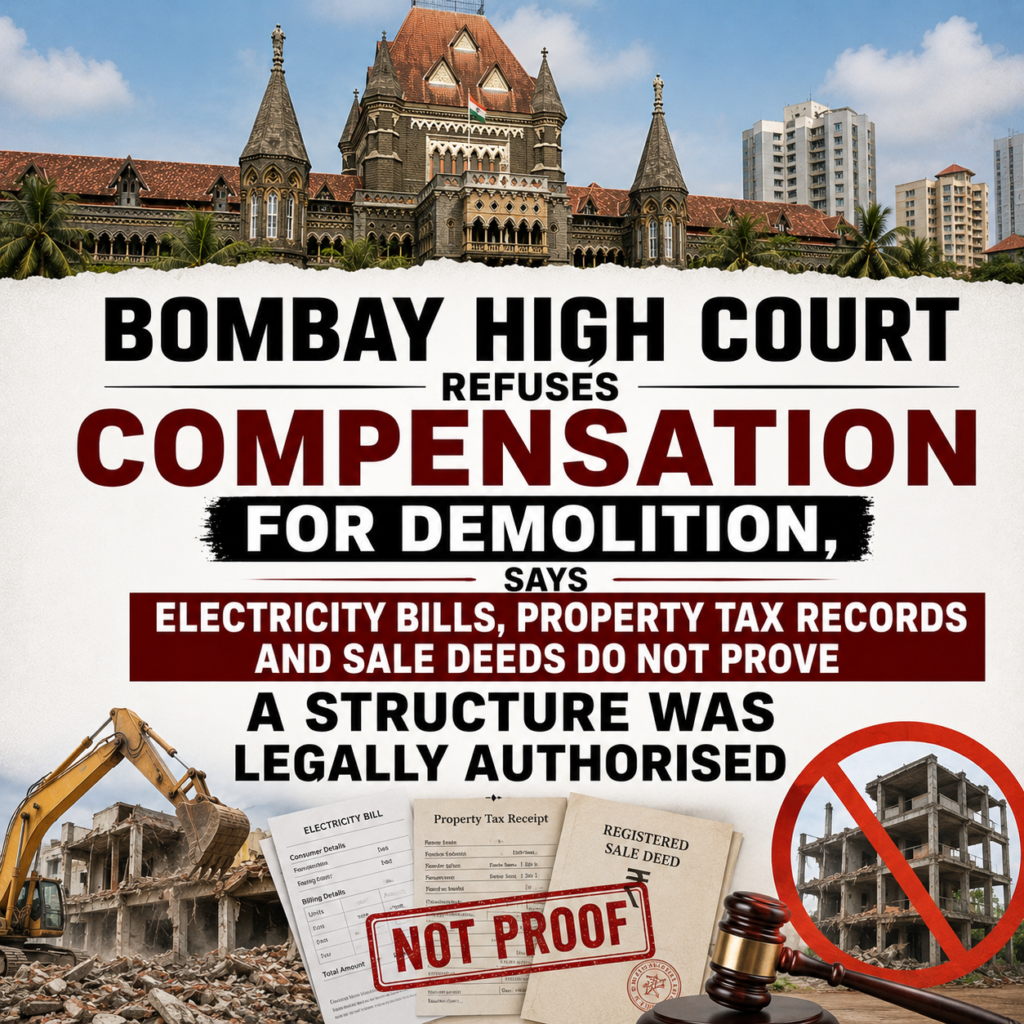
Bombay High Court Refuses Compensation for Demolition of Borivali Structure, Holds Assessment Records and Utility Bills Do Not Prove Authorised Construction
Facts
The petitioner, Ashok Tukaram Ramugade, a 72-year-old senior citizen, filed a writ petition under Article 226 of the Constitution challenging a Stop Work Notice dated 18 January 2024 and an order dated 1 February 2024 issued by the Municipal Corporation of Greater Mumbai.
The dispute concerned a room situated in the compound of Blue Star Crystal Co-operative Housing Society at Borivali West, Mumbai. The petitioner claimed that the room measured 120 sq. ft. and that he had acquired rights over it through sale deeds.
The petitioner alleged that the demolition of the room on 2 February 2024 was illegal. He sought restoration of the structure, compensation of ₹80 lakh with interest at 18% per annum, and disciplinary action against the concerned municipal officers.
To support his claim that the structure was authorised, the petitioner relied on sale deeds, municipal assessment records, electricity bills, water bills, a business licence, and references to the structure in private documents including a development agreement.
The petitioner also claimed that he had only carried out tenantable repairs after receiving a communication from the Municipal Corporation stating that no permission was required for such repairs.
The Municipal Corporation issued the Stop Work Notice alleging that the petitioner had undertaken unauthorised construction beyond the area reflected in the approved plan. The petitioner claimed that the notice and demolition were issued with mala fide intention and at the instance of the developer.
Issues
- Whether the petitioner had produced sufficient material to establish that the demolished structure was sanctioned or authorised under municipal law.
- Whether municipal assessment records, electricity bills, water bills and business licences could prove that a structure was legally authorised.
- Whether permission to carry out tenantable repairs could justify enlargement, reconstruction or alteration of the structure.
- Whether the writ court could grant restoration and compensation when the petitioner’s claim involved disputed questions of title, possession, dimensions and legality of construction.
- Whether the demolition carried out pursuant to the Stop Work Notice and municipal order was illegal.
Petitioner’s Arguments
The petitioner argued that he had acquired rights in the structure through sale deeds dated 13 July 2004 and 5 March 2009.
He submitted that the structure was old and existed prior to 1961-62. To establish this, he relied on municipal assessment records, electricity bills, water bills and a licence for carrying out business from the premises.
The petitioner also argued that the structure had been acknowledged by the developer in the Development Agreement dated 22 August 2022 and in the architect’s proposal letter dated 15 December 2021.
He contended that because of the redevelopment and raised ground level of the new building, the subject premises had come to be situated around four feet below the surrounding ground level, creating apprehension of water logging. Therefore, he sought to carry out repairs and renovation.
According to the petitioner, the Municipal Corporation itself had informed him on 20 December 2023 that no permission was required for tenantable repairs. He claimed that he acted on this communication and carried out only permissible repairs.
The petitioner alleged that the developer had offered inadequate compensation and, after he refused to accept it, threatened to get the structure demolished. He therefore claimed that the Stop Work Notice and demolition were mala fide and illegal.
Respondent’s Arguments
The respondents opposed the petition and contended that the petitioner had failed to produce any sanctioned plan or municipal approval showing that the structure was authorised.
They argued that assessment records, electricity bills, water bills and business licences could only show existence or use of the structure, but could not prove that the structure was legally sanctioned.
The respondents also disputed the petitioner’s reliance on private sale deeds and development documents, contending that such private documents could not operate as municipal sanction.
It was further argued that the petitioner had enlarged the structure beyond the claimed area. While the sale deed referred to a room of about 120 sq. ft., the petitioner’s own material showed that after the work undertaken by him, the structure measured about 246.92 sq. ft.
The respondents submitted that tenantable repair permission could not be used as a licence to enlarge, reconstruct or alter the footprint of a structure.
Analysis of the Law
The Court held that the principal question was whether the petitioner had produced cogent material to show that the subject structure was sanctioned or otherwise authorised under applicable municipal laws.
The Court clarified that municipal assessment records, water bills, electricity bills and business licences may show that a structure existed or was being occupied. However, such documents do not prove title to land or establish that the construction was sanctioned.
The Court further held that old assessment records cannot be used to legalise later additions or enlargements, especially when the original area, dimensions and configuration of the structure are not disclosed.
The Court also held that private sale deeds or private documents acknowledging the existence of a room cannot amount to municipal sanction. A private agreement may show that parties recognised the existence of a structure, but it cannot confer legality on an unauthorised construction.
On tenantable repairs, the Court held that permission to carry out such repairs does not authorise an occupant to enlarge the area, change the dimensions, reconstruct the premises, or alter the original footprint contrary to sanctioned plans.
Precedent Analysis
The Court relied on Laxmi Shetye v. MHADA, where the Division Bench had approved the view in Sidharam M. Yanagandul v. State of Maharashtra that assessment of a structure to municipal taxes does not make an unauthorised structure authorised.
The Court reiterated that even an unauthorised structure can be assessed to municipal tax, but such assessment does not change its unauthorised character.
The Court also relied on Siesta Industrial and Trading Corporation v. MCGM, where it was held that repair permissions granted after the relevant datum line cannot prove either the prior existence of a structure or its authorised status. The Court observed that granting relief on the basis of such repair permissions would encourage illegal constructions and defeat planned development.
The Court further referred to S.P. Chengalvaraya Naidu v. Jagannath, along with other Supreme Court judgments on suppression of material facts and misleading the Court. The Court emphasised that a litigant seeking discretionary relief must make complete and candid disclosure of material facts.
Court’s Reasoning
The Court found that the petitioner had not produced any sanctioned plan specifically pertaining to the subject structure, either for 120 sq. ft. or for 246.92 sq. ft.
The Court noted that the sale deed relied upon by the petitioner referred to a room of about 120 sq. ft., whereas the petitioner’s own material showed that the structure after the work measured approximately 246.92 sq. ft. There was no documentary explanation showing how a 120 sq. ft. room became a 246.92 sq. ft. structure, or that such enlargement was approved by the competent authority.
The Court also noted that the petitioner did not claim ownership of the land and claimed only ownership of the structure. Further, although the sale deed referred to possible membership of the society, the petitioner was admittedly not a member of the society and had not shown that he applied for membership.
The Court held that the petitioner had attempted to rely on private recitals, assessment records and utility bills to create an impression that the structure was authorised. According to the Court, this approach could not be accepted because it would encourage illegal occupants or wrongdoers to benefit from their own or their predecessor’s illegalities.
The Court also held that the petitioner’s claim for restoration and compensation of ₹80 lakh involved disputed questions relating to title, possession, legality, dimensions of the original structure, nature of work undertaken and alleged loss. Such disputed issues could not be adjudicated in writ jurisdiction under Article 226.
Conclusion
The Bombay High Court dismissed the writ petition.
The Court held that the petitioner had failed to prove that the demolished structure was sanctioned or authorised under municipal law. It ruled that assessment records, electricity bills, water bills, business licences and private sale deeds could not substitute a sanctioned plan or municipal approval.
The Court further held that tenantable repair permission could not justify enlargement or reconstruction of the structure from about 120 sq. ft. to about 246.92 sq. ft.
The Court found no illegality in the Stop Work Notice dated 18 January 2024 or the order dated 1 February 2024. Consequently, the demolition carried out pursuant to those actions could not be declared illegal in writ proceedings.
The Court clarified that the petitioner was free to pursue appropriate civil remedies before the competent forum, and all contentions in such proceedings were kept open.
Although the Court was inclined to impose exemplary costs, it refrained from doing so because the petitioner was a senior citizen aged about 72 years.
Case Details
Case: Ashok Tukaram Ramugade v. Municipal Corporation of Greater Mumbai & Ors.
Court: Bombay High Court, Ordinary Original Civil Jurisdiction
Case Number: Writ Petition No. 4542 of 2024
Judge: Justice A.S. Gadkari and Justice Kamal Khata
Date: 07 July 2026
Result: Writ petition dismissed; demolition not held illegal; restoration and compensation refused; liberty granted to pursue civil remedies.