


Court’s decision
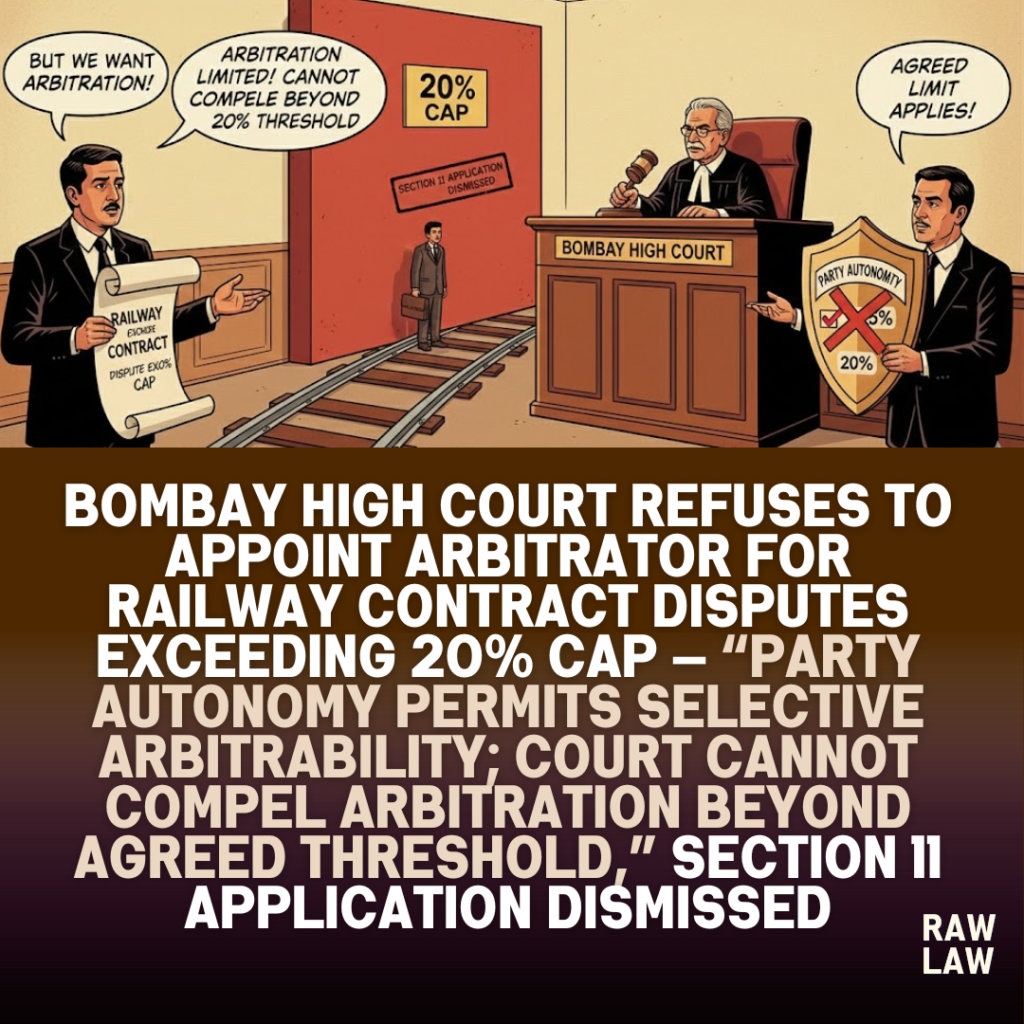
The Bombay High Court, exercising its Ordinary Original Civil Jurisdiction, has dismissed a Commercial Arbitration Application seeking appointment of an arbitrator in a dispute arising out of a railway contract, holding that where parties have expressly agreed to arbitrate only claims up to 20% of the contract value, courts cannot compel arbitration for claims exceeding that threshold. Upholding the sanctity of party autonomy, the Court ruled that such a restrictive arbitration clause is neither discriminatory nor arbitrary, nor violative of Article 14 of the Constitution, particularly when the contractor remains free to pursue civil remedies for higher-value claims.
Facts
The dispute arose from a contract dated 7 May 2018 awarded by the Railways for preparation of designs and structural drawings for bridges in the Manmad–Jalgaon third line project. The total value of the contract was approximately ₹84.52 lakh. The contractor was required to complete designs for 22 bridges within nine months, though multiple extensions were granted. Eventually, the Railways terminated the contract in December 2021 and debarred the contractor from executing the remaining work.
Aggrieved by the termination and allied actions, the contractor initially challenged the termination before the High Court in a writ petition, which was disposed of in June 2025 with liberty to invoke arbitration. Thereafter, the contractor filed an application under Section 11 of the Arbitration and Conciliation Act, 1996, seeking appointment of an arbitrator and claiming losses estimated at ₹3 crore—nearly four times the original contract value. The Railways opposed the application on the ground that the arbitration clause limited arbitrable claims to 20% of the contract value.
Issues
The principal issues before the Court were whether an arbitral tribunal could be constituted under Section 11 when the contractor’s own pleaded claim exceeded 20% of the contract value, whether the restrictive covenant in the arbitration clause was arbitrary or discriminatory, and whether the Court could sever the monetary cap and still enforce the arbitration agreement. The Court also considered the extent of its powers under Section 11 to test the validity of conditions in an arbitration clause on constitutional grounds.
Petitioner’s arguments
The contractor argued that although the contract contained an arbitration clause, the stipulation restricting arbitrability to claims up to 20% of the contract value was arbitrary, discriminatory, and unconscionable. It was contended that the restriction effectively discouraged contractors from raising legitimate claims and created an unequal bargaining position, particularly since no similar monetary cap applied to potential counterclaims by the Railways.
Relying on Supreme Court judgments dealing with unfair arbitration clauses, the contractor submitted that courts, while exercising powers under Section 11, are competent to examine the validity of such conditions under Article 14 of the Constitution. It was argued that the restrictive portion of the clause should be severed while preserving the remainder of the arbitration agreement, or alternatively, that the question of jurisdiction based on claim value could be left to the arbitral tribunal under Section 16.
Respondent’s arguments
The Railways opposed the application by emphasising that arbitration is a creature of consent and that the parties had consciously agreed to arbitrate only disputes up to a specified monetary limit. It was argued that the clause did not prevent the contractor from pursuing claims exceeding 20% of the contract value, but merely required such claims to be adjudicated through ordinary civil proceedings rather than arbitration.
The Railways relied on precedent upholding similar contractual caps and contended that the contractor, having voluntarily entered into the agreement, could not later seek to rewrite its terms. It was further submitted that where no arbitration agreement exists for disputes of a particular value, the Court lacks jurisdiction to appoint an arbitrator under Section 11.
Analysis of the law
The High Court analysed Section 11 of the Arbitration and Conciliation Act alongside the doctrine of party autonomy, which forms the foundation of arbitration law. The Court reiterated that arbitration is consensual in nature and that parties are free not only to choose arbitration as a dispute resolution mechanism, but also to define its scope and limits. There is no legal mandate that all disputes arising from a contract must necessarily be arbitrated.
The Court acknowledged that it has the power under Section 11 to test the validity of an arbitration clause on constitutional and statutory grounds. However, it held that such scrutiny does not permit the Court to expand the scope of arbitration beyond what the parties have agreed. Where the arbitration agreement itself excludes disputes above a certain value, the Court cannot compel parties to arbitrate those disputes.
Precedent analysis
The Court distinguished Supreme Court decisions that struck down pre-deposit clauses or other onerous conditions as arbitrary, noting that those clauses effectively barred access to any remedy. In contrast, the present clause did not extinguish the contractor’s right to seek adjudication; it merely channelled higher-value claims to civil courts.
The Court relied on earlier Bombay High Court authority upholding similar railway arbitration clauses imposing a 20% cap, and clarified that judgments where such clauses were bypassed involved distinct factual situations, such as multiple work orders or cumulative contract values. The Court reaffirmed the principle that a judgment is an authority for what it decides, not for what may be inferred from it.
Court’s reasoning
Applying these principles, the Court found that the contractor’s own pleadings admitted a claim value far exceeding the agreed arbitral threshold. As a result, there was no arbitration agreement covering the disputes sought to be referred. The Court rejected the contention that the clause was discriminatory, holding that it applied uniformly to disputes “between the parties” and that speculation about possible counterclaims could not invalidate the agreement.
The Court also rejected the plea of arbitrariness, observing that unlike clauses struck down in earlier cases, the present clause did not impose a precondition or penalty that deterred legal action. Instead, it preserved the contractor’s right to sue in a civil court for higher claims. Since the clause was neither unconstitutional nor unenforceable, there was no occasion to sever it or appoint an arbitrator contrary to the parties’ agreement.
Conclusion
The Commercial Arbitration Application was dismissed. The Bombay High Court held that in the absence of an arbitration agreement covering claims exceeding 20% of the contract value, it had no jurisdiction to appoint an arbitrator under Section 11. The contractor was left free to pursue its remedies before the appropriate civil forum for adjudication of its claims.
Implications
This judgment reinforces the primacy of party autonomy in arbitration and clarifies that courts will not compel arbitration beyond the limits expressly agreed by contracting parties. For government and public sector contracts, particularly railway contracts, the ruling provides judicial affirmation of monetary caps on arbitrability. For contractors, the decision underscores the importance of carefully evaluating dispute resolution clauses at the bidding stage, as courts are unlikely to dilute or rewrite clear contractual restrictions under Section 11.
Case law references
- Lombardi Engineering Limited v. Uttarakhand Jal Vidyut Nigam Limited: Held that courts under Section 11 can examine validity of arbitration clauses on constitutional grounds; applied to test, but not invalidate, the restrictive covenant.
- ICOMM Tele Limited v. Punjab State Water Supply and Sewerage Board: Distinguished; clause there barred remedies and was arbitrary, unlike the present case.
- Central Organisation for Railway Electrification v. ECI SMO MCML JV: Reiterated equality in arbitral appointment; held inapplicable to monetary cap on arbitrability.
- Railtech Infraventure Private Limited v. Union of India: Upheld enforceability of 20% cap on arbitrability in railway contracts; relied upon.
FAQs
Q1. Can arbitration be limited to claims below a certain value by contract?
Yes. Parties are free to agree that only disputes up to a specified monetary limit will be resolved by arbitration.
Q2. Is a 20% cap on arbitrable claims in railway contracts unconstitutional?
No. The Bombay High Court has held that such a cap is neither arbitrary nor discriminatory if parties can pursue civil remedies for higher claims.
Q3. Can courts appoint an arbitrator despite a contractual bar on arbitrability?
No. If the arbitration agreement expressly excludes certain disputes, courts cannot compel arbitration under Section 11.