


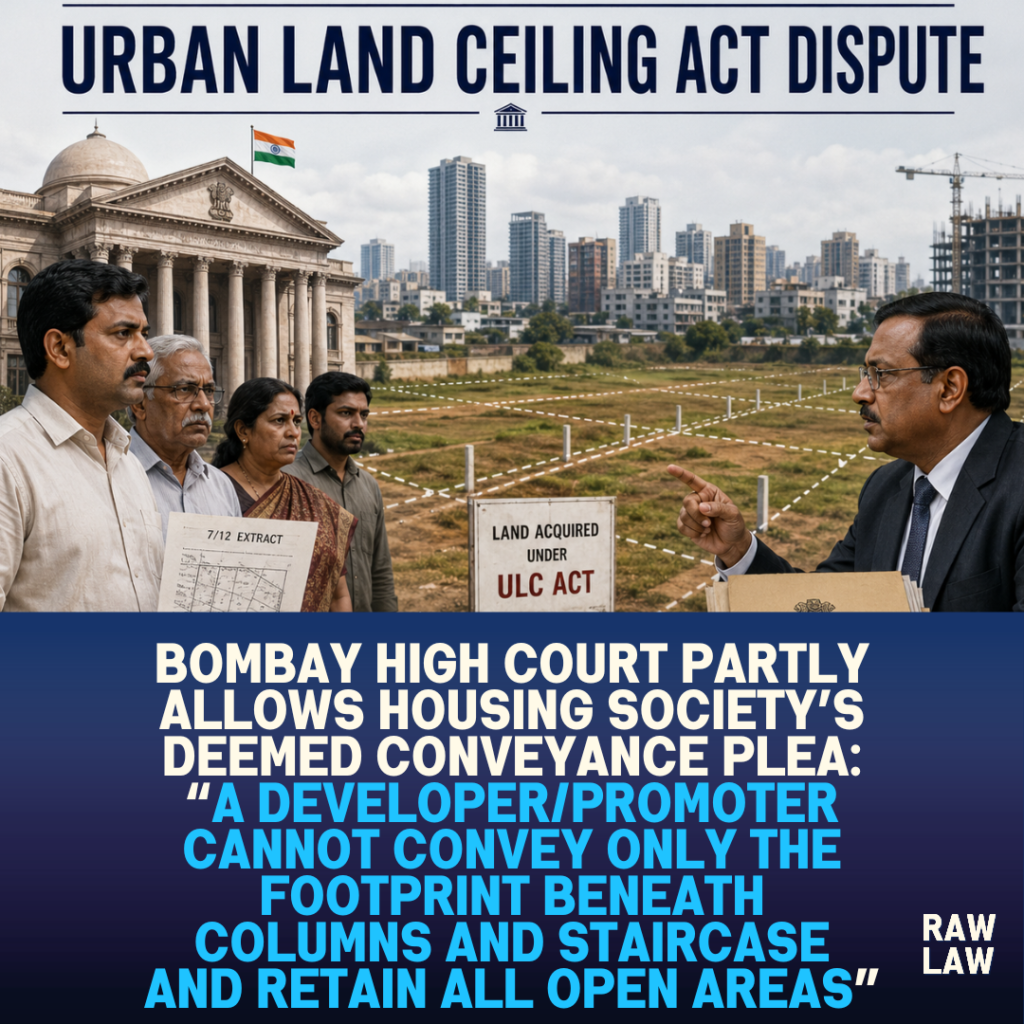
Court’s Decision
The Bombay High Court disposed of the writ petition challenging proceedings under the Urban Land (Ceiling and Regulation) Act, 1976 and refused to grant a declaration that the proceedings had abated under Section 4 of the Urban Land (Ceiling and Regulation) Repeal Act, 1999 (abatement of pending legal proceedings under the repealed ULC Act where possession has not been taken by the State).
The Court held that although service of notice under Section 10(5) of the ULC Act (notice requiring the person in possession to surrender or deliver possession of excess vacant land to the State within 30 days) is mandatory, the present case involved disputed factual questions regarding whether such notice was served and whether possession was actually taken before repeal.
The Court observed:
“Serious disputed questions of facts arise…”
The petitioners were therefore given liberty to file a civil suit, and the Court clarified that:
“All questions, rights and contentions of the rival parties are kept open.”
Facts
The dispute concerned lands at Nashik which were subjected to proceedings under the ULC Act.
After the ULC Act came into force, statements were filed under Section 6(1) of the ULC Act (statement to be filed by a person holding vacant land in excess of the ceiling limit).
Thereafter, the Competent Authority passed an order under Section 8(4) of the ULC Act (final order determining the extent of vacant land held in excess of the ceiling limit after considering objections) and declared 60,821.25 sq. mtrs. as excess land.
The Competent Authority subsequently issued notification under Section 10(1) of the ULC Act (notification giving particulars of excess vacant land proposed to be acquired and inviting claims from interested persons), followed by proceedings under Section 10(2) of the ULC Act (determination of claims of persons interested in the vacant land).
Thereafter, notification was issued under Section 10(3) of the ULC Act (declaration that excess vacant land is deemed to have been acquired and vested absolutely in the State Government).
The petitioners claimed that despite such vesting, possession was never lawfully taken from them. According to them, no valid notice under Section 10(5) of the ULC Act (notice to surrender or deliver possession) was served upon them, and no action was validly taken under Section 10(6) of the ULC Act (power of the authority to take possession, including by use of necessary force, if the person fails or refuses to comply with notice under Section 10(5)).
Since the ULC Act was repealed in Maharashtra on 29 November 2007, the petitioners argued that the proceedings stood abated under Section 4 of the ULC Repeal Act (abatement of pending proceedings where possession had not been taken).
Issues
- Whether possession of the excess land was lawfully taken by the State before the ULC Act was repealed in Maharashtra.
- Whether non-service of notice under Section 10(5) of the ULC Act (notice to surrender or deliver possession of vested excess land) entitled the petitioners to claim abatement under Section 4 of the ULC Repeal Act (abatement of pending ULC proceedings where possession was not taken).
- Whether the High Court could decide the dispute under Article 226 of the Constitution of India (writ jurisdiction of the High Court) or whether the parties had to approach the civil court.
Petitioners’ Arguments
The petitioners argued that mere vesting under Section 10(3) of the ULC Act (vesting of excess vacant land in the State Government) was not enough. According to them, the State had to prove that possession was actually taken either under Section 10(5) of the ULC Act (voluntary surrender or delivery of possession after written notice) or under Section 10(6) of the ULC Act (forcible taking of possession upon failure or refusal to comply with notice).
They contended that the notice under Section 10(5) was not addressed to them or their predecessor. Therefore, the mandatory requirement of law was not satisfied.
They relied on mutation entries and revenue records to claim that they continued to remain in possession of the land even after the alleged ULC proceedings.
They further argued that the earlier writ petition filed by the other branch did not bind them because the specific issue of non-service of notice upon them under Section 10(5) was not considered in that proceeding.
Respondent-State’s Arguments
The State argued that possession had already been taken before the ULC Act was repealed.
It relied upon the notice under Section 10(5) of the ULC Act (notice to surrender or deliver possession), kabje pavati, panchanamas, and related documents to show that possession of the entire excess land admeasuring 60,821.25 sq. mtrs. had already been taken.
The State further argued that if the petitioners disputed the fact of possession, such a dispute involved serious questions of fact which could only be decided by a civil court after evidence.
The State also contended that the petitioners approached the High Court after nearly eight years and therefore could not seek relief in writ jurisdiction.
Analysis of the Law
The Court explained that under Section 10(3) of the ULC Act (vesting of excess vacant land in the State), land may vest in the State, but such vesting does not automatically mean that actual physical possession has been taken.
The Court noted that Section 10(5) of the ULC Act (notice requiring surrender or delivery of possession) requires the authority to issue written notice to the person in possession. If such person fails or refuses to comply, the authority may proceed under Section 10(6) of the ULC Act (taking possession, including by use of force where necessary).
The Court observed:
“Issuance and service of notice under Section 10(5) of the ULC Act is mandatory.”
It further noted:
“Mere vesting of land in the State under Section 10(3) of the ULC Act, is not sufficient…”
However, the Court found that this was not a case where the State had produced no possession-related material. Since the State relied on possession documents, kabje pavati and panchanamas, the Court held that the issue required factual adjudication.
Precedent Analysis
1. State of Uttar Pradesh v. Hari Ram
The Supreme Court held that mere vesting under Section 10(3) of the ULC Act (vesting of excess vacant land in the State) does not give the State actual possession. The State must prove voluntary surrender, peaceful delivery under Section 10(5) (notice-based surrender or delivery of possession), or forcible dispossession under Section 10(6) (taking possession by force if necessary).
2. Gajanan Kamlya Patil v. Additional Collector and Competent Authority
The Supreme Court held that where the State could not produce documents such as panchanama or possession receipt, only de jure possession could be presumed, not actual physical possession.
3. State of Assam v. Bhaskar Jyoti Sarma
The Supreme Court held that a belated challenge may not be entertained where possession had already been taken and third-party rights had intervened.
4. A.P. Electrical Equipment Corporation v. Tahsildar
The Supreme Court clarified that a writ petition under Article 226 of the Constitution (High Court’s power to issue writs for enforcement of rights and legal duties) is not automatically barred merely because disputed facts are involved. However, whether such disputed facts should be examined in writ jurisdiction depends on the facts of each case.
5. Dalsukhbhai Bachubhai Satasia v. State of Gujarat
The Supreme Court held that notice under Section 10(5) of the ULC Act (notice to the person in possession to surrender or deliver possession) must be issued to the person actually in possession. Failure to issue such notice may mean that the legal process of taking possession was incomplete, leading to abatement under Section 4 of the ULC Repeal Act (abatement of pending proceedings after repeal where possession was not taken).
Court’s Reasoning
The High Court found that the petitioners’ case could not be accepted outright because the State had placed documents on record showing that the notice, kabje pavati and panchanamas related to the entire excess land.
The Court held that the Tahsildar’s 2014 order could not be used by the petitioners to prove continuing possession. According to the Court, the order recorded that possession had already been taken and merely directed correction of revenue entries.
The Court observed:
“It cannot be said that the petitioners have made out a clear case in their favour…”
The Court further noted that the petitioners filed the writ petition only in 2015, though the relevant ULC proceedings and earlier litigation dated back to 2007.
Since the question of actual possession and service of notice under Section 10(5) of the ULC Act (notice to surrender or deliver possession) required evidence, the Court held that the parties should approach the civil court.
Conclusion
The Bombay High Court disposed of the writ petition and refused to quash the ULC notifications and notices in writ jurisdiction.
The Court did not finally decide whether possession was lawfully taken or whether the ULC proceedings had abated. Instead, it held that these questions involve serious disputed facts and must be decided by the competent civil court.
The petitioners were granted liberty to file a civil suit, and all rights and contentions were kept open.
The intervention application was also dismissed because the applicant’s claim depended on the same disputed question of whether physical possession had ever been taken.
RAW LAW Takeaway
This judgment clarifies that notice under Section 10(5) of the ULC Act (notice requiring the person in possession to surrender or deliver possession of excess vacant land) is a mandatory step before the State can claim lawful possession. However, where the State produces possession documents such as kabje pavati and panchanamas, and the landowners dispute them, the High Court may refuse to decide the matter in writ jurisdiction and direct the parties to file a civil suit.