


1. Court’s decision
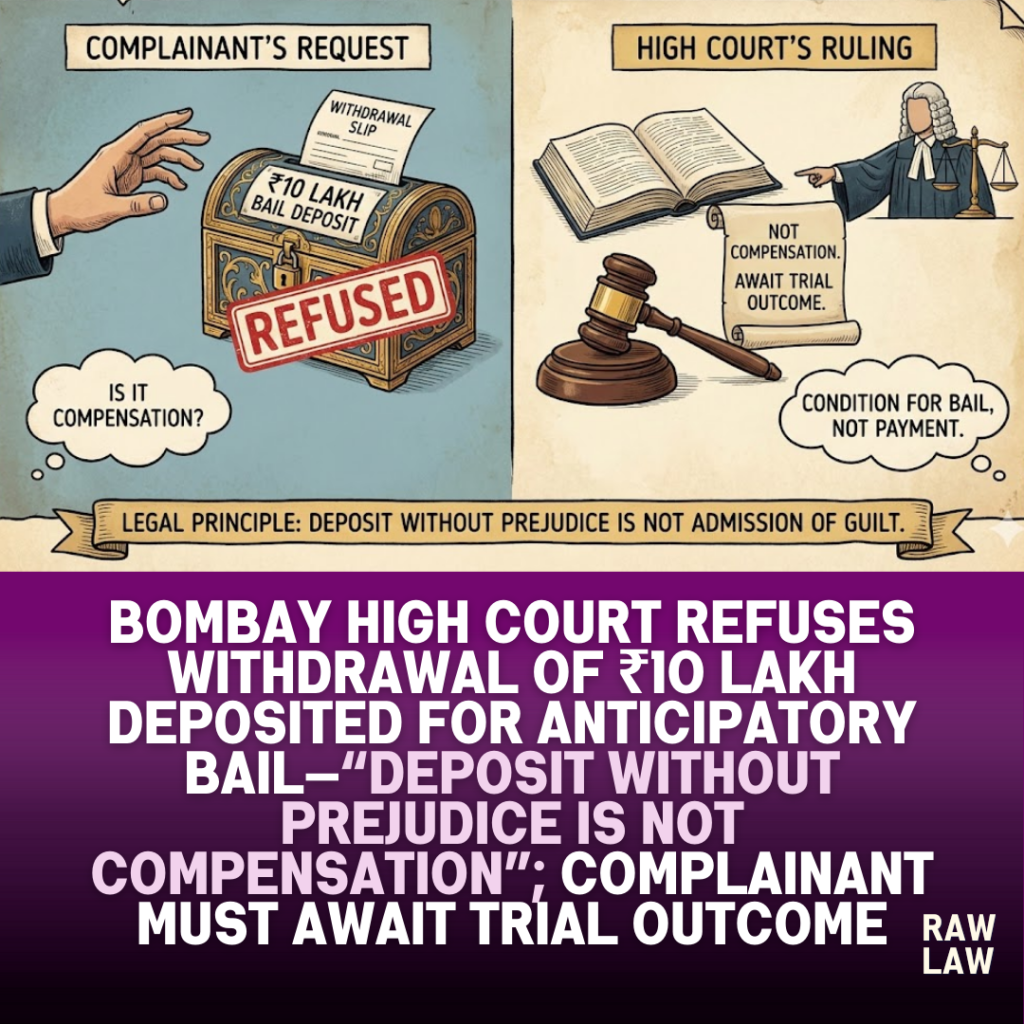
The Bombay High Court (Aurangabad Bench) dismissed a criminal application seeking withdrawal of ₹10 lakh deposited by an accused as a condition recorded during anticipatory bail proceedings. The Court held that the amount was deposited “without prejudice” to the accused’s rights and cannot be treated as compensation or property liable for return under the Code of Criminal Procedure.
Emphasising that the trial in Crime No. 442 of 2017 is still pending and the accused’s guilt remains unproven, the Court declined to permit withdrawal even against a proposed bank guarantee. The trial court was left free to pass appropriate orders at the appropriate stage.
2. Facts
The applicant, who is the first informant in Crime No. 442 of 2017, filed the present application seeking withdrawal of ₹10 lakh deposited by respondent No.2–accused pursuant to an order dated 15 November 2017 in Criminal Application No. 5648 of 2017.
During anticipatory bail proceedings, the accused had voluntarily offered to deposit 50% of the alleged disputed amount of ₹20 lakh to demonstrate bona fides, without prejudice to his defence that he had already paid the amount to a middleman (prime accused Kaushalji).
Upon deposit of ₹10 lakh, anticipatory bail was granted on 9 January 2018. The amount remained deposited with the Court.
3. Issues
The Court considered:
• Whether a complainant can withdraw an amount deposited by an accused during anticipatory bail proceedings.
• Whether such deposit can be treated as return of property under the Code of Criminal Procedure.
• Whether the earlier withdrawal application, disposed of as withdrawn in 2018, barred the present application.
• Whether the “without prejudice” nature of the deposit affects entitlement.
4. Applicant’s arguments
The applicant contended that the amount of ₹10 lakh, representing 50% of the alleged disputed sum, was deposited to secure bail and remained idle with the Court.
It was argued that since the applicant is ready to furnish a bank guarantee of equivalent value, withdrawal should be permitted pending trial.
The applicant submitted that the deposit effectively represented partial liability admitted for purposes of bail and should not be locked until completion of trial.
5. Respondent’s arguments
The accused opposed the application, arguing that the deposit was made voluntarily and without prejudice to his defence that the entire ₹20 lakh had already been paid to the prime accused.
It was contended that the amount was not seized property and could not be returned under criminal procedural provisions. The accused relied upon a Bombay High Court decision in Amul Navnitlal Rawal v. State of Maharashtra, where a similar request for withdrawal was rejected.
Reliance was also placed on the Supreme Court judgment in Dharmesh @ Dharmendra @ Dhami Jagdishbhai @ Jagabhai Bhagubhai Ratadia v. State of Maharashtra, holding that monetary conditions in bail cannot operate as compensation for the complainant.
6. Analysis of the law
The Court carefully examined its earlier orders dated 15 November 2017 and 9 January 2018. It noted that the accused’s offer to deposit ₹10 lakh was expressly recorded as “without prejudice” to his defence.
The Court emphasised that such deposit does not amount to admission of guilt or liability. Nor does it constitute property seized by police under investigation.
The amount was deposited purely to demonstrate bona fides for anticipatory bail and not as restitution or compensation. Therefore, it could not be equated with property subject to return under Sections 451 or 457 of the Code of Criminal Procedure.
7. Precedent analysis
The Court relied upon a coordinate bench decision dated 22 February 2019 in Criminal Application No. 1118 of 2018 (in ABA No. 159 of 2016), where withdrawal of a similar “without prejudice” deposit was rejected during pendency of trial.
It also referred to the Supreme Court’s observations in Dharmesh @ Dharmendra @ Dhami Jagdishbhai @ Jagabhai Bhagubhai Ratadia, cautioning that monetary conditions imposed in bail cannot be treated as compensation to be disbursed as a condition of enlargement on bail.
These precedents reinforced the principle that bail deposits are not substitutes for adjudicated liability.
8. Court’s reasoning
The Court observed that the trial is still pending and the accused’s guilt is yet to be established. Permitting withdrawal at this stage would effectively treat the deposit as partial recovery without adjudication.
It rejected the applicant’s offer to furnish a bank guarantee, noting that the essential issue was not security but entitlement.
The Court also observed that the earlier withdrawal application was disposed of as withdrawn with liberty to approach appropriate forum, but that did not create a substantive right to withdraw.
The application was therefore found devoid of merit. The trial court, however, was granted liberty to pass appropriate orders regarding the amount at the appropriate stage.
9. Conclusion
The Criminal Application No. 2914 of 2024 was dismissed. The Court refused withdrawal of ₹10 lakh deposited during anticipatory bail proceedings.
It clarified that the deposit remains subject to final outcome of trial and that appropriate orders may be passed by the trial court at the proper stage.
10. Implications
This judgment clarifies that:
• Amounts deposited “without prejudice” for bail purposes cannot be treated as compensation.
• Such deposits are not “property” seized under the Code of Criminal Procedure.
• Complainants cannot secure interim recovery through anticipatory bail conditions.
• Bail jurisprudence must not be converted into restitution mechanism.
The ruling reinforces the distinction between bail conditions and adjudicated liability, safeguarding presumption of innocence during pendency of trial.
Case Law References
Amul Navnitlal Rawal v. State of Maharashtra (Bombay High Court) – Rejected withdrawal of deposit made without prejudice during anticipatory bail proceedings.
Dharmesh @ Dharmendra @ Dhami Jagdishbhai @ Jagabhai Bhagubhai Ratadia v. State of Maharashtra (Supreme Court) – Monetary bail conditions cannot be treated as compensation for disbursement.
FAQs
1. Can a complainant withdraw money deposited by an accused during anticipatory bail?
Generally no. If the amount is deposited without prejudice to the accused’s defence and trial is pending, courts will not permit withdrawal before adjudication.
2. Is such deposit considered return of property under CrPC?
No. It is not seized property under criminal procedure but a voluntary deposit to secure bail.
3. Can a bank guarantee justify interim withdrawal?
Not necessarily. The issue is entitlement, not security. Courts prioritise presumption of innocence until guilt is proven.