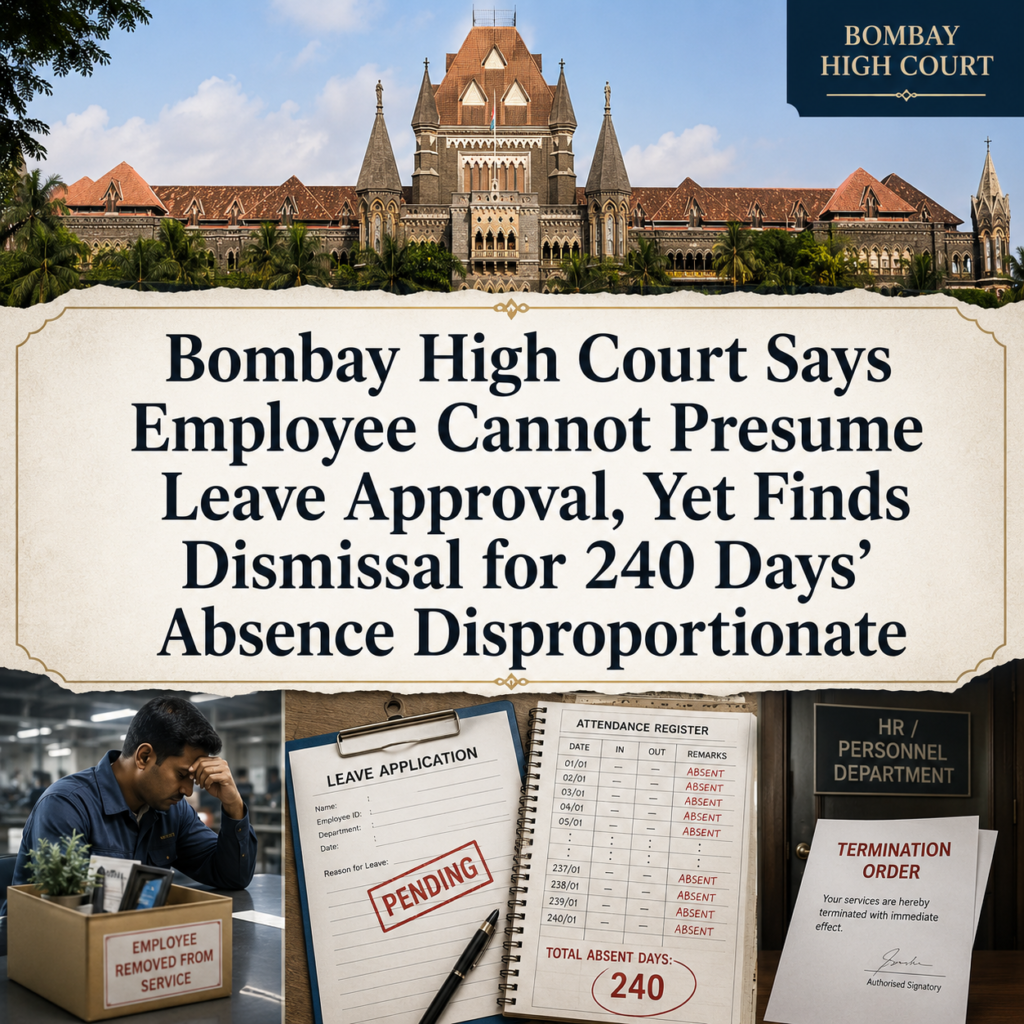
Bombay High Court Holds Dismissal for 240 Days’ Unauthorised Absence Disproportionate, Awards ₹15 Lakh Compensation Instead of Reinstatement
Facts
The petitioner, Shree Vighnahar Sahakari Sakhar Karkhana Ltd., a co-operative sugar factory, challenged the orders passed by the Labour Court and Industrial Court in favour of the respondent employee, Vishwas Yeshwant Dhomse.
The respondent was appointed as a seasonal industrial worker from 19 November 1986 and was later confirmed as a Clerk on 1 March 1996.
The employer issued two chargesheets against him in November 1999. The main allegation was that he remained unauthorisedly absent for 240 days from 17 November 1998 to 19 July 1999. Additional allegations included spreading false rumours, insubordination, refusal to follow lawful orders, refusal to accept letters, leaving the workplace without permission, remaining absent on certain dates, and tampering with the muster roll.
A domestic enquiry was conducted, in which the respondent participated. The Enquiry Officer held the charges proved. The Labour Court initially held that the enquiry was legal, fair and proper and complied with principles of natural justice.
The employer dismissed the respondent from service on 12 February 2002.
The respondent challenged the dismissal by filing Complaint (ULP) No. 128 of 2002 before the Labour Court, Pune. The Labour Court held that the employer had committed unfair labour practice and directed reinstatement with continuity of service and 50% backwages.
Both sides filed revisions. The employer challenged reinstatement and backwages, while the employee sought full backwages. The Industrial Court dismissed the employer’s revision and allowed the employee’s revision, enhancing backwages from 50% to 100%.
The employer then approached the Bombay High Court.
Issues
- Whether the Labour Court and Industrial Court were justified in directing reinstatement of the employee despite the domestic enquiry being held fair and proper.
- Whether the Labour Court committed an error by not properly framing and deciding the issue of perversity in the findings of the Enquiry Officer.
- Whether the respondent’s absence for 240 days could be treated as justified on the basis of medical certificates.
- Whether the punishment of dismissal from service was proportionate to the misconduct proved.
- Whether the employee was entitled to reinstatement with full backwages, or whether compensation would be a more appropriate relief.
Petitioner’s Arguments
The petitioner-employer argued that the Labour Court and Industrial Court wrongly held that it had committed unfair labour practice.
It submitted that the respondent was dismissed only after a proper domestic enquiry, in which the charges were proved. The Labour Court had already held that the enquiry was fair and proper, and that finding had attained finality.
The petitioner argued that the Labour Court failed to frame a proper issue on perversity of the Enquiry Officer’s findings. Without holding the findings perverse, the Labour Court could not have interfered with the dismissal.
It was further argued that if the Labour Court wanted to hold that the misconduct was not proved, it ought to have given the employer an opportunity to lead evidence before the Labour Court to justify the dismissal.
On facts, the petitioner submitted that the respondent had remained absent for 240 days without prior leave. The medical certificates relied upon by him were not produced contemporaneously and were submitted together only in July 1999, creating serious doubt about their genuineness.
The petitioner also argued that the Labour Court and Industrial Court wrongly placed the burden on the employer to communicate rejection of leave. According to the employer, it was the employee’s duty to enquire whether leave was sanctioned.
On backwages, the petitioner argued that the respondent had agricultural income and had also suffered disability due to an accident, making him unable to work. Therefore, award of 50% or 100% backwages was unjustified.
Respondent’s Arguments
The respondent employee supported the orders passed by the Labour Court and Industrial Court.
He argued that the employer had victimised him and had committed unfair labour practice.
According to him, his absence was due to illness, which was supported by medical certificates. He submitted that he had filed leave applications from time to time and that the employer never communicated rejection of those applications.
The respondent argued that since the leave applications were not rejected or communicated, he was justified in believing that leave had been sanctioned.
He also submitted that there was sufficient leave to his credit and therefore his absence could not be treated as unauthorised.
On backwages, the respondent argued that he had pleaded and proved that he was not gainfully employed. He relied on the principle that full backwages should ordinarily follow when termination is set aside.
He also referred to another case involving the same sugar factory where compensation of ₹35 lakh was awarded, and submitted that he should be granted similar or higher compensation if reinstatement was not ordered.
Analysis of the Law
The High Court held that once a domestic enquiry is held to be fair and proper, the Labour Court must properly consider whether the findings of the Enquiry Officer are perverse. If the Labour Court proposes to disregard the enquiry findings or hold that the misconduct is not proved, the employer must be given an opportunity to lead evidence to justify the disciplinary action.
The Court found that the Labour Court had framed only one preliminary issue regarding fairness of enquiry and had held the enquiry to be fair and proper. However, it did not properly frame or decide the issue of perversity of the Enquiry Officer’s findings.
The Court held that the Labour Court followed a procedure unknown to law by treating the employer’s limited evidence, which was produced to prove the enquiry record, as if it was evidence led to justify the dismissal on merits.
The Court further held that the employer had been denied an opportunity to justify its action before the Labour Court. This itself was sufficient to interfere with the orders of the Labour Court and Industrial Court.
On merits, the Court held that the respondent’s absence for 240 days was not disputed. His defence was that he was ill and had submitted medical certificates. However, the Court found serious weaknesses in this defence.
The Court noted that the medical certificates were dated 5 December 1998, 12 January 1999 and 28 January 1999, but all were submitted together only on 30 July 1999. If the certificates were genuine and available at the relevant time, they should have been submitted immediately.
The Court also noted that the ailments mentioned — tennis elbow and lower backache with acute sprain — did not justify continuous absence for eight months, especially when the respondent was not hospitalised even for a day.
The Court held that mere submission of leave applications does not mean that leave is automatically sanctioned. Even if leave is available in an employee’s account, it must be applied for and sanctioned. An employee cannot remain absent for months and presume approval.
Precedent Analysis
The Court relied on Workmen of Motipur Sugar Factory Pvt. Ltd. v. Motipur Sugar Factory, where the Supreme Court held that if a domestic enquiry is defective, invalid or insufficient, the employer should be given an opportunity to prove the misconduct before the Tribunal.
The Court held that this principle applied because the Labour Court had effectively found the misconduct not established without giving the employer a proper opportunity to justify the dismissal.
The respondent relied on Deepali Gundu Surwase v. Kranti Junior Adhyapak Mahavidyalaya to argue that full backwages should follow once termination is set aside. The Court held that this judgment did not apply because the respondent was not given a clean chit and some misconduct was clearly proved.
The petitioner relied on North-East Karnataka Road Transport Corporation v. M. Nagangouda to argue that agricultural income can be considered while deciding backwages. The Court accepted that agricultural income and other surrounding circumstances were relevant while deciding the appropriate relief.
The respondent also referred to Shree Vighnahar Sahakari Sakhar Karkhana Ltd. v. Jaisingh Barku Ghogare, where compensation of ₹35 lakh was granted. However, the Court distinguished that case because the facts were different and, in the present case, misconduct of unauthorised absence was held to be proved.
Court’s Reasoning
The High Court held that the respondent’s unauthorised absence for 240 days was clearly established.
The Court rejected the view of the Labour Court and Industrial Court that the absence was justified merely because the employer did not communicate rejection of leave applications. It held that an employee must verify whether leave has been sanctioned and cannot presume sanction.
The Court was also not convinced that tennis elbow or lower backache could justify absence for eight continuous months. The delayed submission of medical certificates further weakened the respondent’s defence.
However, the Court also held that dismissal from service was too harsh for the misconduct that ultimately remained proved. The employer did not press the other charges before the High Court, and the principal proved misconduct was unauthorised absence.
The Court noted that the respondent had worked for about 16 years before dismissal. Although he was negligent and had committed misconduct, the extreme punishment of dismissal was shockingly disproportionate.
At the same time, the Court held that reinstatement and backwages were not justified because the respondent was not fully exonerated. He had crossed the age of retirement on 25 December 2021, and he had also admitted to some agricultural income and physical disability due to an accident.
Considering all circumstances, the Court held that lump sum compensation would meet the ends of justice.
Conclusion
The Bombay High Court partly allowed the writ petition filed by the employer.
The Court set aside and modified the Labour Court’s order dated 18 July 2014 and the Industrial Court’s orders dated 10 March 2016.
The Court held that the respondent’s unauthorised absence for 240 days was proved, but the punishment of dismissal was disproportionate to the misconduct.
Instead of reinstatement and backwages, the Court directed the petitioner sugar factory to pay ₹15,00,000 as lump sum compensation to the respondent in full and final settlement of all disputes.
The amount was directed to be paid within four weeks. If not paid within that period, it would carry interest at 8% per annum after expiry of four weeks.
Case Details
Case: Shree Vighnahar Sahakari Sakhar Karkhana Ltd. v. Vishwas Yeshwant Dhomse
Court: Bombay High Court, Civil Appellate Jurisdiction
Case Number: Writ Petition No. 2312 of 2017
Judge: Justice Sandeep V. Marne
Date: 07 July 2026
Result: Petition partly allowed; reinstatement and backwages set aside; dismissal held disproportionate; ₹15 lakh lump sum compensation awarded.