


Court’s decision
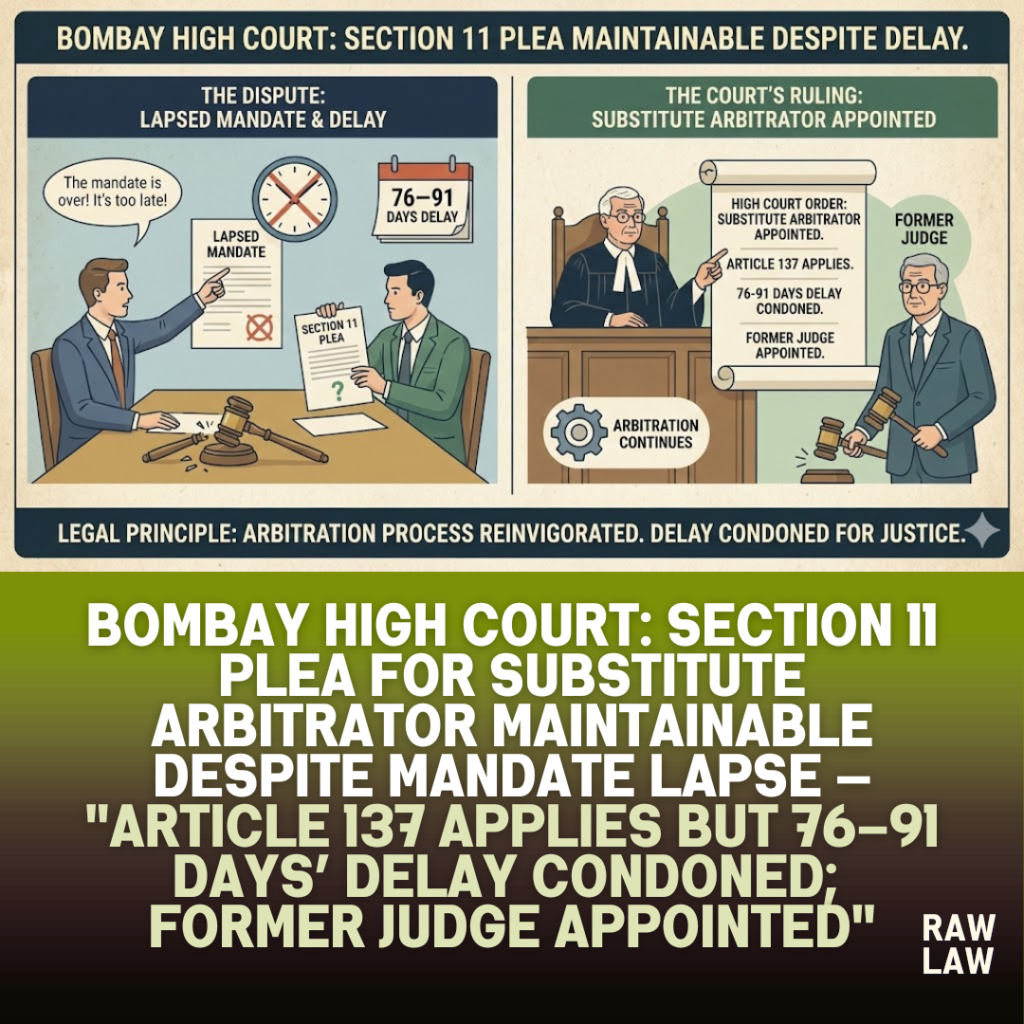
The Bombay High Court allowed two Commercial Arbitration Applications filed by Tata Motors Passenger Vehicles Ltd. under Section 11 of the Arbitration and Conciliation Act, 1996, appointing a substitute arbitrator after the earlier sole arbitrator withdrew from reference. The Court held that although Article 137 of the Limitation Act applies even to substitute appointments, the delay of 76 and 91 days was condonable under Section 5. It clarified that termination of an arbitrator’s mandate does not automatically terminate arbitral proceedings under Section 32. A former Judge of the Court was appointed as substitute arbitrator.
Facts
The dispute arose out of Dealership Agreements dated 26 December 2012 and 9 July 2013 executed between Tata Motors’ predecessor entity and Ghosh Brothers Automobiles for dealership of passenger vehicles and spare parts in Guwahati and adjoining territories.
Alleging outstanding dues exceeding ₹20 crore, Tata Motors invoked Clause 43.2 of the Agreement and approached the Bombay Chamber of Commerce & Industry under its arbitration rules. A retired Judge was appointed as sole arbitrator and proceedings commenced in 2018.
However, after several hearings and an extension of mandate, the learned arbitrator withdrew from reference on 18 March 2021 due to ill health. The applicants repeatedly requested BCCI to appoint a substitute arbitrator, but no appointment followed. Subsequent applications under Sections 29A and 14–15 were disposed of with liberty to approach under Section 11, leading to the present petitions.
Issues
The principal issue was whether the Section 11 applications seeking appointment of a substitute arbitrator were barred by limitation under Article 137 of the Limitation Act.
A related question was whether termination of an arbitrator’s mandate under Section 14 results in automatic termination of arbitral proceedings under Section 32.
The Court also considered whether delay in filing the Section 11 applications could be condoned in the absence of a formal Section 5 application.
Petitioners’ arguments
The applicants contended that only the mandate of the arbitrator had terminated under Section 14, not the arbitral proceedings. Relying on Dani Wooltex Corporation v. Sheil Properties Pvt. Ltd. and Kifayatullah Haji Gulam Rasool v. Bilkish Ismail Mehsania, they argued that substitution under Section 15(2) is mandatory once mandate ends.
It was further submitted that limitation principles applicable to original Section 11 petitions should not strictly apply to substitution applications. Alternatively, even if Article 137 applied, delay was minimal and deserved condonation under Section 5, especially in light of COVID-related exclusion orders.
Respondents’ arguments
The respondents opposed the petitions as time-barred, relying on M/s Arif Azim Co. Ltd. v. Aptech Ltd., where the Supreme Court held Article 137 applicable to Section 11(6) petitions.
They argued that limitation began running from 31 March 2021 when substitution was first sought, and even after exclusion of pandemic-related periods, the applications were filed beyond three years.
It was further contended that earlier Section 29A and Section 14–15 petitions having been withdrawn, fresh Section 11 petitions were not maintainable.
Analysis of the law
The Court reiterated the settled distinction between termination of mandate (Sections 14 and 15) and termination of arbitral proceedings (Section 32). Withdrawal of the arbitrator ends only the mandate, not the reference itself.
Citing Dani Wooltex, the Court emphasized that arbitral proceedings continue notwithstanding arbitrator withdrawal. Section 15(2) mandates appointment of a substitute “according to the rules applicable to the appointment of the arbitrator being replaced.”
On limitation, the Court relied on M/s Arif Azim Co. Ltd., holding that Article 137 governs Section 11 petitions. It rejected the argument that substitution petitions are exempt from limitation, noting that the same rules apply.
However, relying on HPCL Bio-Fuels Ltd. v. Shahaji Bhanudas Bhad, the Court held that delay under Section 11 is condonable even without a formal application.
Precedent analysis
In M/s Arif Azim Co. Ltd., the Supreme Court clarified that Section 43 makes the Limitation Act applicable to arbitration and that Article 137 governs Section 11 applications.
In HPCL Bio-Fuels Ltd., the Court recognized that Section 5 of the Limitation Act applies to Section 11 petitions and that formal condonation applications are not mandatory.
Dani Wooltex Corporation established that termination of mandate does not equate to termination of proceedings.
The Bombay High Court harmonized these precedents to conclude that while limitation applies, procedural justice requires pragmatic condonation in appropriate cases.
Court’s reasoning
The Court calculated that, after excluding COVID-related suspension periods and granting benefit under Section 14 for bona fide prosecution of earlier proceedings, delay remained of 76 and 91 days.
Given that the applicants had diligently pursued substitution through institutional channels and earlier petitions, and that arbitration agreement continued to subsist, the Court held that technicalities should not defeat substantive adjudication.
The delay was condoned under Section 5, and Justice R.Y. Ganoo (Retd.) was appointed as substitute arbitrator, with fees governed by the Bombay High Court (Fee Payable to Arbitrators) Rules, 2018.
Conclusion
The Bombay High Court condoned delay and appointed a substitute arbitrator under Section 11. It reaffirmed that arbitral proceedings survive withdrawal of an arbitrator and that Article 137 applies even to substitution petitions, though delay may be condoned in appropriate circumstances.
Implications
This judgment clarifies three crucial principles in arbitration law:
- Termination of mandate does not terminate the reference.
- Article 137 governs even substitute arbitrator applications.
- Delay in Section 11 petitions is condonable under Section 5.
For commercial litigants, the ruling underscores that procedural diligence is essential, but courts will adopt a pragmatic approach where arbitration is already in motion.
Case law references
- Dani Wooltex Corporation v. Sheil Properties Pvt. Ltd. (2024) 7 SCC 1 – Withdrawal of arbitrator terminates mandate, not proceedings.
- M/s Arif Azim Co. Ltd. v. Aptech Ltd. (2024) – Article 137 applies to Section 11 petitions.
- HPCL Bio-Fuels Ltd. v. Shahaji Bhanudas Bhad (2024 SCC OnLine SC 3190) – Delay under Section 11 condonable without formal application.
- Kifayatullah Haji Gulam Rasool v. Bilkish Ismail Mehsania (2000 (4) Mh.L.J. 341) – Mandate termination distinct from termination of proceedings.
FAQs
1. Does withdrawal of an arbitrator end arbitration proceedings?
No. Under Sections 14 and 15 of the Arbitration Act, only the mandate ends. Proceedings terminate only under Section 32.
2. Is limitation applicable to substitute arbitrator petitions?
Yes. Article 137 applies even to substitute appointments under Section 11 read with Section 15(2).
3. Can delay in filing a Section 11 petition be condoned?
Yes. Courts may condone delay under Section 5 of the Limitation Act, even without a formal condonation application.