


1. Court’s decision
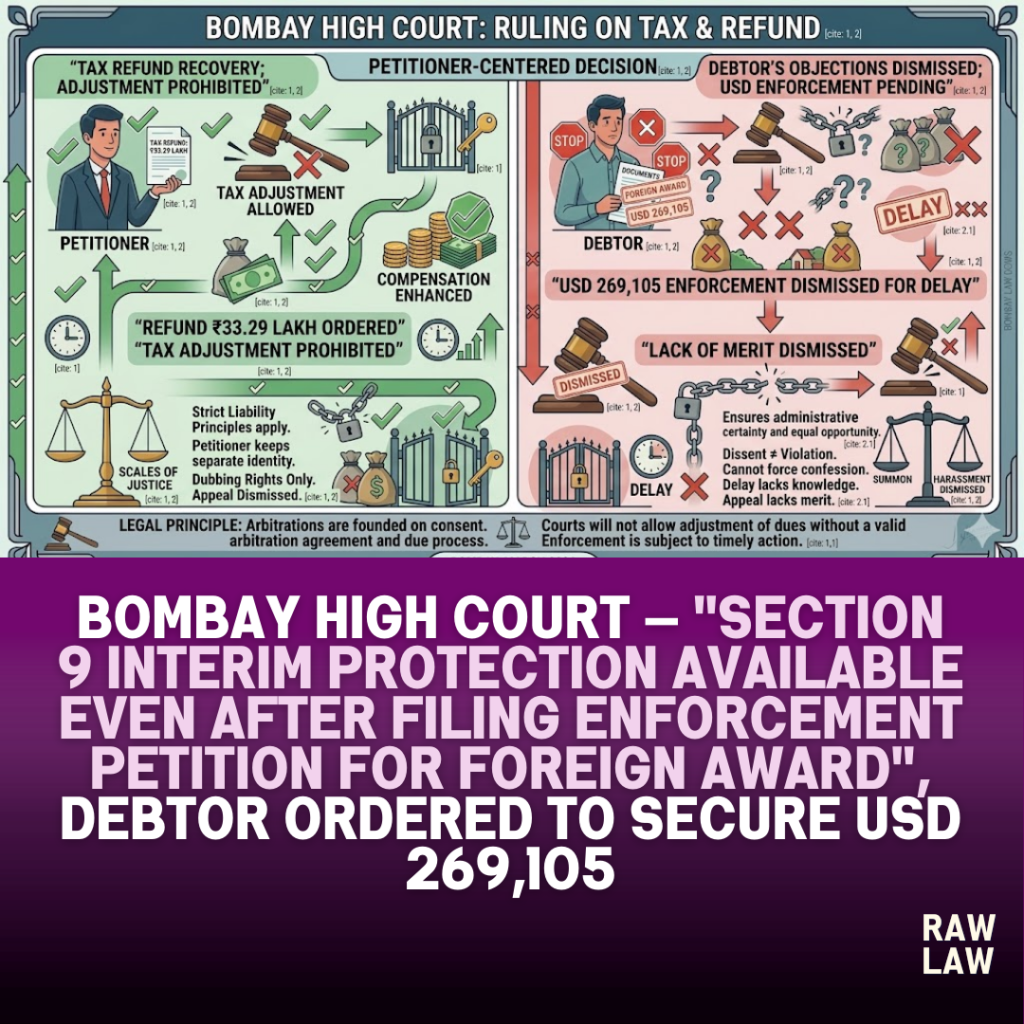
The Bombay High Court ruled that the jurisdiction of courts to grant interim measures under Section 9 of the Arbitration and Conciliation Act continues to remain available even after a petition is filed for enforcement of a foreign arbitral award under Part II of the Act.
The Court clarified that the filing of a recognition and enforcement petition does not automatically convert the foreign award into a decree. Until the court declares the award enforceable under Section 49, the award creditor may seek interim protection to prevent dissipation of assets.
Consequently, the Court ordered the respondent company to deposit the awarded amount of USD 269,105.08 in its Indian rupee equivalent with the court registry and imposed restrictions on disposal of its assets.
2. Facts
The dispute arose from a foreign arbitral award dated 23 March 2020 issued in favour of a shipping company. The award directed the respondent shipping company to pay USD 269,105.08.
To enforce the award in India, the award creditor initiated enforcement proceedings under Sections 47 and 48 of the Arbitration and Conciliation Act, which govern recognition and enforcement of foreign arbitral awards.
Simultaneously, the award creditor filed a petition under Section 9 of the Act, seeking interim measures to secure the award amount pending the outcome of enforcement proceedings.
The respondent company opposed the Section 9 petition on jurisdictional grounds. It argued that once enforcement proceedings under Part II had been initiated, recourse to Section 9 was no longer permissible.
3. Issues
The High Court was required to determine whether a party seeking enforcement of a foreign arbitral award can simultaneously invoke Section 9 of the Arbitration and Conciliation Act.
The core issue was whether filing a petition under Part II of the Act for recognition and enforcement of a foreign award automatically bars the jurisdiction of courts to grant interim measures under Section 9.
The Court also examined whether the filing of enforcement proceedings could be equated with execution proceedings, thereby limiting access to interim protection.
4. Petitioner’s arguments
The award creditor argued that Section 9 expressly permits courts to grant interim measures after the making of an arbitral award but before its enforcement.
It was submitted that foreign awards do not automatically become decrees in India. Instead, they require judicial recognition under Section 49 before they attain the status of a decree.
Therefore, until the court declares the award enforceable, the award creditor must have access to interim protection to prevent the award debtor from dissipating assets.
The petitioner further relied on judicial precedents holding that courts retain jurisdiction to grant protective measures to ensure that an arbitral award does not become a “paper award”.
5. Respondent’s arguments
The respondent argued that once enforcement proceedings under Part II of the Arbitration Act were initiated, Section 9 jurisdiction was no longer available.
According to the respondent, proceedings under Part II combine recognition, enforcement, and execution into a single proceeding. Therefore, invoking Section 9 simultaneously would create conflicting jurisdictions.
The respondent also relied on earlier judgments suggesting that once execution proceedings commence, courts should not entertain applications for interim protection.
On this basis, it was argued that the Section 9 petition was not maintainable.
6. Analysis of the law
The Court examined the statutory framework governing domestic and foreign arbitral awards under the Arbitration and Conciliation Act.
It noted that Section 9 allows parties to seek interim measures before or during arbitral proceedings and also after the award is made but before it is enforced.
The Court contrasted the enforcement regimes for domestic and foreign awards. A domestic arbitral award automatically becomes enforceable as a decree after the expiry of the time period for challenging it under Section 34.
Foreign awards, however, follow a different statutory pathway. They must first be recognized by the court under Part II before they acquire the status of a decree under Section 49.
7. Precedent analysis
The Court examined earlier Supreme Court decisions addressing the enforcement of foreign awards.
In previous rulings, the Supreme Court clarified that proceedings under Part II of the Arbitration Act involve recognition and enforcement of foreign awards but do not automatically convert them into decrees upon filing of the petition.
The Court also considered prior High Court decisions recognizing that interim protection may be necessary to safeguard the interests of award creditors during enforcement proceedings.
These precedents supported the view that interim measures can be granted even after an award is made.
8. Court’s reasoning
The High Court held that a foreign arbitral award does not automatically acquire the status of a decree merely upon filing an enforcement petition.
Instead, the court must first determine whether the award satisfies the conditions for enforcement under Section 48 of the Arbitration Act.
Only after this judicial determination does the award become enforceable as a decree under Section 49.
Therefore, until such recognition occurs, the statutory phrase in Section 9—“after the making of the arbitral award but before it is enforced”—remains applicable.
The Court concluded that denying interim protection during this period could defeat the purpose of arbitration by allowing award debtors to dissipate assets.
9. Conclusion
The High Court held that filing a petition for recognition and enforcement of a foreign arbitral award does not extinguish the jurisdiction of courts to grant interim relief under Section 9.
Accordingly, the Court rejected the respondent’s jurisdictional objection and granted interim protection in favour of the award creditor.
The respondent was directed to deposit USD 269,105.08 in its INR equivalent with the court registry and was restrained from alienating its assets until compliance.
10. Implications
The judgment clarifies the interplay between interim protection under Section 9 and enforcement of foreign awards under Part II of the Arbitration Act.
It confirms that courts can grant protective measures even after enforcement proceedings are filed, ensuring that award creditors are not left without remedies while recognition of the award is pending.
The decision strengthens India’s pro-arbitration jurisprudence by preventing award debtors from frustrating enforcement through asset dissipation during recognition proceedings.
Case Law References
1. Fuerst Day Lawson Ltd. v. Jindal Exports Ltd.
The Supreme Court held that enforcement proceedings for foreign awards involve recognition and execution within a single proceeding.
2. LMJ International Ltd. v. Sleepwell Industries Co. Ltd.
The Court clarified the scope of proceedings under Part II of the Arbitration and Conciliation Act concerning foreign awards.
3. Heligo Charters Pvt. Ltd. v. Aircon Feibars FZE
The Bombay High Court recognized the availability of interim measures in relation to foreign arbitral awards.
FAQs
1. Can courts grant interim relief after a foreign arbitral award is issued?
Yes. Courts may grant interim protection under Section 9 of the Arbitration and Conciliation Act even after the award is issued but before it is formally enforced.
2. When does a foreign arbitral award become a decree in India?
A foreign arbitral award becomes a decree only after the court recognizes it as enforceable under Section 49 of the Arbitration and Conciliation Act.
3. Why is interim protection important in arbitration enforcement?
Interim protection prevents award debtors from dissipating assets or frustrating enforcement while the court examines the validity of the foreign award.