


1. Court’s decision
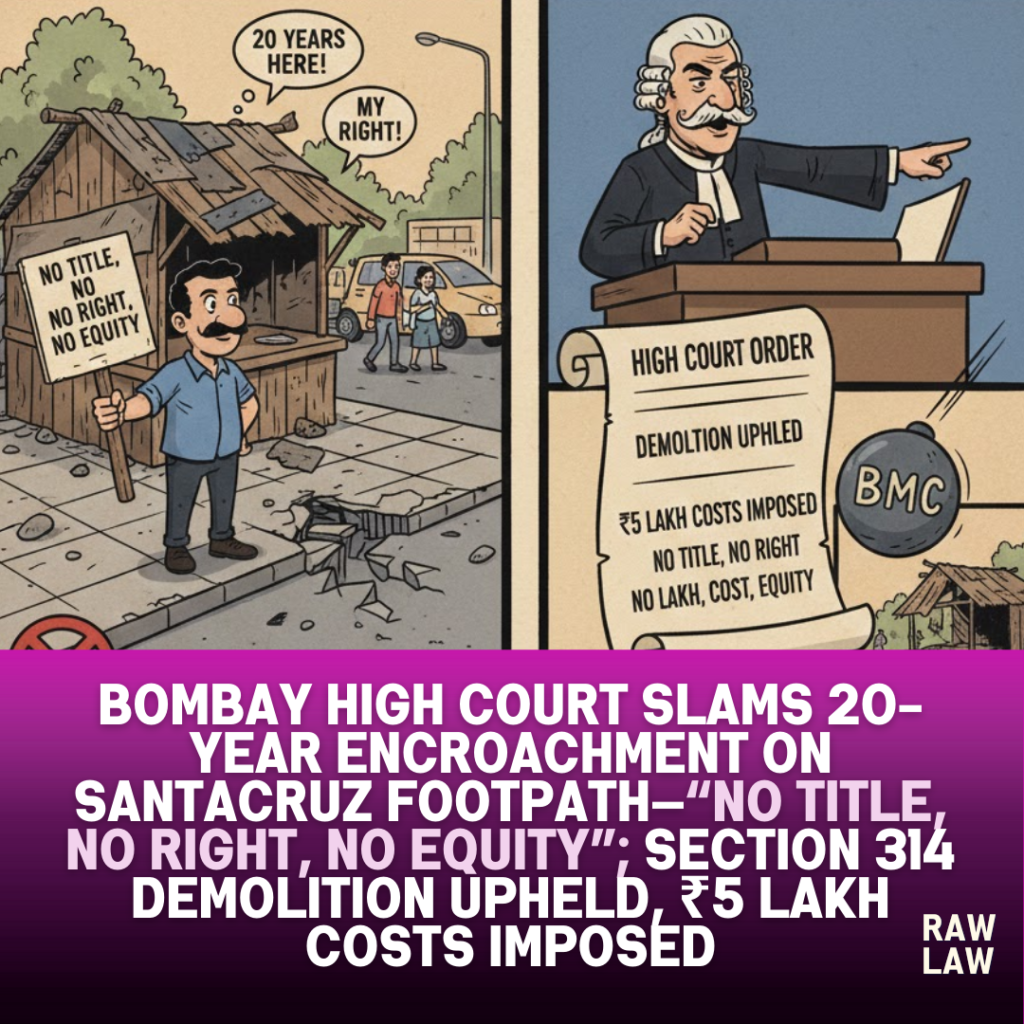
The Bombay High Court dismissed an Appeal From Order challenging the City Civil Court’s refusal to grant interim injunction against demolition of a roadside structure under Section 314 of the Brihanmumbai Municipal Corporation Act, 1888. The Court upheld the demolition notice and imposed exemplary costs of ₹5 lakh on the petitioner, directing payment to the Armed Forces Battle Casualties Welfare Fund.
It held that the structure was an unauthorised encroachment on a public street and that no equitable relief could be granted to a litigant who failed to establish lawful title or prior authorisation. The contempt petition was dismissed with a stern warning to municipal officers.
2. Facts
The petitioner claimed occupation of a shop structure on M.G. Road, Santacruz (West), Mumbai, allegedly purchased by her late father in 1986 under an unregistered agreement. The structure was used for running a video game parlour. Electricity bills, shop and establishment registration, and municipal tax assessments were relied upon to assert long-standing existence.
In July 2019, the Municipal Corporation issued a notice under Section 314 of the BMC Act seeking removal of the structure on the ground that it was situated on a public street and constituted obstruction. The petitioner filed a civil suit seeking injunction against demolition. The Trial Court rejected interim relief. The present appeal challenged that rejection and also raised contempt allegations regarding partial demolition during pendency.
3. Issues
The High Court considered:
• Whether the petitioner established any lawful right, title, or authorization over the suit structure.
• Whether Section 314 proceedings were validly invoked for removal of the structure from a public street.
• Whether payment of municipal taxes, electricity bills, or shop registration created any enforceable right.
• Whether the partial demolition during subsistence of interim protection amounted to contempt.
4. Petitioner’s arguments
The petitioner contended that the structure existed for decades and was not a hawker’s stall. She argued that Section 314 was wrongly invoked and that action, if any, should have been taken under Section 351 after due process. It was asserted that the structure was not situated on the road or nala and that the notice was vague and non-speaking.
Reliance was placed on electricity bills, non-agricultural tax payments, shop and establishment certificate, and the 1986 agreement. It was argued that long-standing possession entitled her to equitable protection. She also alleged that despite an interim order, part of the structure was demolished, warranting contempt action and restoration to original dimensions.
5. Respondent’s arguments
The Municipal Corporation argued that the structure was located on a municipal footpath forming part of a public street. It was unauthorised and obstructed traffic near Santacruz railway station.
It was contended that Section 314 empowers removal of encroachments on streets without notice. The petitioner had produced no sanctioned plans or permissions establishing lawful construction.
Regarding contempt, the Corporation admitted partial demolition during a broader anti-encroachment drive but explained it as inadvertent. Reconstruction was carried out after the Court’s order was brought to notice, and unconditional apology was tendered.
6. Analysis of the law
The Court emphasized that an unregistered agreement relating to public land confers no title or enforceable right. The document itself referred to transfer of “open space,” not any authorised structure.
It reiterated settled law that electricity bills, municipal tax assessments, and shop licences do not create or regularise title. Assessment to property tax does not convert an unauthorised structure into an authorised one.
The Court extracted Section 314, which empowers removal without notice of structures erected upon any street. Referring to Supreme Court precedent, it held that land acquired for public purposes constitutes a “public place” and encroachments thereon can be summarily removed.
The definition of “street” under Section 3(w) and “public street” under Section 3(x) was relied upon to hold that the structure fell squarely within municipal removal powers.
7. Precedent analysis
The Court relied on Dalip Singh v. State of Uttar Pradesh (2010) 2 SCC 114, holding that litigants who approach courts with suppression or misrepresentation are not entitled to equitable relief.
In Municipal Corporation of Greater Bombay v. Premnagar Zopadpatti Committee Society (1991 Supp (2) SCC 712), the Supreme Court held that encroachments on public land can be removed under Sections 313 and 314.
The Court also relied on Sidharam M. Yanagandul v. State of Maharashtra (2006 SCC OnLine Bom 971) and its affirmation in Laxmi Gopinath Shetye v. MHADA (2024:BHC-OS:4270), holding that property tax assessment does not regularise unauthorised construction.
The reliance placed by the petitioner on Sopan Maruti Thopte v. Pune Municipal Corporation (AIR 1996 Bom 304) was rejected as distinguishable, since that case concerned Section 351 proceedings, not Section 314.
8. Court’s reasoning
The Court held that the petitioner had “no title, no right, no equity.” Long-standing illegal occupation cannot ripen into lawful entitlement. Permitting continued protection would send a dangerous signal encouraging encroachment.
It observed that the petitioner retained possession for over six years after issuance of notice, thereby deriving benefit from illegality. Courts cannot reward such conduct.
On contempt, while the Corporation’s explanation of inter-departmental miscommunication was termed unsatisfactory, reconstruction and unconditional apology were considered sufficient to close proceedings with a warning.
The Court further directed the Municipal Commissioner to conduct inquiry into prolonged inaction that allowed the structure to subsist for over two decades, stressing municipal accountability.
9. Conclusion
The Appeal was dismissed with costs of ₹5 lakh payable to the Armed Forces Battle Casualties Welfare Fund. The Trial Court’s order refusing injunction was upheld. Interim relief stood vacated. The contempt petition was dismissed with warning.
The Court rejected the petitioner’s request for stay, holding that no case for protection of an unauthorised structure was made out.
10. Implications
This ruling reinforces the strict judicial approach toward encroachments on public streets in Mumbai. It reiterates that:
• Long possession does not legitimise illegality.
• Tax payments and licences do not create title.
• Section 314 empowers summary removal of street encroachments.
• Courts will impose exemplary costs in abuse of process cases.
The judgment also sends a parallel message to municipal authorities: prolonged inaction enabling encroachments may invite accountability measures.
Case Law References
- Dalip Singh v. State of Uttar Pradesh (2010) 2 SCC 114 – Relief denied to litigants approaching with suppression or misrepresentation.
- Municipal Corporation of Greater Bombay v. Premnagar Zopadpatti Committee Society (1991 Supp (2) SCC 712) – Encroachments on public land removable under Sections 313 & 314.
- Sidharam M. Yanagandul v. State of Maharashtra (2006 SCC OnLine Bom 971) – Tax assessment does not regularise unauthorised structure.
- Laxmi Gopinath Shetye v. MHADA (2024:BHC-OS:4270) – Affirmed that assessment does not confer legality.
- Sopan Maruti Thopte v. Pune Municipal Corporation (AIR 1996 Bom 304) – Distinguished.
FAQs
1. Does paying property tax or electricity bills make an illegal structure legal?
No. Courts have consistently held that tax assessment or utility connections do not regularise unauthorised construction.
2. Can the Municipal Corporation demolish structures on a footpath without notice?
Yes. Under Section 314 of the BMC Act, structures erected on public streets can be removed without notice.
3. Can long possession protect an encroachment?
No. Long-standing illegal occupation does not create title or equitable right against statutory removal action.