


Court’s decision
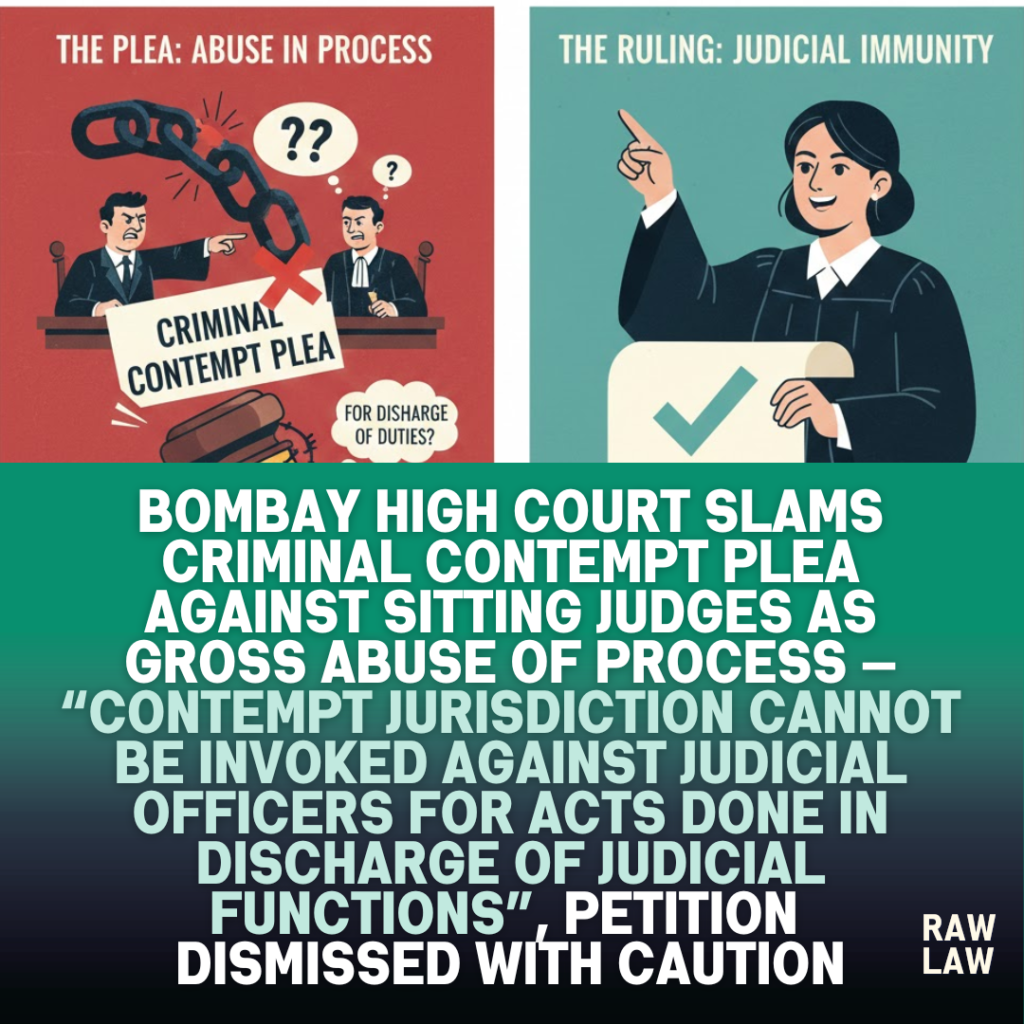
The Bombay High Court dismissed a criminal contempt petition filed against a sitting and a former Additional Sessions Judge, holding that the petition was wholly misconceived and constituted a gross abuse of the process of law. The Division Bench ruled that contempt jurisdiction under the Contempt of Courts Act, 1971 cannot be invoked against judicial officers for acts performed in discharge of their judicial duties. The Court cautioned the petitioner against instituting frivolous proceedings in the future and directed that a copy of the order be forwarded to the courts handling the pending matters involving the petitioner.
Facts
The petitioner, appearing in person, is a teacher and social worker who is currently facing trial in a criminal case before the Additional Sessions Court at Panvel. The trial arises from offences registered under provisions of the Scheduled Castes and Scheduled Tribes (Prevention of Atrocities) Act, 1989, along with multiple sections of the Indian Penal Code and the Maharashtra Police Act.
In addition to the criminal proceedings, a civil dispute relating to immovable property is pending between the petitioner and the original informant. Transfer applications and writ proceedings are also pending before the High Court in connection with the criminal matter.
The grievance in the criminal contempt petition was directed against judicial orders passed by the trial court. The petitioner alleged that the trial court failed to consider his contention regarding a forged caste certificate submitted by the informant and claimed that such inaction prejudiced his defence and resulted in denial of a fair trial.
Issues
The central issue before the High Court was whether contempt jurisdiction can be invoked against judicial officers for acts performed in the discharge of their judicial functions.
A secondary issue concerned whether allegations of denial of a fair trial, arising from adverse judicial orders, could justify initiation of criminal contempt proceedings against presiding judges.
The Court also examined whether the contents and tenor of the petition amounted to interference with the administration of justice and an attempt to browbeat judicial officers.
Petitioner’s arguments
The petitioner contended that the concerned judicial officers had willfully disobeyed legal norms, obstructed justice, and undermined the dignity of the court. He sought initiation of criminal contempt proceedings and further prayed that judicial assignments entrusted to one of the judicial officers be withheld. The petition also requested disciplinary action and an inquiry into alleged fabrication and tampering of court records. According to the petitioner, the failure of the trial court to take cognizance of the alleged forged caste certificate caused prejudice to his defence and resulted in denial of a fair trial. He framed the issue as one affecting the integrity of the justice delivery system and sought intervention in the interest of justice.
Respondent’s arguments
There was no representation on behalf of the respondents at the time of hearing. However, the High Court examined the maintainability and substance of the petition on its own assessment. The Court scrutinized the pleadings and evaluated whether any material existed to justify invocation of criminal contempt jurisdiction against judicial officers acting within the scope of their judicial duties.
Analysis of the law
The High Court emphasized that contempt jurisdiction under the Contempt of Courts Act, 1971 is a special jurisdiction meant to protect the authority of courts and ensure the proper administration of justice. It is not a mechanism to challenge or penalize judicial officers for passing orders in the course of adjudication.
Judicial orders are subject to appellate or revisional scrutiny under statutory remedies. If a litigant is aggrieved by an adverse order, the proper course is to approach the competent appellate or revisional forum. Contempt proceedings cannot be used as a substitute for appeal, revision, or review.
The Court made it clear that invoking criminal contempt against judges for judicial acts strikes at the independence of the judiciary. Permitting such proceedings would expose judicial officers to harassment and pressure from disgruntled litigants, thereby undermining the administration of justice.
Precedent analysis
While the order did not cite specific judicial precedents, it rested on settled principles governing contempt jurisdiction and judicial immunity for acts performed in judicial capacity.
Indian jurisprudence consistently holds that judges cannot be subjected to contempt proceedings for passing judicial orders, even if those orders are alleged to be erroneous. The appropriate remedy lies in statutory appellate mechanisms. The High Court reaffirmed this settled position by reiterating that contempt jurisdiction cannot be invoked against judicial officers for acts done in discharge of their judicial functions.
The ruling reinforces the established doctrine that judicial independence requires insulation from retaliatory proceedings initiated by dissatisfied litigants.
Court’s reasoning
Upon perusal of the petition, the High Court found the allegations to be wholly unfounded, reckless, and lacking in substance. The Court observed that the petitioner’s grievance stemmed from adverse judicial orders and dissatisfaction with how his applications were handled during trial.
The Bench noted that merely because a court passes an order adverse to a litigant, it cannot furnish grounds for initiating proceedings against judicial officers. The tenor and contents of the petition indicated an apparent attempt to browbeat the concerned judges.
The Court further held that such conduct amounts to interference with and obstruction of the administration of justice. It observed that the petition appeared calculated to malign the reputation of judicial officers and undermine public confidence in the judicial system.
Although the matter was considered fit for imposition of exemplary costs and even initiation of contempt proceedings against the petitioner, the Court refrained from doing so considering that he appeared in person. Nonetheless, a clear caution was issued that future frivolous or misconceived proceedings would invite appropriate action, including contempt.
Conclusion
The Bombay High Court unequivocally dismissed the criminal contempt petition, holding that contempt jurisdiction cannot be invoked against judicial officers for acts done in discharge of their judicial functions. The Court characterized the petition as a gross abuse of the process of law and a calculated attempt to interfere with the administration of justice.
While exercising restraint by not imposing costs or initiating action against the petitioner, the Court issued a stern warning against future misuse of judicial process. The order reinforces the sanctity of judicial independence and affirms that adverse judicial orders must be challenged through appropriate statutory remedies, not through contempt petitions.
Implications
This ruling has significant implications for the misuse of criminal contempt jurisdiction and the protection of judicial officers from harassment. The judgment strengthens the principle that judicial independence cannot be compromised by disgruntled litigants attempting to intimidate judges through criminal contempt petitions.
For litigants, the message is clear: dissatisfaction with trial court orders must be addressed through appeal, revision, or other statutory remedies. Contempt jurisdiction is not an alternative dispute resolution mechanism.
The decision also serves as a cautionary precedent against frivolous litigation aimed at undermining public confidence in the judiciary. By firmly rejecting the petition while exercising measured restraint, the Bombay High Court has struck a balance between judicial authority and procedural fairness.
Case Law References
The judgment did not cite specific precedents. However, it relied on settled principles of contempt jurisprudence:
- Judicial officers are immune from contempt proceedings for acts performed in discharge of judicial functions.
- Adverse judicial orders must be challenged through statutory appellate or revisional remedies.
- Contempt jurisdiction cannot be used as a substitute for appeal or as a tool to intimidate judges.
- Frivolous proceedings that attempt to browbeat judicial officers may themselves amount to interference with administration of justice.
The present Court applied these principles to hold the petition wholly misconceived and dismissed it accordingly.
FAQs
1. Can a judge be subjected to criminal contempt for passing an adverse judicial order?
No. The Bombay High Court has clarified that contempt jurisdiction cannot be invoked against judicial officers for acts done in discharge of their judicial functions. If a party is aggrieved by a judicial order, the remedy lies in appeal or revision.
2. What is the proper remedy if a litigant believes a trial court denied a fair trial?
The appropriate course is to challenge the order before a competent appellate or revisional court under the statutory framework. Filing a criminal contempt petition against the judge is not a legally permissible remedy.
3. Can filing a frivolous contempt petition lead to action against the petitioner?
Yes. The Court observed that such conduct may amount to interference with administration of justice. Although no action was taken in this case, the petitioner was cautioned that future frivolous proceedings could invite contempt action.