


Court’s decision
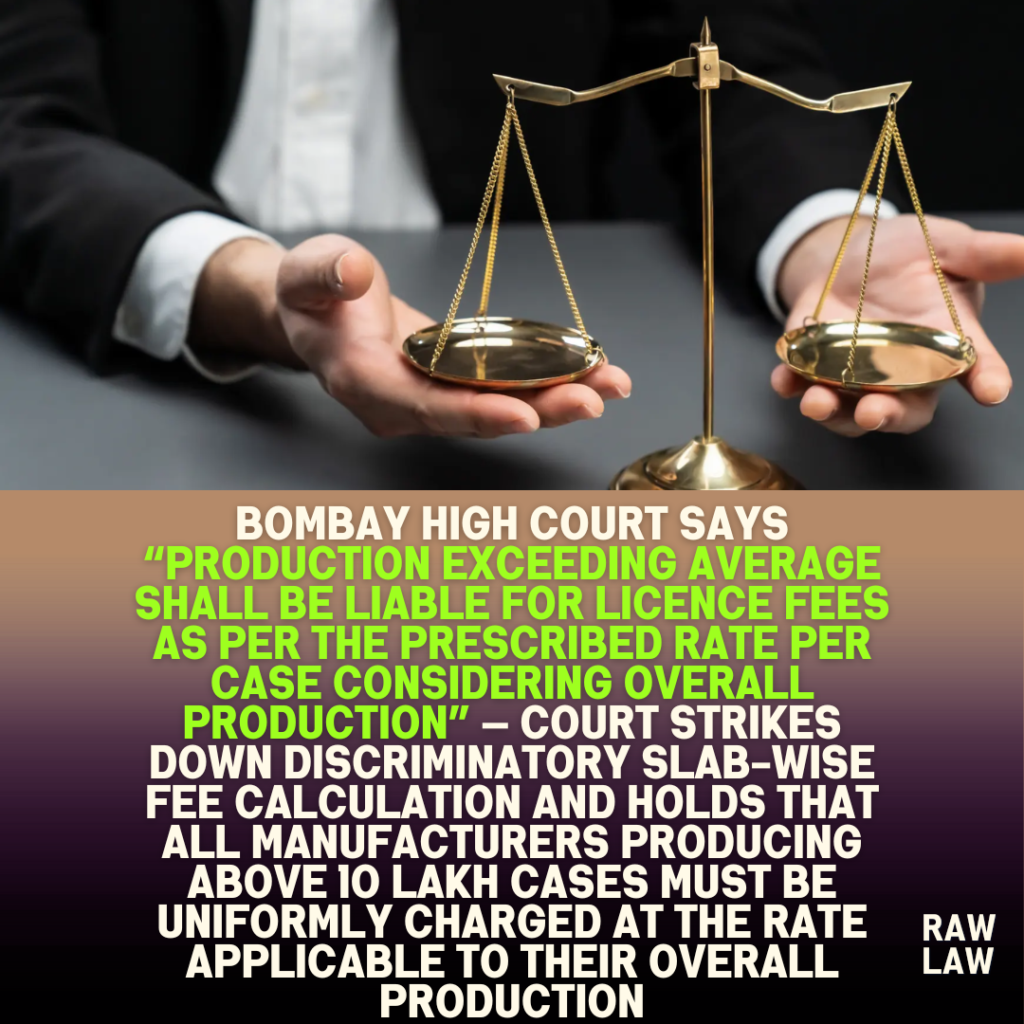
The Bombay High Court quashed the State’s order demanding additional licence fees from the Petitioner by applying a slab-wise calculation system. The Court held that the Notification governing CL-1 licence fees for 2016–17 required all manufacturers producing more than 10 lakh cases to be charged a uniform rate of Rs. 7 per case, irrespective of their preceding three-year average. The Court found that the State’s decision to treat the Petitioner differently from all other licence holders with comparable production volumes amounted to arbitrary and unequal treatment violative of Article 14.
The Court noted that the Notification explicitly required fees for production exceeding the three-year average to be determined based on the “rate per case considering overall production,” which did not permit any slab-wise differentiation. The Court relied on the express language of the Notification and the State’s own RTI disclosures showing that every other licensee producing more than 10 lakh cases in 2016–17 was charged uniformly at Rs. 7 per case. This demonstrated that the Petitioner was the sole manufacturer subjected to discriminatory treatment.
As a result, the Court set aside the Impugned Order, directed the State to refund or credit excess amounts, and clarified that interest on the refund would be payable at the applicable statutory rate. The writ petition was allowed, and Rule made absolute.
Facts
The Petitioner held a CL-1 licence for manufacturing country liquor. For 2016–17, licence fees were payable in advance based on the average production of the preceding three years. The Petitioner’s three-year average was 8,41,775 cases, so the licence was renewed at Rs. 10 per case, totalling Rs. 84,17,750. During the year, production increased beyond 10 lakh cases, leading the Petitioner to notify the authorities that fees should be calculated at Rs. 7 per case based on overall production. By year-end, the Petitioner produced 11,30,345 cases and sought a refund of Rs. 5,05,335 on the ground that the applicable rate was Rs. 7 per case.
The State rejected this interpretation and demanded Rs. 24,94,665 more, insisting on Rs. 10 per case for the first 10 lakh cases and Rs. 7 per case thereafter. A show-cause notice threatened cancellation of the licence. The Petitioner contested the demand, asserting that the Notification required charging the per-case rate applicable to overall production, not a slab-wise computation.
Issues
- Whether the Notification mandated a slab-wise licence-fee structure or required application of a uniform rate per case based on overall production.
- Whether differential treatment of the Petitioner, despite similar production levels as other licence holders, violated Article 14.
- Whether the State was justified in demanding additional fees based solely on the Petitioner’s lower three-year average.
Petitioner’s arguments
The Petitioner argued that the Notification required payment of licence fees “as per the prescribed rate per case considering overall production” whenever production exceeded the preceding three-year average. The Petitioner asserted that this language precluded any slab-wise calculation. It further argued that all other manufacturers producing more than 10 lakh cases during 2016–17 were charged uniformly at Rs. 7 per case, as confirmed through RTI disclosures. The Petitioner maintained that singling it out for differential treatment solely because its earlier average was below 10 lakh cases was arbitrary, irrational, and unconstitutional. It contended that a licence fee is a charge for the privilege of manufacturing liquor for the relevant year, making actual production the only legitimate basis for fee calculation.
Respondent’s arguments
The State argued that the Petitioner fell into a different category because its three-year average production was below 10 lakh cases. It submitted that licence fees for existing licensees were tied to the average and that only the excess over the average should be charged at the slab-wise per-case rate. The State contended that charging all producers at a flat rate might have been an error and could not be used to claim equality in illegality. It insisted that the Petitioner was liable to pay Rs. 10 per case for production up to 10 lakh cases and Rs. 7 per case thereafter, citing the table in the Notification as the source of this layered structure.
Analysis of the law
The Court interpreted the Notification through a literal and purposive lens. It observed that for existing licence holders, advance fees were tied to the three-year average, but adjustments for excess production were governed by the explicit mandate that production exceeding the average be charged “as per the prescribed rate per case considering overall production.” The Court held that this phrase did not contemplate a slab-wise computation. It required authorities to determine which rate applied to the total production and then apply that rate uniformly.
The Court noted that if overall production was under 2 lakh cases, the flat fee of Rs. 20 lakhs applied; if between 2 lakh and 10 lakh cases, the rate was Rs. 10 per case; and if above 10 lakh cases, the rate was Rs. 7 per case. This structure, the Court observed, aligned with the State’s consistent practice for all other similarly situated manufacturers. Thus, the State’s deviation in the Petitioner’s case violated the uniformity embedded in the Notification.
Precedent analysis
The Court invoked general Article 14 principles, reiterating that the State cannot discriminate between persons belonging to the same class unless an intelligible differentia exists and bears rational nexus to the object sought to be achieved. It also referenced settled law distinguishing licence fees from taxation, explaining that licence fees must be grounded in reasonableness and policy rather than arbitrary discrimination.
Although the judgment did not rely on named precedents extensively, the Court applied foundational administrative-law principles requiring consistent application of statutory instruments and prohibiting disparate treatment without express statutory basis.
Court’s reasoning
The Court held that the State’s attempt to impose slab-wise fees lacked support in the Notification and contradicted its own treatment of all other manufacturers who produced above 10 lakh cases during 2016–17. The Court found that the only reason the Petitioner was treated differently was its lower three-year average before the start of the year; however, the Notification did not authorize such differentiation.
The Court emphasized that the privilege conferred by a CL-1 licence pertains to actual production during the licence year, making overall production the proper determinant of the fee. The slab system suggested by the State was neither contemplated by the Notification nor consistently implemented. Consequently, the Impugned Order was deemed arbitrary, irrational, and unconstitutional, warranting judicial interference.
Conclusion
The writ petition was allowed, and the Impugned Order was quashed. The Court directed the State to refund or credit any excess amount collected from the Petitioner and clarified that any refund would carry interest at the applicable statutory rate. The Court held that uniformity in applying the Notification was essential to maintain fairness, and the State could not single out one manufacturer without statutory justification.
Implications
This judgment has wide consequences for all industries governed by production-based licensing frameworks. It reinforces that the State must apply fee-determining notifications uniformly and cannot create implied categories absent legislative authorization. For the liquor industry, the ruling confirms that actual production—not historical averages—determines applicable fees once production exceeds the threshold. For administrative law, the decision strengthens Article 14 scrutiny and signals that inconsistent application of fiscal or licensing notifications is vulnerable to judicial review.