


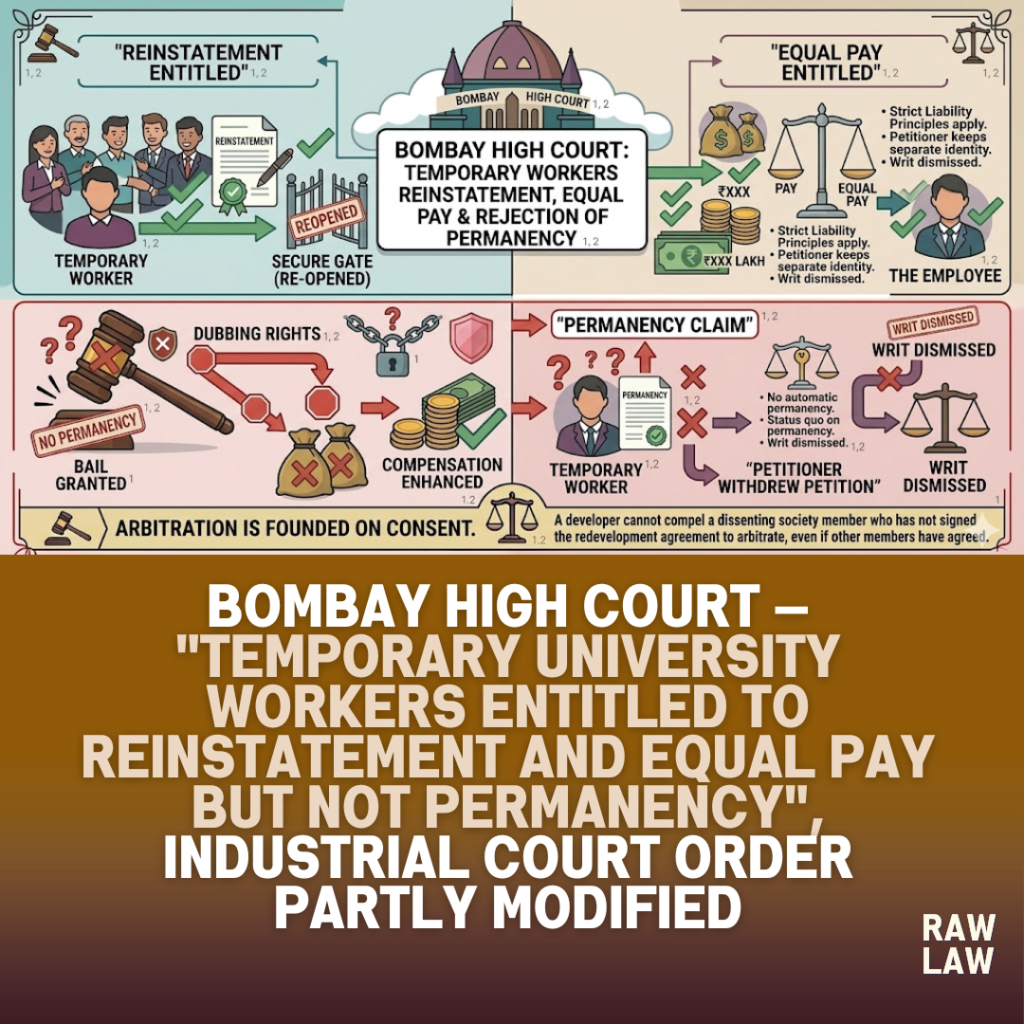
1. Court’s decision
The Bombay High Court partly upheld the Industrial Court’s findings against the University of Mumbai in a dispute involving temporary workers who alleged unfair labour practices.
While affirming the direction for reinstatement and recognition of unfair labour practice, the Court modified certain monetary directions granted by the Industrial Court. It held that reinstatement of temporary employees cannot be equated with permanency or regularization of service.
The Court therefore sustained the finding of unfair labour practice and the direction for reinstatement, but interfered with the order granting salary in the lowest grade from the date of initial appointment.
2. Facts
The dispute arose when a group of temporary workers engaged by the University of Mumbai across several posts such as peons, clerks, drivers, laboratory assistants, and data entry operators alleged unfair labour practices.
The workers had been employed on temporary engagements that were periodically extended. Many of them had worked for years in the university.
While they were preparing to file a complaint seeking permanency and equal wages, the university issued a circular discontinuing their services.
The workers subsequently filed a complaint before the Industrial Court under the Maharashtra Recognition of Trade Unions and Prevention of Unfair Labour Practices Act, alleging that the termination was intended to frustrate their claim for permanency and equal pay.
3. Issues
The High Court examined several legal issues arising from the dispute.
First, whether the Industrial Court had jurisdiction to entertain the complaint and grant relief of reinstatement.
Second, whether discontinuation of the workers’ services constituted unfair labour practice under labour law.
Third, whether the workers were entitled to reinstatement and wage parity with permanent employees.
Fourth, whether the Industrial Court was justified in directing payment of salary in the lowest grade from the dates of initial engagement.
4. Petitioner’s arguments
The university argued that the Industrial Court had committed serious errors in granting reinstatement and wage benefits.
It was contended that the workers were engaged on temporary or fixed-term appointments and had no right to continue in service after the expiry of their tenure.
The university also argued that it lacked authority to create posts without sanction from the State Government, and therefore reinstatement would force the institution to retain employees in non-sanctioned positions.
Additionally, it was argued that the Industrial Court lacked jurisdiction over issues relating to termination and reinstatement, which should fall within the jurisdiction of other forums under university legislation.
5. Respondent’s arguments
The workers argued that the university had engaged in unfair labour practices by employing them as temporary workers for long periods while denying them the status and benefits of permanent employees.
They contended that their services were abruptly discontinued only after they initiated legal proceedings seeking regularization and equal pay.
According to the workers, the termination was a retaliatory measure designed to defeat their legal claims.
They also submitted that they had worked for several years performing the same duties as regular employees but were paid significantly lower wages.
6. Analysis of the law
The High Court examined the provisions of the MRTU and PULP Act relating to unfair labour practices.
It noted that employing workers as temporary employees for extended periods to deny them benefits of permanency can amount to unfair labour practice.
However, the Court also emphasized that reinstatement of temporary workers does not automatically lead to regularization of their services.
The Court clarified that labour courts may grant reinstatement or wage parity as remedial measures, but such relief does not confer permanent employment status.
7. Precedent analysis
The Court relied on Supreme Court decisions dealing with reinstatement and back wages in labour disputes.
It referred to precedents holding that reinstatement of daily wage or temporary workers does not automatically result in regularization.
The Court also relied on judgments clarifying that claims for arrears of wages are subject to limitation principles, even where the underlying grievance constitutes a continuing or recurring wrong.
These precedents guided the Court in modifying the Industrial Court’s monetary directions.
8. Court’s reasoning
The Court found that the discontinuation of the workers’ services had been carried out without complying with statutory safeguards under labour law.
No notice, compensation, or retrenchment procedure was followed before terminating their services.
The Court also noted that many other temporary workers continued to work in the university, indicating discriminatory treatment against the complainants.
These factors justified the Industrial Court’s direction for reinstatement.
However, the High Court held that the Industrial Court erred in directing payment of salary in the lowest grade from the date of initial engagement.
Such a direction ignored limitation principles and could result in recovery of wages for periods far beyond permissible limits.
9. Conclusion
The High Court concluded that the Industrial Court was correct in holding the university guilty of unfair labour practice and directing reinstatement of the workers.
However, the monetary directions required modification because they granted wage benefits in a legally unsustainable manner.
The Court therefore partly allowed the university’s petitions, upheld the finding of unfair labour practice and reinstatement, but interfered with the direction granting wages in the lowest grade from the dates of joining.
10. Implications
The judgment reinforces important principles in labour law relating to temporary employment in public institutions.
It highlights that long-term engagement of temporary workers without granting statutory benefits can constitute unfair labour practice.
At the same time, the ruling clarifies that reinstatement does not automatically result in regularization or permanency of service.
The decision also underscores that monetary claims for arrears must comply with limitation rules even in cases involving recurring labour law violations.
Case Law References
1. State of Gujarat v. Thakor Hathaji Mohanji
The Supreme Court held that reinstatement of a daily wage worker does not amount to regularization of service.
2. M.R. Gupta v. Union of India
The Court clarified that salary disputes involving incorrect pay fixation may constitute recurring causes of action but recovery of arrears remains subject to limitation.
3. Union of India v. Tarsem Singh
The Supreme Court held that in cases of recurring salary claims, relief for arrears should normally be restricted to three years.
4. Deepali Gundu Surwase v. Kranti Junior Adhyapak Mahavidyalaya
The Court held that reinstatement following illegal termination may justify grant of back wages as a natural consequence.
FAQs
1. Does reinstatement of temporary workers mean they become permanent employees?
No. Courts have clarified that reinstatement does not automatically result in permanency or regularization of service.
2. What is an unfair labour practice in employment law?
Unfair labour practice includes actions such as employing workers as temporary employees for long periods to deny them benefits available to permanent employees.
3. Can workers claim salary arrears from the date they first joined employment?
Generally no. Courts apply limitation principles, meaning arrears can usually be claimed only for a limited period, often up to three years prior to the legal claim.