


Court’s decision
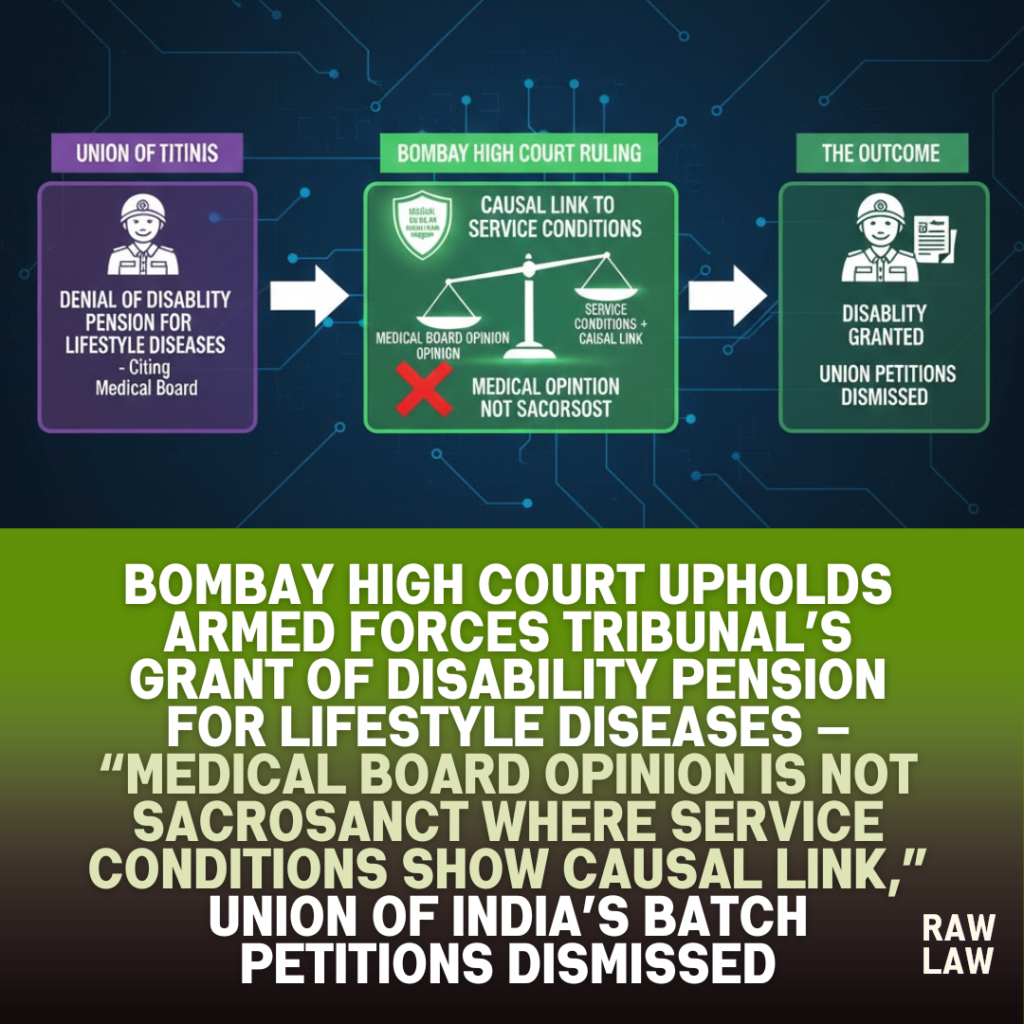
The Bombay High Court has dismissed a large batch of writ petitions filed by the Union of India challenging orders of the Armed Forces Tribunal granting disability pension to retired Army and Navy personnel suffering from ailments such as diabetes mellitus, hypertension, obesity, hearing loss, leukemia, and other non-battle disabilities. The Court held that the opinion of the Medical Board is not conclusive or immune from judicial scrutiny and that where service records, deployment history, and surrounding circumstances establish attributability or aggravation by military service, disability pension cannot be denied merely by branding diseases as “constitutional” or “lifestyle-related.” The Court upheld the Tribunal’s findings and refused to interfere.
Facts
The batch of petitions arose from multiple orders passed by the Armed Forces Tribunal, Mumbai, allowing original applications filed by retired Army and Navy personnel. In these cases, the respondents had either been invalided out of service or released in low medical category on superannuation, premature retirement, or completion of tenure. The disabilities included diabetes mellitus, primary hypertension, dyslipidemia, obesity, bilateral hearing loss, panic disorder, ankylosing spondylitis, ulcerative colitis, chronic myeloid leukemia, and other ailments.
In the lead matter, a senior Army officer was prematurely retired in low medical category after over 23 years of service, including postings in high-altitude and operational areas such as Ladakh and participation in major military operations. The Release Medical Board acknowledged the onset of diabetes and hypertension during service but opined that diabetes was a constitutional disorder not connected with service, while hypertension was aggravated by service. Disability pension was denied by authorities but later granted by the Tribunal. Similar factual patterns existed across the connected cases.
Issues
The central issues before the High Court were whether the Armed Forces Tribunal could interfere with the opinion of Medical Boards in disease-related disability pension cases, whether the Pension Entitlement Rules, 2008 curtailed the presumption in favour of servicemen compared to the earlier regime, and whether diseases commonly described as lifestyle or constitutional ailments could be held attributable to or aggravated by military service. The Court also examined whether the Tribunal erred in granting rounding-off of disability percentage and disability pension to personnel released on superannuation or completion of tenure.
Petitioner’s arguments
The Union of India argued that under the Pension Entitlement Rules, 2008, disability pension is admissible only when a clear causal connection between service conditions and the disease is established. It was contended that diseases such as diabetes, hypertension, obesity, and cardiac ailments are lifestyle or constitutional disorders that commonly develop with age and cannot automatically be linked to military service. The Union submitted that the Medical Boards comprise trained experts whose opinions, once approved by higher medical authorities, are final and binding. It was further argued that many respondents were posted at peace stations when their diseases were detected and were not invalided out but retired normally, making them ineligible for disability pension. Reliance was placed on the absence of any statutory presumption under the 2008 Rules.
Respondents’ arguments
The retired personnel contended that none of them suffered from the disabilities at the time of entry into service and that their ailments developed after years of strenuous military duty. They emphasised prolonged exposure to stress, harsh climatic conditions, high-altitude postings, operational deployments, and exigencies of service. It was argued that the Medical Board’s opinion could not override contemporaneous service records and medical histories showing onset or aggravation during service. The respondents relied on consistent Supreme Court jurisprudence holding that denial of disability pension cannot rest solely on bald medical opinions without reasons. They further argued that the Tribunal had correctly applied the beneficial scheme of pension law.
Analysis of the law
The High Court undertook a detailed examination of the Pension Entitlement Rules, 2008, the earlier 1982 Rules, and the Navy Pension Regulations. It rejected the Union’s argument that the 2008 Rules narrowed eligibility, holding instead that the scheme continued to be welfare-oriented. The Court emphasised that while mere manifestation of a disease during service does not automatically establish attributability, the Rules expressly recognise aggravation of disease due to service conditions, including stress, operational duties, extreme climates, and high altitudes.
The Court noted that the Rules do not elevate the Medical Board’s opinion to an infallible status. Judicial review is permissible where the opinion is unsupported by reasons, ignores material service conditions, or contradicts service records.
Precedent analysis
The Court relied extensively on Supreme Court decisions such as Dharamvir Singh v. Union of India, which held that disability arising during service is presumed attributable unless the employer rebuts it with cogent evidence. The Court distinguished cases where claims were rejected due to long unexplained delays or absence of service nexus. It reaffirmed that rounding-off of disability percentage is permissible once disability pension is granted. The Tribunal’s approach, the Court held, was consistent with binding precedent and could not be termed perverse.
Court’s reasoning
Applying these principles, the High Court found that in most cases the Medical Boards had merely labelled diseases as “constitutional” without analysing the impact of service conditions, operational stress, or prolonged exposure. In contrast, the Tribunal had examined service profiles, postings, duration of service, and medical history before concluding that the disabilities were attributable to or aggravated by service.
The Court held that denying disability pension solely because a disease is common in the civilian population would defeat the beneficial object of pension laws. It further held that personnel released in low medical category on superannuation or completion of tenure are not excluded from disability pension if the disability is linked to service and assessed at 20% or more.
Conclusion
The Bombay High Court dismissed all the writ petitions filed by the Union of India and upheld the Armed Forces Tribunal’s orders granting disability pension and rounding-off benefits to the respondents. The Court held that no substantial error of law or jurisdictional infirmity was made out and that the Tribunal’s findings were based on evidence and settled legal principles.
Implications
This judgment is a significant reaffirmation of the pro-serviceman approach in disability pension jurisprudence. It clarifies that Medical Board opinions are not conclusive and that courts and tribunals must look beyond labels such as “lifestyle disease.” The ruling will have wide implications for pending and future disability pension claims, particularly those involving non-battle diseases, and strengthens the position of retired personnel seeking recognition of service-related health deterioration.
Case law references
- Dharamvir Singh v. Union of India: Held that disability arising during service is presumed attributable unless rebutted; applied to uphold Tribunal’s orders.
- Union of India v. Rajbir Singh: Recognised rounding-off of disability once pension is granted; relied upon implicitly.
- Sukhvinder Singh v. Union of India: Held that medical opinion without reasons cannot defeat disability pension; principles followed.
FAQs
Q1. Are Medical Board opinions final in disability pension cases?
No. Courts have held that Medical Board opinions are subject to judicial scrutiny and cannot override service records and surrounding circumstances.
Q2. Can diabetes or hypertension qualify for disability pension?
Yes, if it is shown that the disease arose during service or was aggravated by military service conditions.
Q3. Is disability pension available on superannuation?
Yes. Personnel retiring in low medical category on superannuation may be granted disability pension if the disability is attributable to or aggravated by service and assessed at 20% or more.