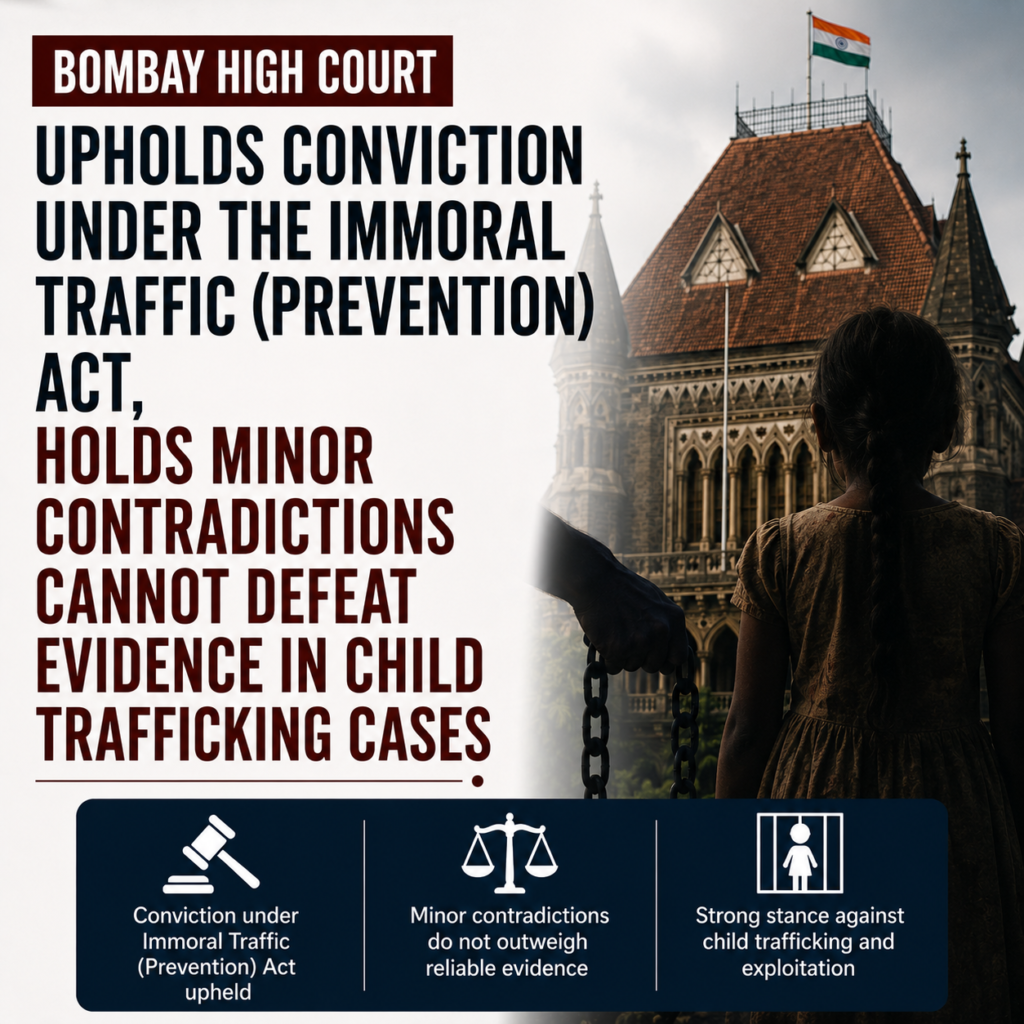
Bombay High Court Upholds Conviction in Minor Girls Trafficking Case; Holds PITA Presumption Applies When Victims Are Found With Accused in Brothel
Facts
The applicant, Smt. Rita Dilip Ghosh, filed a criminal revision challenging the order dated 7 April 2003 passed by the Additional Sessions Judge, Greater Mumbai, which had confirmed her conviction by the Metropolitan Magistrate, 18th Court, Girgaon, Mumbai. The applicant had been convicted under Section 6 of the Immoral Traffic (Prevention) Act, 1956 and sentenced to rigorous imprisonment for two years with a fine of ₹3,000/-. She had been acquitted of the offence under Section 41 of the Juvenile Justice Act, 1986.
The prosecution case was that on 26 August 1996, officers of D.B. Marg Police Station received information that a brothel was being run in Rele/Rai Building at S.V. Marg, Mumbai. Police officers called panch witnesses and conducted a raid. On the third floor of the building, two minor girls were found in one room with the applicant. The girls were rescued, the applicant was arrested, and she was later charge-sheeted.
The trial court convicted the applicant under Section 6 of PITA. The appellate court confirmed the conviction and sentence. The applicant then approached the High Court in revision.
Issues
The principal issue before the Bombay High Court was whether the conviction of the applicant under Section 6 of PITA was sustainable on the evidence on record.
The Court also considered whether the prosecution had proved that the rescued girls were minors, whether they were found with the applicant in a place used for prostitution, and whether the presumption under Section 6(2) of PITA stood attracted.
Another issue was whether alleged contradictions regarding the date of raid, delay in FIR, non-examination of victims, absence of ossification test, and alleged non-compliance with Section 15 of PITA were sufficient to interfere with concurrent findings of conviction in revisional jurisdiction.
Applicant’s Arguments
The applicant argued that the prosecution had failed to prove the allegations beyond reasonable doubt. It was submitted that there were material contradictions because the panch witness stated that she was called on 27 August 1996, whereas the police witnesses referred to the raid as having taken place on 26 August 1996.
The applicant further argued that the prosecution had failed to prove that a brothel was being run by her. It was also submitted that there was unexplained delay in registration of the FIR and contradictions between the evidence of police witnesses on that aspect.
The applicant contended that the medical officer had not conducted an ossification test to conclusively determine the age of the victims. It was further argued that the victims were not examined in court, and therefore an adverse inference ought to be drawn against the prosecution.
The applicant also argued that only a Special Police Officer could take action under PITA, and the prosecution had failed to prove the participation of ACP Gawali in the raid. It was submitted that the case was based on circumstantial evidence and did not satisfy the test laid down in Sharad Birdhichand Sarda v. State of Maharashtra.
Respondent’s Arguments
The State supported the conviction and sentence. It argued that both courts below had correctly appreciated the evidence and found the applicant guilty.
The State submitted that the alleged contradictions were minor and immaterial. According to the prosecution, information was received on 26 August 1996, but the raid and panchnama continued after midnight into 27 August 1996, which explained the reference to both dates.
The State further submitted that the victims could not be examined because they had been sent to their native places by the Juvenile Board. It was argued that the medical evidence clearly established that the victims were minors, and the evidence of the panch witness and police officers proved that the minor girls were found with the applicant in the premises.
The State also submitted that ACP Gawali, who was a Special Police Officer, was present during the raid and that this fact was proved through the evidence of PW-2.
Analysis of the Law
The Court held that offences under PITA, particularly involving minor victims, are serious offences against humanity and society. In such cases, victims are often traumatised and may not be in a position to depose in court. Therefore, minor contradictions in the evidence of prosecution witnesses cannot automatically be treated as fatal.
The Court examined Section 6(2) of PITA, which creates a presumption against a person found with a child in a brothel. Once foundational facts are proved, namely that the victim was a minor and was found with the accused in a brothel or place of prostitution, the statutory presumption operates unless rebutted by the accused.
The Court held that in the present case, the prosecution had proved the foundational facts through the evidence of the panch witness, police officers, panchnama and medical officer. The applicant did not lead evidence, did not enter the witness box, and her defence was one of total denial. Therefore, the presumption under Section 6(2) remained unrebutted.
Precedent Analysis
The Court considered Noor Aga v. State of Punjab, relied upon by the applicant to argue that foundational facts must be proved before a statutory presumption can apply. The Court held that this principle did not help the applicant because the prosecution had proved the foundational facts in the present case.
The Court distinguished Ganesh Bhavan Patel v. State of Maharashtra, holding that the delay in FIR in the present case was sufficiently explained. It also distinguished Mussauddin Ahmed v. State of Assam, observing that this was not a fit case to draw adverse inference merely because the victims were not examined.
The Court also considered P. Sasikumar v. State, Chandrappa v. State of Karnataka, and State of Madhya Pradesh v. Anoop Singh, but held that these decisions did not assist the applicant on facts.
On the scope of revision, the Court relied on K. Chinnaswamy Reddy v. State of Andhra Pradesh, which holds that revisional jurisdiction should be exercised only in exceptional cases involving glaring procedural defects, manifest errors of law, or miscarriage of justice. The Court found no such defect in the present case.
Court’s Reasoning
The Court found that PW-1, the panch witness, had identified the applicant and stated that two minor girls were found with her in the room. PW-2 and PW-3, the police officers, also supported the prosecution case and stated that the girls were rescued from the premises.
The Court rejected the alleged contradiction regarding dates. It held that information was received on 26 August 1996, and by the time the panch witnesses came and the third floor was searched, it was past midnight on 27 August 1996. Therefore, the references to both dates were consistent with the panchnama and did not damage the prosecution case.
On the issue of age, the Court relied on PW-4, the medical officer, who examined the victims and opined, based on physical examination, secondary sexual characteristics and X-rays, that the victims were about 13 to 14 years old. The Court rejected the argument that no ossification test was conducted, observing that ossification assessment is itself based on X-rays and medical opinion. Even after giving a margin of two years, the victims would still be minors.
The Court held that the evidence of PW-1, PW-2 and PW-3, read with the panchnama and medical evidence, established that the minor girls were found with the applicant in a place of prostitution. Therefore, the presumption under Section 6(2) of PITA applied with full force.
The Court also rejected the argument regarding non-participation of a Special Police Officer, noting that PW-2 had stated that ACP Gawali was present during the raid, and both courts below had accepted that evidence.
Conclusion
The Bombay High Court dismissed the criminal revision and upheld the concurrent findings of conviction and sentence against the applicant under Section 6 of PITA.
The Court held that the prosecution had proved that two minor girls were found with the applicant in a place of prostitution, and the statutory presumption under Section 6(2) of PITA was not rebutted. The alleged contradictions were held to be minor and insufficient to disturb the conviction in revisional jurisdiction.
The Court discharged the rule, cancelled the applicant’s bail bonds and sureties, and directed the trial court to take appropriate steps to secure the applicant’s presence in accordance with law.
Case Details
Case: Smt. Rita Dilip Ghosh v. State of Maharashtra
Court: Bombay High Court, Criminal Appellate Jurisdiction
Case Number: Revision Application No. 227 of 2003
Judge: Justice M. M. Sathaye
Date: 3 July 2026
Result: Criminal revision dismissed; conviction and sentence under Section 6 of PITA upheld; trial court directed to secure applicant’s presence.