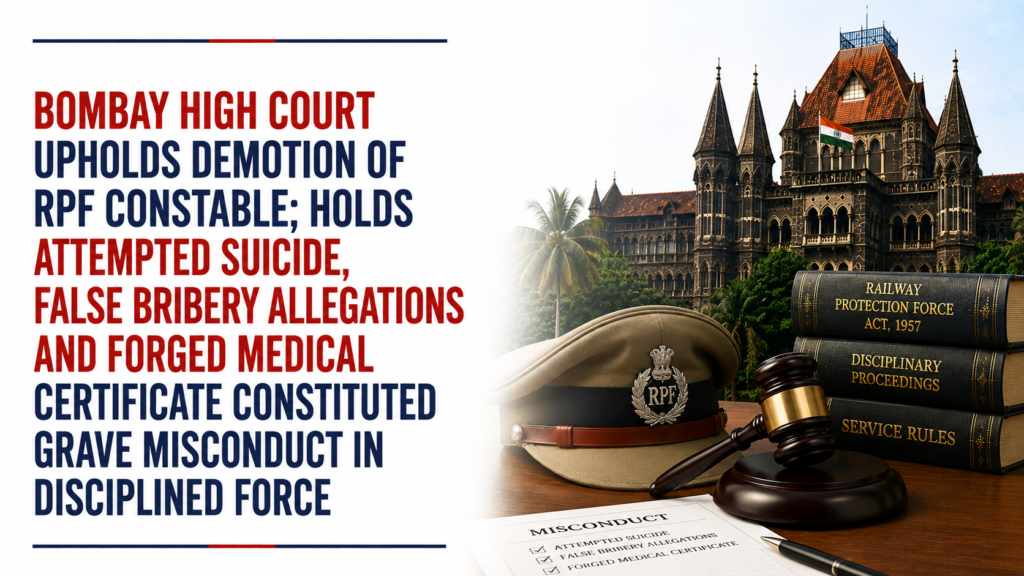
RPF Constable’s Demotion Upheld After Court Finds Suicide Threats Used to Pressure Authorities for Transfer
Facts
The petitioner, an RPF Constable, sought an inter-zonal transfer on the ground that his daughter suffered from severe asthma and required continuous care. According to him, his transfer request was repeatedly rejected because he refused to pay an alleged bribe of ₹1,50,000 demanded by a Head Constable and senior officers.
After his transfer request was rejected, the petitioner attempted suicide by consuming rat poison while on duty. He subsequently sent emails threatening suicide and accusing senior RPF officials of demanding bribes for processing his transfer.
The Railway Protection Force initiated disciplinary proceedings and issued a charge-sheet alleging, among other things, that the petitioner:
- attempted suicide while on duty;
- visited the Principal Chief Security Commissioner’s office without permission;
- submitted an invalid/forged medical certificate;
- attempted to pressurise the administration through suicide threats; and
- made false allegations of bribery against superior officers.
Following a departmental inquiry, the disciplinary authority reduced the petitioner to the lowest stage in Level-3 pay for five years with cumulative effect. His departmental appeals failed, leading him to invoke the writ jurisdiction of the Bombay High Court.
Issues
- Whether the departmental inquiry suffered from procedural illegality or violation of the RPF Rules.
- Whether the findings of misconduct recorded by the disciplinary authorities were supported by evidence.
- Whether the punishment of reduction in rank and salary for five years was disproportionate.
- Whether the High Court should interfere with concurrent findings of fact recorded in departmental proceedings.
Petitioner’s Arguments
The petitioner contended that:
- the disciplinary proceedings were initiated only as retaliation for his complaint alleging demand of a bribe for processing his transfer;
- the inquiry was conducted by an officer allegedly incompetent under the Railway Protection Force Rules, 1987;
- his allegations regarding corruption were genuine and had not been fairly investigated;
- the charges did not disclose misconduct warranting such a severe punishment; and
- the penalty of reduction in rank and salary was arbitrary and disproportionate.
Respondent’s Arguments
The Railway authorities argued that:
- the petitioner attempted suicide while on duty and later used suicide threats to pressure the administration into granting a transfer;
- he fabricated or tampered with a medical certificate submitted in support of his transfer request;
- he made false allegations of bribery without producing any evidence;
- the departmental inquiry was conducted in accordance with law and all five charges were proved;
- three departmental authorities had concurrently upheld the findings; and
- the punishment imposed was, if anything, lenient considering the gravity of misconduct committed by a member of an armed force.
Analysis of the Law
The High Court examined the disciplinary proceedings under the:
- Railway Protection Force Rules, 1987, particularly the provisions governing discipline and conduct of Force members;
- Railway Services (Conduct) Rules, 1966; and
- settled principles governing judicial review of departmental inquiries under Article 226 of the Constitution.
The Court reiterated that the scope of judicial review in disciplinary matters is limited. Where findings are based on evidence and no procedural illegality or perversity is demonstrated, the High Court will not act as an appellate authority to reassess evidence or substitute its own view regarding punishment.
The Court also emphasised that members of the Railway Protection Force, being part of an armed force of the Union, are expected to maintain the highest standards of discipline, mental resilience and integrity.
Precedent Analysis
The judgment primarily rests upon the application of settled principles governing:
- limited judicial review of departmental proceedings;
- deference to concurrent factual findings recorded by disciplinary authorities;
- proportionality of punishment; and
- the heightened standards of discipline expected from members of uniformed services.
The Court principally applied these established service law principles to the facts of the present case rather than undertaking an extensive discussion of judicial precedents.
Court’s Reasoning
The High Court found no reason to interfere with the departmental findings.
It observed that:
- all five charges framed against the petitioner had been held proved during a full-fledged departmental inquiry;
- the petitioner failed to produce evidence substantiating his allegations of bribery;
- the inquiry established that the petitioner attempted suicide while on duty and later used suicide threats as a means to exert pressure upon the administration;
- evidence also supported the finding that the petitioner had submitted an invalid medical certificate and visited superior offices without obtaining mandatory permission.
The Court gave significant weight to the concurrent findings recorded by the Inquiry Officer, the Disciplinary Authority and both Appellate Authorities.
Emphasising the special nature of the Railway Protection Force as a disciplined armed force, the Court held that personnel are expected to display exceptional discipline, mental strength and responsibility. Conduct such as attempting suicide during duty hours, threatening senior officers and making unsubstantiated corruption allegations seriously undermines discipline within the Force.
Accordingly, the Court held that the punishment of reduction to the lowest stage in Level-3 pay for five years with cumulative effect was neither arbitrary nor disproportionate.
Conclusion
The Bombay High Court dismissed the writ petition and upheld the disciplinary orders.
The Court held that the departmental inquiry was fairly conducted, the findings of misconduct were supported by evidence, and the punishment imposed was proportionate considering the petitioner’s conduct and the high standards of discipline expected from members of the Railway Protection Force. It therefore declined to interfere under Article 226 of the Constitution.
Case Details
Case: Brijesh Kumar v. Chairman, Railway Board & Others
Court: Bombay High Court
Case Number: Writ Petition No. 8000 of 2023
Judges: Justice G. S. Kulkarni and Justice Aarti Sathe
Date: 4 August 2026
Result: Writ Petition dismissed; departmental punishment reducing the petitioner’s pay to the lowest stage in Level-3 for five years with cumulative effect was upheld.