


1. Court’s decision
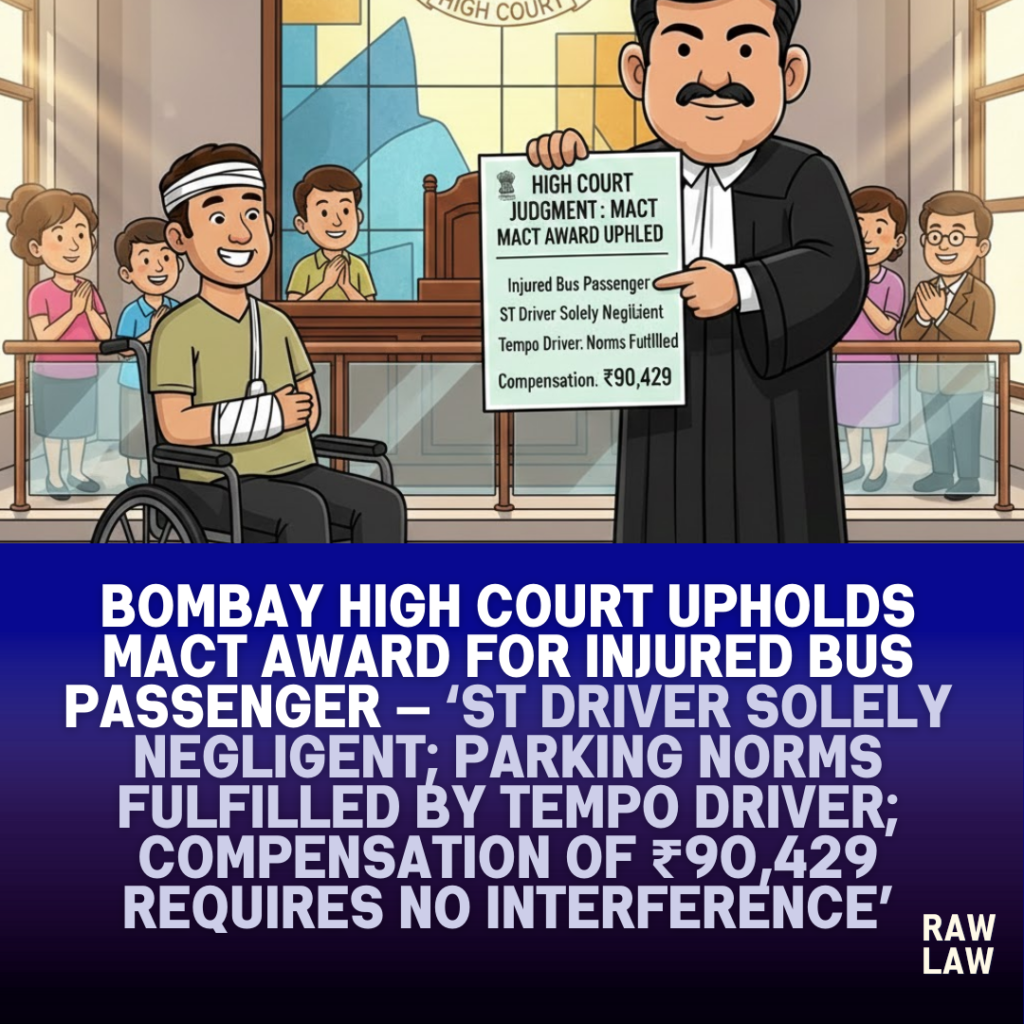
The Bombay High Court dismissed the appeal filed by the State Transport Corporation challenging a Motor Accident Claims Tribunal (MACT) award directing payment of ₹90,429 with 7% interest to an injured bus passenger. The Court held that the Tribunal’s findings—fixing negligence on the ST bus driver and rejecting allegations against the tempo driver—were well reasoned, evidence-based, and required no appellate interference. The Court also upheld the quantified compensation, emphasizing that medical bills, attendant expenses, special diet, and suffering were properly considered. The Court granted the claimant liberty to withdraw the deposited sum and directed the Corporation to pay the award within three weeks if not already deposited.
2. Facts
The respondent, a young professor, was traveling in an ST bus from Nashik to Pune at about 1:30 a.m. on 29 August 2017. Near Narayangaon, amidst light drizzle, the bus—moving at high speed—rammed into a stationary tempo parked at the roadside for puncture repair. The respondent suffered head injury with mild subarachnoid haemorrhage, a mandibular fracture, and a frontal sinus fracture. He underwent treatment at Siddhi Multispecialty Hospital and Apollo Hospital, incurring approximately ₹1,00,000 in expenses and enduring prolonged diet restrictions.
He filed a claim seeking ₹2,25,000 for pain, trauma, loss of income, medical expenditure, and incidental losses. MACT awarded him ₹90,429 with 7% interest, prompting the present appeal by the ST Corporation.
3. Issues
The High Court considered the following questions:
• Whether the MACT erred in holding the ST bus driver negligent.
• Whether the tempo driver was also negligent, warranting apportionment of liability.
• Whether the non-joinder of the tempo driver/owner rendered the claim defective.
• Whether the compensation of ₹90,429 was excessive or inadequately reasoned.
• Whether the Tribunal failed to consider the ST driver’s testimony properly.
4. Appellant’s arguments
The State Transport Corporation argued that the MACT ignored the driver’s testimony, which allegedly showed that the tempo had been parked in the middle of the road without indicators. The Corporation claimed the tempo driver’s negligence was the real cause of the accident and that he ought to have been impleaded as a party. The appellant insisted that failure to join the tempo owner/driver made the claim liable to dismissal. Further, the appellant argued that even if the ST driver was partly negligent, the principle of contributory negligence required apportionment. Consequently, the Corporation urged the Court to set aside or substantially modify the award.
5. Respondent’s arguments
Counsel for the injured claimant argued that the MACT judgment was comprehensive and correctly assessed negligence and compensation. He submitted that the tempo driver had fully complied with safety requirements—using indicators and placing stones—before repairing the puncture at the roadside. He emphasized that the ST driver was driving rashly at night in rainy conditions and failed to keep a proper lookout. The respondent maintained that all medical bills were genuine and unchallenged before MACT. The Tribunal had lawfully applied the preponderance of probabilities standard and awarded fair, not excessive, compensation.
6. Analysis of the law
The Court reiterated that motor accident claims are decided on the principle of preponderance of probabilities, not strict proof. The MACT had relied on multiple evidentiary components—spot panchanama, FIR, co-passenger statements, and the driver’s own deposition—and drawn a logical inference of negligence.
The High Court observed that the Road Regulations, 1989 (Section 15) require careful roadside parking, warning indicators, and visible safeguards. The Tribunal’s finding that the tempo driver complied with these requirements was supported by the FIR and panchanama. Conversely, the driver’s high speed, even in drizzle and at night, suggested lack of due care.
On non-joinder, the Court held that claim petitions are not defeated for failure to implead every potentially negligent party; what matters is whether the claimant established negligence by the offending vehicle.
7. Precedent analysis
The Tribunal had relied on two Supreme Court decisions—Chaus Taushif Amliya v. Memon Mahmmad Umar Anwarbhai (2020) and Kajal v. Jagdish Chand (2023)—which affirmed that medical expenses, attendant charges, special diet, and pain-and-suffering form legitimate components of compensation, to be assessed proportionately to the nature and duration of suffering.
The High Court found this reliance appropriate and held that MACT applied these principles faithfully. The Court also implicitly applied longstanding jurisprudence that appellate interference with MACT findings is limited and permissible only when findings are perverse or unsupported by evidence. Here, the findings were neither.
8. Court’s reasoning
The Court upheld MACT’s conclusion for several reasons:
• The spot panchanama corroborated the FIR and eyewitness accounts, showing the bus was speeding and collided despite the tempo being safely parked with warning indicators.
• The tempo’s condition—climbing the divider and tilting on the bus—demonstrated the force of impact, implying excessive speed.
• The ST driver’s negligence was sufficiently established; the MACT was right in giving greater evidentiary weight to physical evidence and co-passenger accounts.
• Contributory negligence was unsustainable because the tempo driver complied with all mandatory precautions.
• Compensation was logically arrived at using genuine medical bills, unchallenged by the Corporation.
The Court held that no perversity or legal infirmity existed to justify appellate interference.
9. Conclusion
The High Court affirmed the MACT award of ₹90,429 with interest at 7% per annum. The respondent is permitted to withdraw the amount already deposited. If the Corporation has not deposited the award amount either before the MACT or the High Court, it must do so within three weeks from uploading of the order. The appeal was dismissed with no order as to costs. The Court found the Tribunal’s factual evaluation thorough and the compensation fair, proportionate, and supported by evidence.
10. Implications
The ruling reinforces judicial deference to MACT findings, emphasizing the sufficiency of preponderance-of-probabilities evidence and discouraging speculative arguments on non-joinder. It clarifies that obeying roadside safety norms shields stationary drivers from contributory negligence claims. The judgment underscores that appellate courts will not reappreciate evidence unless MACT findings are perverse. For transport corporations, the ruling highlights the need to ensure safe driving practices, especially during night and weather-related hazards. For claimants, it affirms that genuine medical bills and consistent evidence of injury will be fully compensated.
CASE LAW REFERENCES
1. Chaus Taushif Amliya v. Memon Mahmmad Umar Anwarbhai (2020)
Supreme Court held that medical expenses, attendant charges and diet-related expenditure must be awarded proportionately to suffering. Applied by MACT and affirmed by the High Court.
2. Kajal v. Jagdish Chand (2023)
Reaffirmed the compensatory principles for pain, suffering, and ancillary expenses, used by MACT to determine fair compensation.
FAQ SECTION
1. Why did the Bombay High Court uphold the MACT award?
Because the Tribunal’s findings on negligence and compensation were evidence-based, consistent with FIR, panchanama, and safety norms, and showed no perversity warranting interference.
2. Was the tempo driver negligent?
No. Evidence showed he placed stones and switched on indicators as required under Section 15 of the Road Regulations, 1989. The ST bus driver alone was negligent.
3. Is non-joinder of the tempo driver fatal to a MACT claim?
No. Claims are not defeated for non-joinder if the claimant proves negligence of the offending vehicle; liability need not be apportioned when evidence shows sole negligence.