


Court’s decision
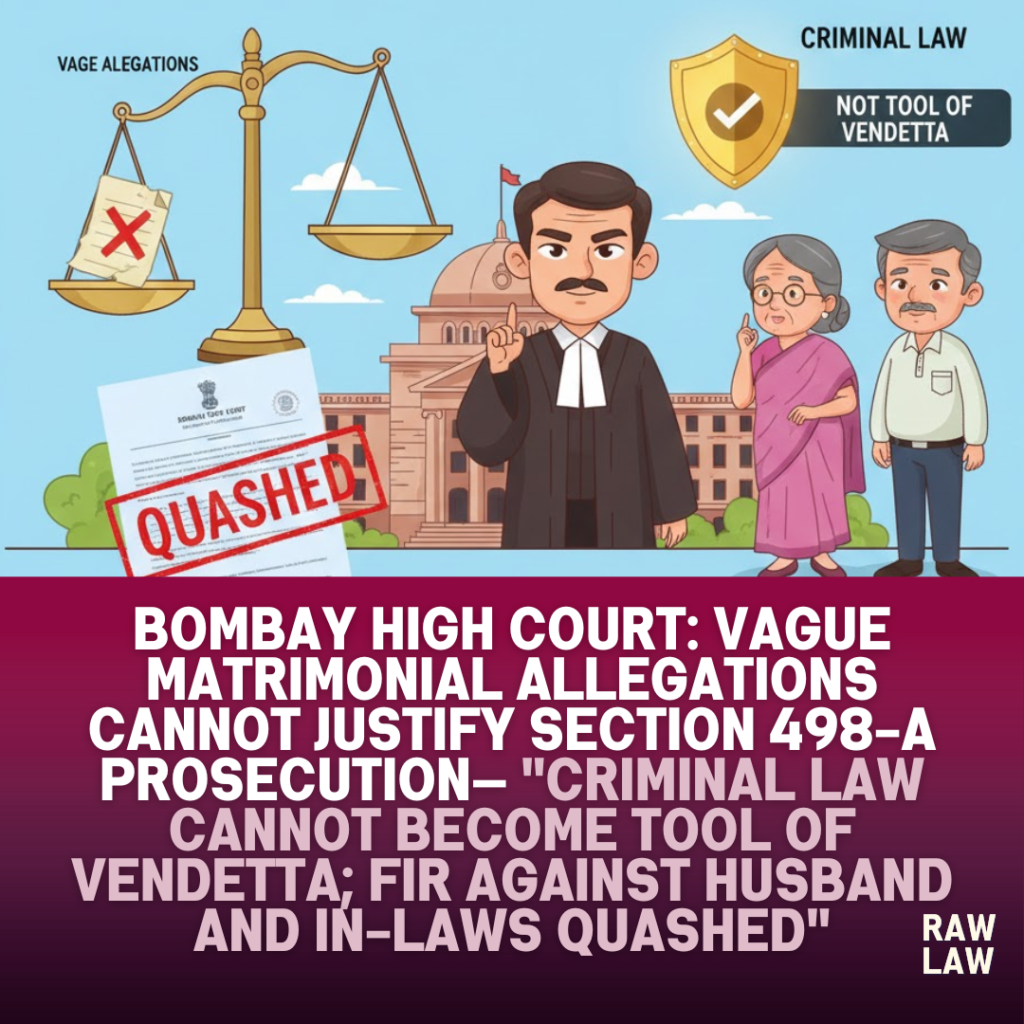
The Bombay High Court (Nagpur Bench) quashed an FIR registered under Section 498-A read with Section 34 of the Indian Penal Code against a husband and his family members. The Court held that the allegations of cruelty were omnibus, vague, and unsupported by specific instances demonstrating grave mental or physical cruelty as required under law.
Invoking its inherent powers under Section 482 of the Code of Criminal Procedure, the Court concluded that continuation of the criminal proceedings would amount to abuse of process of law. The FIR was accordingly set aside.
Facts
The marriage between the husband and the complainant was solemnised in June 2020. Both parties were highly educated professionals working in Pune. Due to the COVID-19 pandemic, the couple initially resided with the husband’s parents at Washim and later shifted to Pune.
Over time, marital discord arose, leading to repeated quarrels. In February 2024, the husband lodged a non-cognizable complaint at Hinjewadi Police Station alleging abuse and apprehending false implication. Medical records indicated injuries on his person.
Subsequently, the husband initiated divorce proceedings in April 2024. Settlement discussions were held between both families, culminating in a mutual understanding regarding financial settlement and termination of pregnancy. The pregnancy was medically terminated with written consent of both parties.
On 1 July 2024, after receiving notice of divorce proceedings, the wife lodged an FIR alleging mental, financial, and physical harassment, coercion to terminate pregnancy, and installation of a hidden camera.
Issues
The central issue before the High Court was whether the FIR disclosed ingredients of cruelty under Section 498-A of the Indian Penal Code.
The Court was required to examine whether the allegations, even if taken at face value, constituted wilful conduct of such gravity as to drive the complainant to commit suicide or cause grave injury to life, limb, or mental health.
Additionally, the Court examined whether the criminal proceedings were initiated as a retaliatory measure amid matrimonial negotiations and divorce litigation.
Petitioner’s arguments
The applicants contended that the FIR was a counterblast to the divorce petition and earlier police complaint lodged by the husband. They relied upon documentary evidence including medical reports, WhatsApp conversations, settlement discussions, and the written consent for medical termination of pregnancy.
It was argued that the allegations were general and omnibus, lacking dates, specific incidents, or details of cruelty. The applicants asserted that the hidden camera allegation was inherently improbable since the couple resided primarily in Pune and not at Washim during the relevant period.
Relying on recent Supreme Court precedents, the applicants submitted that the High Court must scrutinize matrimonial complaints carefully to prevent misuse of Section 498-A IPC.
Respondent’s arguments
The complainant defended the FIR, alleging harassment by the husband and in-laws, demand for ornaments and money, coercion to terminate pregnancy, and invasion of privacy by installation of a hidden camera.
She relied upon the Supreme Court’s decision in Niharika Infrastructure Pvt. Ltd. v. State of Maharashtra, arguing that investigation into cognizable offences should not be lightly quashed at the threshold and that courts should refrain from evaluating the merits at the investigation stage.
Analysis of the law
The High Court considered the legal framework governing Section 498-A IPC and the scope of inherent powers under Section 482 CrPC.
Relying upon Dara Lakshmi Narayana v. State of Telangana and Achin Gupta v. State of Haryana, the Court reiterated that while Section 498-A was enacted to curb cruelty against married women, there has been judicial recognition of its misuse through exaggerated and omnibus allegations.
The Court also examined Preeti Gupta v. State of Jharkhand, where the Supreme Court cautioned against indiscriminate implication of husband’s relatives residing separately.
While acknowledging the principles in Niharika Infrastructure Pvt. Ltd. v. State of Maharashtra, the Court noted that quashing is permissible where the complaint fails to disclose essential ingredients of the offence.
Applying the four-step test laid down in Pradeep Kumar Kesarwani v. State of Uttar Pradesh, the Court evaluated whether the material produced by the applicants was sound, unimpeachable, and sufficient to dislodge the allegations.
Precedent analysis
In Dara Lakshmi Narayana v. State of Telangana, the Supreme Court emphasized that vague and generalized allegations cannot sustain prosecution under Section 498-A IPC.
In Achin Gupta v. State of Haryana, the Court warned that criminal proceedings should not be weaponized in matrimonial disputes and that courts must look beyond the complaint to assess attending circumstances.
In Preeti Gupta v. State of Jharkhand, the Supreme Court highlighted the tendency to implicate entire families without specific allegations.
In Pradeep Kumar Kesarwani v. State of Uttar Pradesh, the Supreme Court laid down a structured test for quashing proceedings under Section 482 CrPC, emphasizing the need to prevent abuse of process.
The High Court found that the present case squarely fell within these principles.
Court’s reasoning
The High Court observed that the FIR lacked specific dates, details, or concrete instances of cruelty of the gravity contemplated under Section 498-A IPC.
The allegation regarding forced termination of pregnancy was contradicted by documentary evidence showing mutual consent and medical certification. The claim of installation of a hidden camera was rendered doubtful in light of admitted residence at Pune during the relevant period.
The Court noted the chronology: prior police complaint by the husband, filing of divorce petition, settlement negotiations, and only thereafter lodging of FIR. This sequence suggested retaliatory intent.
The documentary material, including WhatsApp chats and medical records, was found to be unimpeachable and unrebutted. Continuation of proceedings would therefore amount to abuse of process.
Conclusion
The Bombay High Court allowed the criminal application and quashed FIR No. 580/2024 registered under Section 498-A read with Section 34 IPC. The Court held that the allegations were general and insufficient to constitute cruelty as defined in law.
Implications
This judgment reinforces judicial caution in matrimonial prosecutions under Section 498-A IPC. It underscores that while genuine cases of cruelty deserve protection, courts must guard against misuse of criminal law as a bargaining tool in divorce and settlement negotiations.
The ruling affirms that High Courts possess both authority and constitutional responsibility to intervene where criminal proceedings are manifestly attended by mala fide intent and lack foundational facts.
It also strengthens the jurisprudence emphasizing scrutiny of omnibus allegations against extended family members.
Case law references
- Dara Lakshmi Narayana v. State of Telangana (2025) 3 SCC 735
Held that vague and generalized allegations in matrimonial disputes cannot justify prosecution under Section 498-A IPC. - Achin Gupta v. State of Haryana (2025) 3 SCC 756
Observed that Section 498-A is sometimes misused as a weapon rather than shield; courts must scrutinize allegations carefully. - Preeti Gupta v. State of Jharkhand (2010) 7 SCC 667
Cautioned against over-implication of husband’s relatives and emphasized careful judicial scrutiny. - Niharika Infrastructure Pvt. Ltd. v. State of Maharashtra (2021) 19 SCC 401
Laid down parameters governing quashing of FIRs and cautioned against routine interference. - Pradeep Kumar Kesarwani v. State of Uttar Pradesh (2025 SCC OnLine SC 1947)
Outlined a four-step test for quashing proceedings under Section 482 CrPC.
FAQs
1. Can a High Court quash an FIR under Section 498-A IPC?
Yes. If the allegations are vague, omnibus, or fail to disclose essential ingredients of cruelty, the High Court may quash proceedings under Section 482 CrPC to prevent abuse of process.
2. What constitutes ‘cruelty’ under Section 498-A IPC?
Cruelty includes wilful conduct likely to drive a woman to commit suicide or cause grave injury to life, limb, or mental health, or harassment in connection with unlawful demands.
3. Are in-laws automatically liable in 498-A cases?
No. Specific and credible allegations must be made against each accused. General accusations against entire family members are insufficient.