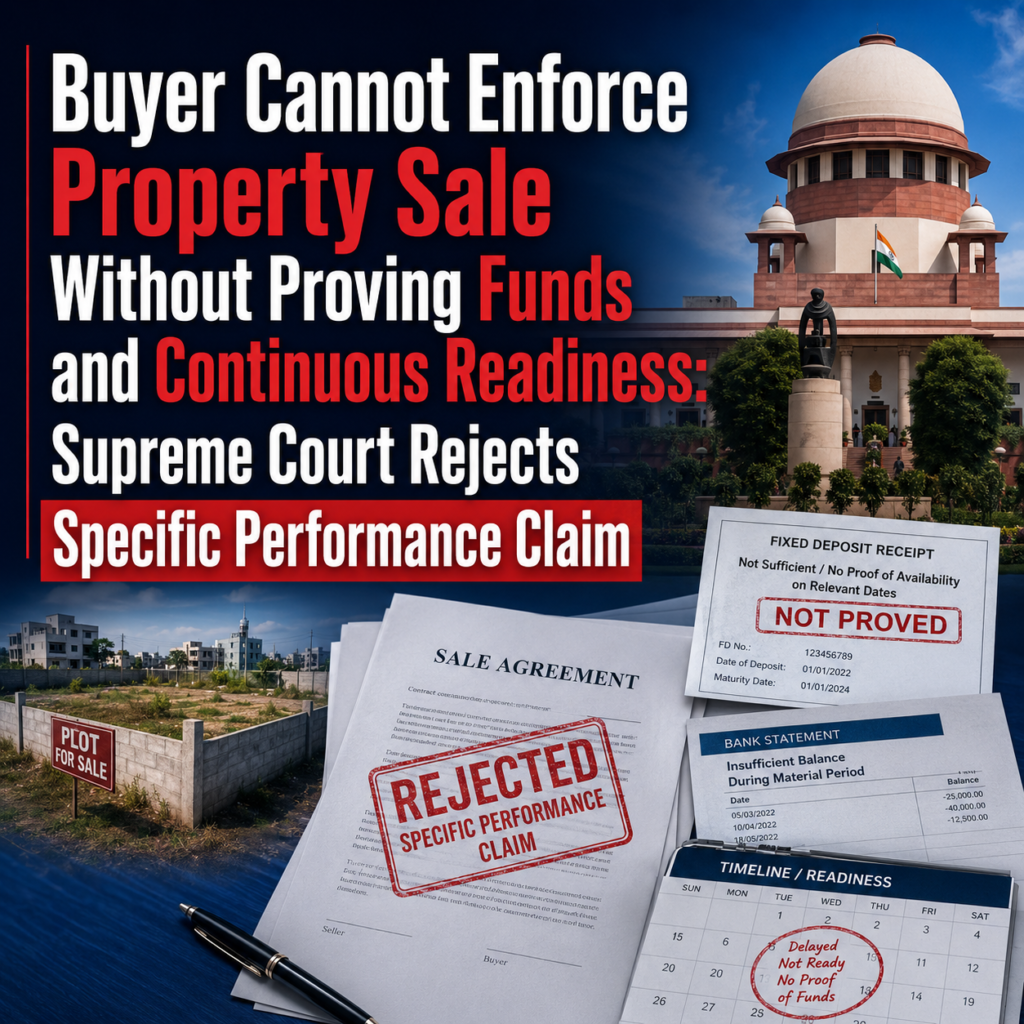
Supreme Court Refuses Property Sale Enforcement After Buyer Failed to Show Funds, Cooperation and Prompt Legal Action
Facts
Mohammed Khaleel, the original plaintiff, entered into an agreement to sell dated 20 December 1990 with the respondent, Jayamma, for the purchase of a vacant site measuring 100 feet by 78 feet for ₹3 lakh. He paid ₹25,000 as earnest money, while the balance consideration of ₹2.75 lakh was to be paid at the time of registration. The sale deed was required to be executed within four months.
The respondent handed over the original title documents to the plaintiff. According to the plaintiff, possession of the property was also delivered, and the respondent had agreed that an approach road would be provided through adjoining family property. The respondent, however, maintained that an approach road already existed and that she did not own any adjoining land from which another road could be carved out.
The plaintiff issued a notice on 15 April 1991 calling upon the respondent to perform the agreement. The notice was not served due to an incorrect address. On 26 April 1991, the respondent rescinded the agreement, alleging that the plaintiff had failed to obtain permission under the Urban Land (Ceiling and Regulation) Act, 1976, complete the transaction within the stipulated period or pay the balance consideration.
The plaintiff subsequently asserted that the transaction could not be completed because the property had not been properly measured, the approach road had not been formed and the necessary statutory permission had not been obtained. He filed a suit for specific performance on 20 December 1993—two years and nine months after the respondent’s refusal—and alternatively sought ₹3 lakh as compensation.
The Trial Court decreed the suit, holding that the plaintiff was ready and willing to perform the agreement, that time was not of the essence and that the respondent had wrongfully rescinded the contract.
The Karnataka High Court reversed the decree, holding that the plaintiff had failed to prove continuous readiness and willingness, had not cooperated in obtaining statutory permission and had approached the Court after substantial delay. The plaintiff’s legal representatives thereafter appealed to the Supreme Court.
Issues
- Whether the appellants had established the plaintiff’s continuous readiness and willingness to perform his obligations under the agreement to sell.
- Whether Fixed Deposit Receipts created several years after the institution of the suit could prove that the plaintiff had the financial capacity to pay the balance consideration during the relevant period.
- Whether the plaintiff’s failure to furnish the affidavit and documents necessary for obtaining permission under the Urban Land Ceiling law demonstrated lack of willingness to complete the transaction.
- Whether filing the suit within the prescribed limitation period was sufficient, despite an unexplained delay of two years and nine months after the respondent’s categorical refusal.
- Whether the appellants were entitled to the discretionary and equitable relief of specific performance.
Petitioner’s Arguments
The appellants, representing the original plaintiff, argued that the High Court had wrongly concluded that the plaintiff was not ready and willing to perform the contract.
They relied upon four Fixed Deposit Receipts of ₹70,000 each, totalling ₹2.80 lakh, to show that the plaintiff possessed funds sufficient to pay the balance sale consideration of ₹2.75 lakh. They contended that the High Court had incorrectly considered only two of the four deposits.
The appellants submitted that the plaintiff’s request for proper measurement and demarcation of the property did not demonstrate unwillingness. According to them, identification and measurement of immovable property were necessary steps for executing a valid conveyance.
They further argued that obtaining permission under the Urban Land Ceiling law was primarily the responsibility of the respondent as the owner and transferor of the property. The plaintiff had expressed his willingness to sign all required documents, but the respondent had taken no meaningful steps to obtain the permission.
The appellants also challenged the High Court’s reliance upon delay. They contended that the suit had been filed within the statutory limitation period and that no specific issue regarding delay had been framed or adjudicated by the Trial Court. Therefore, delay could not be used for the first time in appeal to deny specific performance.
Respondent’s Arguments
The respondent argued that the plaintiff had failed to prove both financial readiness and willingness to complete the sale.
She submitted that the Fixed Deposit Receipts relied upon by the appellants were created between 1999 and 2001, whereas the agreement was executed in 1990 and the suit was filed in 1993. These later deposits could not establish that the plaintiff had the balance consideration available when the agreement was required to be performed.
The respondent further contended that the permission under the Urban Land Ceiling law required cooperation from both parties. The plaintiff had failed to furnish the necessary affidavit and documents and had merely waited for the respondent to act.
According to the respondent, the plaintiff introduced additional conditions concerning the formation of an approach road, despite the existence of an access road to the property. This showed that he was unwilling to perform the agreement according to its original terms.
She also relied upon the unexplained delay of two years and nine months between the rescission of the agreement and the institution of the suit. Even though the suit was technically within limitation, the plaintiff’s failure to act promptly disentitled him from obtaining the equitable relief of specific performance.
Analysis of the Law
The Supreme Court examined Section 16(c) of the Specific Relief Act, 1963, as it stood before the 2018 amendment. Under that provision, a plaintiff seeking specific performance was required to specifically plead and prove that he had continuously remained ready and willing to perform the essential obligations required of him.
The Court explained that readiness refers principally to the plaintiff’s financial capacity to perform the contract, while willingness is determined from his conduct, intention and participation in completing the transaction. Both requirements must coexist continuously from the date of the agreement until the decree.
The plaintiff was not required to physically deposit the entire balance consideration in Court. However, he was required to place reliable evidence on record showing that he possessed sufficient funds, or the capacity to arrange those funds, at the relevant time.
The Court held that financial documents created many years after the agreement and after the filing of the suit cannot retrospectively establish readiness during the contractual period. The four Fixed Deposit Receipts dated between 1999 and 2001 did not prove that the plaintiff had ₹2.75 lakh available either within the stipulated four months or when he instituted the suit in 1993.
On willingness, the Court noted that statutory permission under the Urban Land Ceiling law required participation by both parties. The plaintiff’s failure to furnish the necessary affidavit or forms, coupled with his passive conduct, weighed against his claim of continuous willingness.
The Court further held that filing a suit within limitation does not automatically entitle a plaintiff to specific performance. Since specific performance is an equitable and discretionary relief, courts may examine whether the plaintiff approached the Court promptly and acted diligently after the defendant’s refusal.
Accordingly, an unexplained delay—though falling within the statutory limitation period—may demonstrate lack of continuous readiness and willingness and justify refusal of specific performance.
Precedent Analysis
N.P. Thirugnanam (Dead) by LRs. v. Dr. R. Jagan Mohan Rao, (1995) 5 SCC 115
The Supreme Court reiterated that continuous readiness and willingness is a condition precedent for specific performance. Courts must consider the plaintiff’s conduct before and after filing the suit, along with his financial capacity to pay the consideration.
The Court applied this principle to assess whether the plaintiff had shown adequate funds during the relevant contractual period.
His Holiness Acharya Swami Ganesh Dassji v. Sita Ram Thapar, (1996) 4 SCC 526
This decision distinguished readiness from willingness. Readiness concerns financial capacity, while willingness is inferred from the party’s conduct and surrounding circumstances.
The Supreme Court relied upon this distinction in finding that neither the plaintiff’s financial position nor his conduct supported the grant of specific performance.
Umabai v. Nilkanth Dhondiba Chavan, (2005) 6 SCC 243
The Court referred to this judgment for the proposition that a finding on continuous readiness and willingness is mandatory under Section 16(c). The entire pleadings and evidence must be evaluated rather than isolated statements or documents.
Man Kaur v. Hartar Singh Sangha, (2010) 10 SCC 512
This precedent clarified that even where the defendant has committed a breach, the plaintiff cannot obtain specific performance unless he independently proves his own readiness and willingness.
Thus, an alleged breach by the respondent could not cure the plaintiff’s failure to establish that he had the balance consideration and was prepared to fulfil his obligations.
K.S. Vidyanadam v. Vairavan, (1997) 3 SCC 1
The Supreme Court held that merely filing a suit within limitation does not mean that contractual timelines can be ignored. Time stipulations remain relevant even where time is not formally treated as the essence of an agreement for sale of immovable property.
Azhar Sultana v. B. Rajamani, (2009) 17 SCC 27
The Court recognised that, while exercising discretionary jurisdiction, courts may consider whether the plaintiff instituted the suit within a reasonable time. What constitutes reasonable time depends upon the facts and conduct of the parties.
Saradamani Kandappan v. S. Rajalakshmi, (2011) 12 SCC 18
The judgment affirmed that every suit for specific performance should not be decreed merely because it was filed within limitation. Courts may refuse relief when the purchaser waits for an unreasonable period after the breach.
Atma Ram v. Charanjit Singh, (2020) 3 SCC 311
The Supreme Court relied upon this case to emphasise that unexplained delay after issuance of a legal notice can indicate conduct inconsistent with readiness and willingness.
Rajesh Kumar v. Anand Kumar, (2024) 13 SCC 80
This decision consolidated the principles concerning delay in specific-performance suits. It held that filing a suit at the end of the limitation period, without satisfactory explanation, may disentitle a plaintiff from equitable relief.
The Court applied this principle to the plaintiff’s unexplained delay of two years and nine months after the respondent’s categorical refusal.
Court’s Reasoning
The Supreme Court found that the four Fixed Deposit Receipts did not establish the plaintiff’s financial readiness. All four deposits were created between 1999 and 2001, several years after the agreement and the filing of the suit. They could not prove that funds were available when the sale was contractually required to be completed or when the suit was instituted.
There was no other reliable evidence showing that the plaintiff possessed, or could arrange, the balance consideration of ₹2.75 lakh during the relevant period.
The Court also found that the plaintiff had failed to participate in obtaining permission under the Urban Land Ceiling law. The testimony of his own legal representative showed that the plaintiff had not furnished the necessary affidavit or statutory forms. Instead of actively pursuing completion of the transaction, he remained passive and expected the respondent to take all steps.
The respondent had categorically refused performance on 26 April 1991. Despite this clear refusal, the plaintiff waited until 20 December 1993 to institute the suit. No satisfactory explanation was offered for this delay of two years and nine months.
The Court held that a plaintiff seeking an equitable remedy must act promptly and with conduct beyond reproach. Compliance with the outer limitation period does not excuse unexplained inaction after a clear breach or refusal.
Considering the absence of contemporaneous proof of financial readiness, failure to cooperate in obtaining statutory permission and substantial unexplained delay, the Court concluded that the plaintiff had not demonstrated continuous readiness and willingness.
Conclusion
The Supreme Court held that a purchaser seeking specific performance must prove continuous financial readiness and willingness through evidence relating to the period when the contract was required to be performed.
Fixed Deposit Receipts created years after the agreement and after the institution of the suit cannot establish financial capacity retrospectively. Similarly, failure to participate in obtaining necessary statutory permission and an unexplained delay in approaching the Court may demonstrate lack of willingness.
The Court clarified that filing a suit within limitation does not create an automatic right to specific performance. Since the remedy is equitable and discretionary, the plaintiff must also approach the Court promptly and demonstrate diligent conduct throughout.
Accordingly, the Supreme Court upheld the Karnataka High Court’s refusal of specific performance and dismissed the civil appeal.
Case Details
Case: Mohammed Khaleel (Dead) Through Legal Representatives & Others v. Jayamma
Court: Supreme Court of India
Case Number: Civil Appeal No.2187 of 2011
Neutral Citation: 2026 INSC 651
Judges: Justice Prashant Kumar Mishra and Justice N.V. Anjaria
Date: 23 June 2026
Result: Civil appeal dismissed; the Karnataka High Court’s judgment refusing specific performance was upheld.