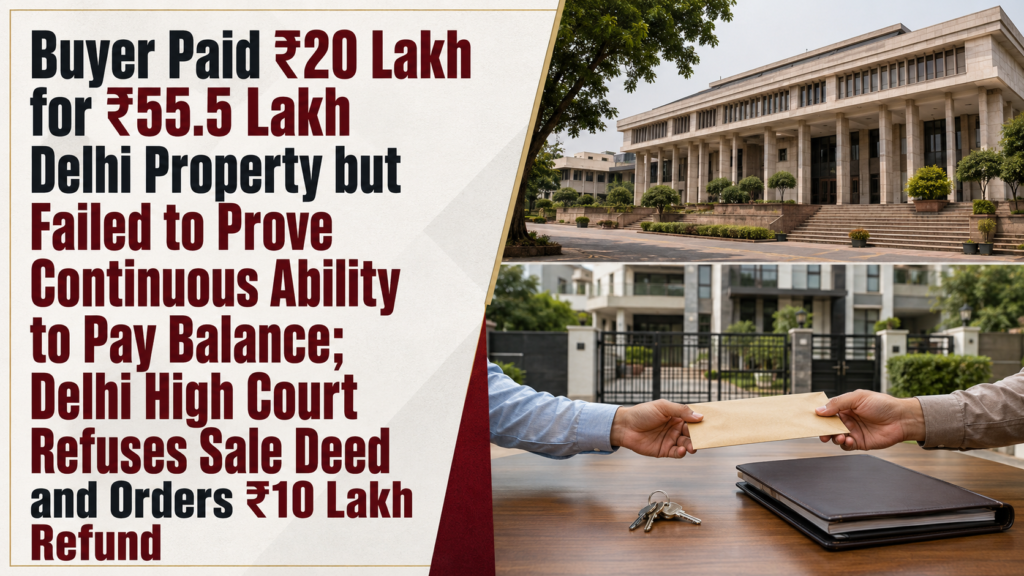
Buyer and Seller Both Reached Sub-Registrar’s Office but Sale Failed; Delhi High Court Says Mere Presence Did Not Prove Financial Readiness
Facts
Chander Pal Singh entered into an Agreement to Sell dated 25 May 2008 with Kamlesh Nagpal for purchasing a built-up property bearing Number 7, Gobind Park, Village Khureji Khas, Shahdara, Delhi, admeasuring approximately 80 square yards.
The total sale consideration was fixed at ₹55.5 lakh. The buyer initially paid ₹5 lakh as earnest money.
The parties subsequently substituted the earlier agreement with another Agreement to Sell dated 19 June 2008, executed on 20 June 2008. Under the substituted agreement:
- The buyer paid an additional ₹15 lakh.
- The total amount paid became ₹20 lakh.
- ₹10 lakh was treated as earnest money.
- The remaining ₹10 lakh was treated as advance or part-payment.
- The balance ₹35.5 lakh was payable at the time of executing the sale deed.
- The sale deed was to be executed by 1 August 2008.
The agreement provided that if the seller failed to complete the transaction, the buyer could recover double the earnest money. If the buyer defaulted, the earnest money could be forfeited.
Both parties attended the Sub-Registrar’s office on 1 August 2008 and obtained receipts recording their presence. However, the sale deed was not executed.
The buyer claimed that he was present with the balance consideration and that the seller avoided completing the transaction. The seller maintained that the buyer had failed to bring a bank draft for ₹35.5 lakh.
On 2 August 2008, the buyer issued a legal notice demanding execution of the sale deed. On 29 August 2008, he also lodged a complaint with the office of the Assistant Commissioner of Police, Gandhi Nagar.
The buyer subsequently filed a suit seeking specific performance of the Agreement to Sell and possession of the property.
During the proceedings:
- The seller admitted receiving ₹10 lakh as earnest money and ₹10 lakh as part-payment.
- The seller agreed to refund the ₹10 lakh received as part-payment.
- The Court directed repayment of that amount in November 2009, and it was refunded.
- The remaining ₹10 lakh earnest money continued to remain with the seller.
The Trial Court held that the seller had agreed to sell the entire building, including the ground floor and three upper floors. However, it dismissed the suit because the buyer failed to prove continuous readiness and willingness to pay the balance ₹35.5 lakh.
The buyer filed a Regular First Appeal before the Delhi High Court. Alternatively, he sought refund of the remaining ₹10 lakh earnest money with interest.
He also filed an application under Order XLI Rule 27 of the Code of Civil Procedure, 1908, seeking to introduce his and his wife’s 2011 bank statements as additional evidence.
Issues
- Whether the buyer continuously remained ready and willing to perform the Agreement to Sell.
- Whether the buyer proved continuous financial capacity to pay the balance sale consideration of ₹35.5 lakh.
- Whether his presence at the Sub-Registrar’s office with account-payee cheques established readiness.
- Whether cheques issued from the accounts of friends and relatives could establish assured availability of funds.
- Whether the buyer’s subsequent demand for return of his money demonstrated unwillingness to complete the sale.
- Whether the seller’s alleged breach relieved the buyer of his obligation to prove readiness and willingness.
- Whether 2011 bank statements could be introduced as additional evidence to prove readiness concerning a transaction due for completion in 2008.
- Whether the remaining ₹10 lakh earnest money should be refunded despite no specific refund prayer having been made in the original suit.
Appellant’s Arguments
Chander Pal Singh argued that:
- The Trial Court had already held that the agreement covered the entire building, including the ground floor.
- That finding supported his case that the seller was attempting to avoid the transaction.
- He had continuously been ready and willing to complete the sale.
- He sold another property in Indirapuram, Ghaziabad, to arrange funds for the transaction.
- He paid ₹20 lakh, approximately 37% of the total consideration, demonstrating his genuine intention to purchase the property.
- He attended the Sub-Registrar’s office on the agreed date with four cheques aggregating to ₹35.5 lakh.
- A substantial amount of ₹24 lakh was available in an account jointly held by him and his wife.
- The remaining cheques were issued by friends and relatives whose accounts allegedly contained sufficient funds on 1 August 2008.
- It was unnecessary for a purchaser to carry ready cash throughout the litigation; proof of financial capacity was sufficient.
- The Trial Court incorrectly examined the account balances on dates after 1 August 2008.
- The Agreement to Sell permitted execution of the sale deed in favour of the buyer or his nominees, making third-party funding permissible.
- His legal notice issued immediately after the failed transaction established continued willingness.
- The seller had retained and used ₹20 lakh while refusing to complete the sale.
- Earnest money could not be forfeited without proof of actual loss.
- The seller suffered no loss because she herself claimed that the property was worth approximately ₹75 lakh against the agreed price of ₹55.5 lakh.
- At minimum, the remaining ₹10 lakh earnest money should be refunded.
Respondent’s Arguments
Kamlesh Nagpal argued that:
- Continuous readiness and willingness were mandatory under Section 16(c) of the Specific Relief Act, 1963.
- The buyer had to establish readiness from the agreement date until the decree.
- He failed to produce reliable evidence of having ₹35.5 lakh available on 1 August 2008 or continuously thereafter.
- No bank records established availability of funds between the agreement, the closing date, institution of the suit and trial.
- The buyer produced no evidence showing that he purchased the necessary stamp papers.
- His police complaint sought return of money rather than execution of the sale deed, contradicting his alleged willingness.
- The balance consideration had to be paid by the buyer, not by unrelated third parties.
- Account-payee cheques issued by private individuals carried no guarantee of encashment.
- Some relevant accounts did not maintain sufficient balances during the cheques’ validity.
- The legal notice dated 2 August 2008 did not mention the four cheques.
- The buyer had not sought refund of the earnest money in the original suit.
- An alternative refund claim could not be introduced for the first time in appeal.
- The ₹10 lakh part-payment had already been refunded pursuant to the earlier Court order.
Analysis of the Law
Applicable Version of Section 16(c)
Section 16(c) of the Specific Relief Act, 1963, was amended in 2018. Before the amendment, a plaintiff seeking specific performance was required to “aver and prove” continuous readiness and willingness.
The Delhi High Court held that the 2018 amendment was prospective. Since the transaction arose in 2008, the unamended provision applied.
Accordingly, the buyer had to establish:
- A valid Agreement to Sell;
- Breach by the seller; and
- Continuous readiness and willingness to perform his obligations.
Meaning of Readiness and Willingness
“Readiness” refers to the purchaser’s capacity to perform the contract, including financial capacity to pay the balance consideration.
“Willingness” refers to the purchaser’s conduct and demonstrated intention to complete the transaction.
Both requirements must exist continuously from the agreement until the decree. Readiness at one isolated point is insufficient.
The buyer was not required to physically carry or deposit the entire sale consideration unless directed by the Court. However, he was required to prove the continuous availability of funds or genuine capacity to arrange them.
Seller’s Breach Does Not Remove Buyer’s Burden
Even if the seller wrongfully refuses to execute the sale deed, the buyer cannot obtain specific performance unless he independently proves continuous readiness and willingness.
The seller’s breach provides a cause of action, but the buyer’s readiness and willingness constitute a separate statutory requirement.
Precedent Analysis
Pydi Ramana alias Ramulu v. Davarasety Manmadha Rao, (2024) 7 Supreme Court Cases 515
The Supreme Court held that the 2018 amendment to the Specific Relief Act operates prospectively.
For earlier transactions, a plaintiff must establish a valid agreement, breach by the defendant and continuous readiness and willingness.
P. Daivasigamani v. S. Sambandan, (2022) 14 Supreme Court Cases 793
The Supreme Court explained that readiness includes the plaintiff’s financial capacity to pay the purchase price.
The Delhi High Court applied this principle while examining the buyer’s bank accounts and cheques.
Shenbagam and Others v. K.K. Rathinavel, 2022 Supreme Court Cases OnLine Supreme Court 71
This decision held that willingness must be assessed from the plaintiff’s conduct throughout the transaction.
The buyer’s later demand for return of his money was treated as inconsistent with continuous willingness to complete the sale.
Kamal Kumar v. Premlata Joshi, (2019) 3 Supreme Court Cases 704
The Supreme Court recognised specific performance as an equitable and discretionary remedy.
Courts must examine the validity of the contract, performance, readiness and willingness, hardship and entitlement to alternative relief such as refund.
J.P. Builders v. A. Ramadas Rao, (2011) 1 Supreme Court Cases 429
The Supreme Court held that continuous readiness and willingness are conditions precedent to specific performance and must be established throughout the relevant period.
The burden remains upon the plaintiff even if the defendant does not specifically challenge readiness.
C.S. Venkatesh v. A.S.C. Murthy, 2020 Supreme Court Cases OnLine Supreme Court 143
The Supreme Court held that the amount required to be paid must be proved to have been available and that the plaintiff’s conduct before and after filing the suit must be considered.
Man Kaur, Deceased Through Legal Representatives v. Hartar Singh Sangha, (2010) 10 Supreme Court Cases 512
The Supreme Court distinguished between breach by a seller and the statutory bar arising from the buyer’s failure to prove readiness.
Even where the seller commits a breach, specific performance cannot be granted if the buyer lacks the funds or capacity to complete the transaction.
Sanjay Kumar Singh v. State of Jharkhand, (2022) 7 Supreme Court Cases 247
The Supreme Court held that additional evidence may be admitted in appeal when the appellate court requires it to pronounce judgment or where it directly affects the central issue.
Rahul Associates v. BMS Enterprises, 2024 Supreme Court Cases OnLine Delhi 9274
The Delhi High Court held that additional evidence under Order XLI Rule 27 must be admitted sparingly and only in exceptional circumstances.
A party cannot use the provision merely to fill gaps in its existing evidence.
Court’s Reasoning
The Court accepted that both the buyer and the seller had attended the Sub-Registrar’s office on 1 August 2008. However, presence alone did not establish financial readiness.
The buyer relied upon four account-payee cheques:
- One cheque for ₹24 lakh from an account jointly held by the buyer and his wife;
- One cheque for ₹4 lakh issued by Rajesh Kumar; and
- Two cheques of ₹3.75 lakh each issued from accounts belonging to Meer Singh Sehrawat.
The Court found that these were ordinary account-payee cheques and not banker’s cheques. They carried no guaranteed assurance of payment and could not have been encashed immediately on the agreed date.
The relevant accounts also did not continuously maintain sufficient balances during the cheques’ validity. Evidence of funds existing around 1 August 2008 demonstrated, at best, temporary rather than continuous readiness.
The buyer produced no convincing evidence of availability of the balance consideration:
- On the date of filing the suit;
- During the pendency of the proceedings; or
- Continuously until the decree.
He also failed to produce evidence that the necessary stamp papers had been purchased.
The police complaint dated 29 August 2008 was treated as particularly significant. Instead of consistently seeking execution of the sale deed, the buyer referred to asking the seller and her family to return his money.
The Court held that a purchaser seeking refund within weeks of the stipulated performance date could not simultaneously claim to have remained continuously willing to complete the sale.
Even if the seller had committed a breach, the buyer’s failure to satisfy Section 16(c) barred specific performance.
Additional Evidence
The buyer sought to introduce bank statements showing substantial balances in December 2011.
The Court held that those statements did not establish his financial capacity:
- On the agreed completion date in August 2008;
- On the date of filing the suit in December 2008; or
- Continuously throughout the relevant period.
The Court could decide the appeal on the existing evidence. The proposed evidence therefore had no direct bearing on the judgment, and the application under Order XLI Rule 27 was rejected.
Refund of Earnest Money
The buyer had originally paid ₹20 lakh:
- ₹10 lakh as part-payment; and
- ₹10 lakh as earnest money.
The ₹10 lakh part-payment had already been refunded pursuant to the Court’s order dated 27 October 2009.
During the appeal, the seller stated that she was willing to refund the remaining ₹10 lakh earnest money without prejudice to her rights.
Based on that statement, the Court directed her to refund the remaining ₹10 lakh within four weeks. No interest was awarded.
Conclusion
The Delhi High Court held that:
- The buyer failed to prove continuous financial readiness to pay the balance ₹35.5 lakh.
- Temporary availability of funds around the stipulated date was insufficient.
- The personal cheques did not establish guaranteed or continuing payment capacity.
- His subsequent demand for return of money contradicted continuous willingness.
- Even a breach by the seller could not overcome the buyer’s failure under Section 16(c).
- The Trial Court correctly refused specific performance.
- The 2011 bank statements were irrelevant to the crucial period and could not be admitted as additional evidence.
- The remaining ₹10 lakh earnest money should nevertheless be refunded because of the seller’s statement before the Court.
The appeal was disposed of by upholding the refusal of specific performance and directing refund of ₹10 lakh within four weeks. The additional-evidence application was rejected.
Case Details
Case: Chander Pal Singh v. Kamlesh Nagpal
Neutral Citation: 2026:DHC:5760
Court: High Court of Delhi at New Delhi
Case Number: Regular First Appeal Number 246 of 2017 with Civil Miscellaneous Application Number 8298 of 2017
Judge: Justice Mini Pushkarna
Reserved On: 16 April 2026
Pronounced On: 20 July 2026
Result: Specific performance refused; remaining ₹10 lakh earnest money ordered to be refunded within four weeks; application for additional evidence rejected; appeal disposed of.