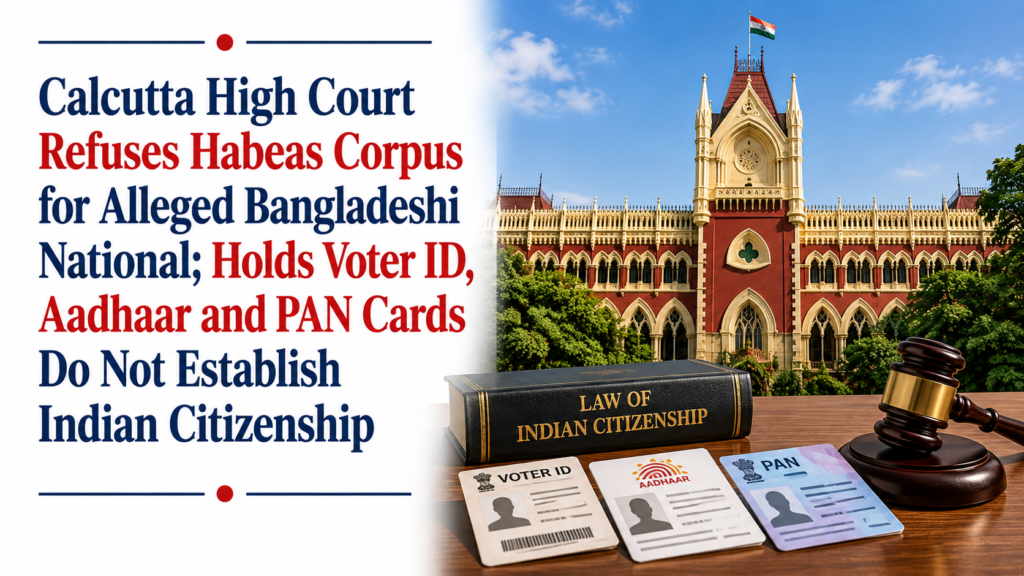
Calcutta High Court Holds MHA Deportation Circular Validly Invoked; Detainee Failed to Discharge Statutory Burden of Proof
Facts
The petitioner, claiming to be the uncle of the detainee, filed a habeas corpus petition alleging that his nephew, an alleged Indian citizen, had been wrongfully detained by the authorities on 18 June 2026. The detainee’s name had initially been shown as “under adjudication” during the Special Intensive Review (SIR), 2026 of electoral rolls and was subsequently deleted from the voters’ list. An appeal against such deletion was stated to be pending.
The petitioner relied upon documents including the detainee’s Voter Identity Card, Aadhaar Card, PAN Card, bank account records, Record of Rights, and documents relating to his paternal aunt to establish Indian citizenship. The State, however, produced the detention order and asserted that after inquiry, interrogation and verification, the detainee was found to be a Bangladeshi national. The State also relied on a video recording in which the detainee allegedly admitted that he was a Bangladeshi national.
Issues
- Whether the detention of the alleged foreign national was illegal.
- Whether the petitioner had established the detainee’s Indian citizenship.
- Whether documents such as Voter ID, Aadhaar Card, PAN Card and bank records constitute conclusive proof of Indian citizenship.
- Whether the burden of proving citizenship had been discharged under the Immigration and Foreigners Act, 2025.
- Whether interference under Article 226 by way of habeas corpus was warranted.
Petitioner’s Arguments
The petitioner contended that the detainee was an Indian citizen and that his detention was illegal.
It was argued that the detainee had not been granted an opportunity of hearing during the Special Intensive Review (SIR), 2026, and until the pending appeal against deletion from the electoral roll was decided, his citizenship could not be questioned.
The petitioner relied upon the Supreme Court’s decision in Sabitri Dey @ Swasthi Dey v. Union of India, contending that due process required an opportunity of hearing before detention and deportation.
To establish citizenship, reliance was placed upon:
- Voter Identity Card,
- Aadhaar Card,
- PAN Card,
- Bank account records,
- Record of Rights relating to ancestors, and
- Passport and other documents of the detainee’s paternal aunt.
Respondents’ Arguments
The State submitted that the detainee had been detained strictly in accordance with the Ministry of Home Affairs Circular dated 2 May 2025 governing deportation of illegally staying Bangladeshi and Rohingya nationals.
It was contended that inquiry, interrogation and verification had established that the detainee was a Bangladeshi national, and the detention order had therefore been issued under the Immigration and Foreigners Act, 2025.
The Union of India supported the State and submitted that all States were required to follow the MHA Circular. It was further argued that the burden of proving Indian citizenship lay upon the detainee under the Immigration and Foreigners Act, 2025, and that no sufficient documentary evidence had been produced.
Analysis of the Law
The Court examined the Immigration and Foreigners Act, 2025, particularly the statutory burden placed upon a person alleged to be a foreign national.
The Court observed that after repeal of the Foreigners Act, 1946, the Immigration and Foreigners Act, 2025 governed such proceedings. The burden continued to remain on the detainee to establish Indian citizenship.
The Court also analysed the Citizenship Act, 1955, noting that citizenship may be acquired only through:
- Section 3 – Citizenship by birth;
- Section 4 – Citizenship by descent; and
- Section 5 – Citizenship by registration.
The Court held that the petitioner failed to establish the detainee’s citizenship under any of these statutory modes.
Precedent Analysis
The Court considered the Supreme Court’s decision in:
- Sabitri Dey @ Swasthi Dey & Ors. v. Union of India & Ors. (2026 INSC 694).
The Court distinguished the decision, observing that it dealt with proceedings under the Foreigners Act, 1946 and the Foreigners (Tribunals) Order, 1964 applicable in Assam.
While reaffirming that the burden to establish citizenship lies upon the person proceeded against, the Court held that the present detention was governed by the Immigration and Foreigners Act, 2025 and the MHA Circular dated 2 May 2025, neither of which had been challenged in the writ petition. Accordingly, Sabitri Dey did not assist the petitioner on the facts of the case.
Court’s Reasoning
The Division Bench found several serious deficiencies in the petitioner’s case.
First, the petitioner failed to establish the detainee’s citizenship by birth, as neither the birth certificate nor satisfactory proof of date and place of birth was produced.
Secondly, citizenship by descent was also not established because the names of the detainee’s father differed across documents and no coherent documentary chain connected the detainee with the alleged Indian ancestors.
The Court also noticed contradictions in the petitioner’s own case. In the police complaint, the petitioner described himself as the detainee’s cousin, whereas in the writ petition he claimed to be the detainee’s uncle, despite being eight years younger than the detainee. These inconsistencies substantially undermined his credibility.
The Court further drew an adverse inference from the petitioner’s refusal to disclose the place where the detainee’s parents were buried, despite repeated opportunities and despite suggesting DNA examination if such information were supplied.
Finally, the Court held that:
- Voter Identity Card only proves enrolment in the electoral roll;
- Aadhaar Card is not proof of citizenship;
- PAN Card is likewise not conclusive proof of nationality;
- Bank account records merely show existence of banking relationships; and
- ancestral land records and relatives’ documents do not independently establish the detainee’s citizenship.
Consequently, the statutory burden under the Immigration and Foreigners Act, 2025 remained undischarged.
Conclusion
The Calcutta High Court dismissed the habeas corpus petition.
The Court held that the petitioner and the detainee failed to establish Indian citizenship either by birth, descent or registration under the Citizenship Act, 1955.
It further held that Voter ID, Aadhaar Card, PAN Card, bank records and ancestral land records do not by themselves constitute conclusive proof of Indian citizenship, and that the statutory burden under the Immigration and Foreigners Act, 2025 had not been discharged. Accordingly, the Court declined to interfere with the detention order.
Case Details
Case: Suman Molla v. State of West Bengal & Ors.
Court: High Court at Calcutta
Case Number: WPA(H) No. 58 of 2026
Judges: Hon’ble Mr. Justice Debangsu Basak and Hon’ble Mr. Justice Ajay Kumar Gupta
Date: 20 July 2026
Result: Writ Petition Dismissed. The Calcutta High Court upheld the detention, holding that the detainee failed to prove Indian citizenship and that the documents relied upon were insufficient to discharge the statutory burden.