


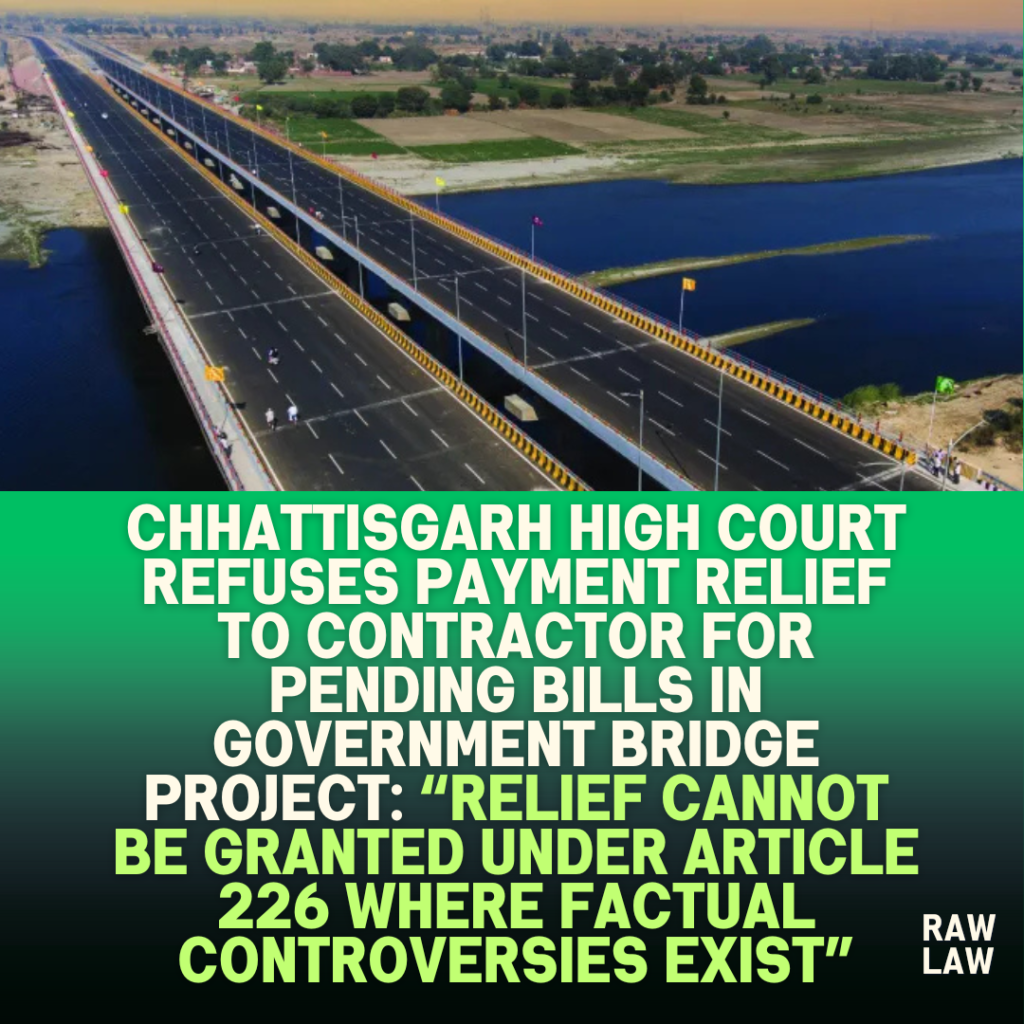
Court’s Decision
In a judgment dated 9 June 2025, the Chhattisgarh High Court dismissed the writ petition seeking directions for payment of ₹76 lakhs in pending bills for a government bridge construction contract. The Court held that the petition raised disputed questions of fact which could not be resolved in writ jurisdiction under Article 226 of the Constitution of India. The Division Bench comprising Chief Justice Ramesh Sinha and Justice Bibhu Datta Guru observed:
“When there are disputed question of facts involved in a case, the High Court should not exercise its jurisdiction under Article 226 of the Constitution of India.”
Accordingly, the writ petition was dismissed with liberty to the petitioner to avail alternative remedies.
Facts
The petitioner, a sole proprietorship bridge construction firm, had entered into a contract with the Public Works Department of Chhattisgarh for the construction of a High-Level Bridge and approach road. The original agreement was dated 24.12.2021, valued at ₹9.63 crores, with an initial deadline of 22.01.2023. Due to various site-related impediments, the work could not proceed smoothly and was delayed. The department granted three successive extensions: the first without penalty until 23.06.2023, the second with penalty until 31.01.2024, and the third until 31.03.2025.
Despite executing works valued over ₹1.10 crore, the petitioner claimed that payments had been withheld since June 2023. The petitioner highlighted that ₹76 lakhs had been recommended for payment by authorities up to the level of respondent No. 2 but remained unpaid. An application for further extension was filed on 28.03.2025 and remained pending.
Issues
- Whether the High Court can entertain a writ petition under Article 226 for directions to make payment in a contract involving disputed facts.
- Whether the non-payment of bills despite execution of work warrants judicial intervention in writ jurisdiction.
Petitioner’s Arguments
The petitioner contended that:
- He was executing the work diligently under the contract and 70% of the work was completed.
- Payments for works amounting to ₹76 lakhs had been recommended but not released, severely impacting financial stability.
- Non-payment was contrary to the agreement which obligated timely running bill payments.
- The delay was affecting the petitioner’s ability to pay labourers and suppliers, damaging creditworthiness.
- Multiple letters, including the one dated 24.01.2025, and follow-ups had been sent seeking release of payments.
Respondent’s Arguments
The State, through its Deputy Advocate General, opposed the petition, contending:
- The writ petition was not maintainable as it involved disputed questions of fact.
- Such disputes could not be resolved merely on the basis of affidavits and required a full-fledged adjudication before a civil court.
- The petition essentially sought adjudication of a contractual dispute without a statutory flavour, which did not warrant exercise of Article 226 jurisdiction.
Analysis of the Law
The Court reiterated the principle that disputed questions of fact and claims arising from contractual obligations are not to be decided in writ jurisdiction. Reliance was placed on multiple precedents affirming that writ petitions are not appropriate for resolution of such matters, particularly in the absence of admitted liability or crystallised dues.
Precedent Analysis
- Chairman, Grid Corporation of Orissa Ltd. v. Sukamani Das (1999) 7 SCC 298
Held that the High Court erred in entertaining writ petitions for compensation arising out of electrocution deaths as they involved disputed facts and required adjudication of negligence. - S.P.S. Rathore v. State of Haryana (2005) 10 SCC 1
Reiterated that in tortious liability cases involving factual disputes, writ jurisdiction is not proper. - Shubhas Jain v. Rajeshwari Shivam, 2021 SCC OnLine SC 562
Emphasised that High Courts cannot assess conflicting technical reports in writ proceedings. - Union of India v. Puna Hinda (2021) 10 SCC 690
Clarified that contractual disputes without statutory flavour must be adjudicated through agreed dispute resolution mechanisms. - M.P. Power Management Co. Ltd. v. Sky Power Southeast Solar India (P) Ltd. (2023) 2 SCC 703
Stated that writ courts should not entertain petitions involving disputed facts in contractual matters where alternate remedies exist.
Court’s Reasoning
The Court held that the petitioner’s claim for payment of ₹76 lakhs involved:
- Disputed facts concerning actual execution and measurement of work.
- Lack of crystallised dues or conclusive admission of liability by the respondent authorities.
- Contentious interpretation of the terms of the contract and fulfillment of obligations.
The Court noted:
“It is well settled proposition of law that when there are disputed question of facts involved in a case, the High Court should not exercise its jurisdiction under Article 226 of the Constitution of India.”
Hence, it concluded that the petitioner should approach the appropriate forum, such as a civil court or arbitration, as per the contract.
Conclusion
The High Court dismissed the writ petition, observing that:
“The relief of compensation sought by the petitioner is contingent upon the resolution of disputed question of facts raised, and these questions cannot be adjudicated under Article 226.”
Liberty was, however, granted to the petitioner to pursue alternative remedies.
Implications
This judgment reinforces the principle that writ jurisdiction is not a substitute for civil or arbitral remedies in contractual disputes involving contested facts. It provides further clarity on the boundary between public law jurisdiction and private contract enforcement, particularly in cases where government departments are parties.
Also Read: Kerala High Court Holds Insurer Liable for Injuries Caused by Temple Elephant