


Court’s Decision
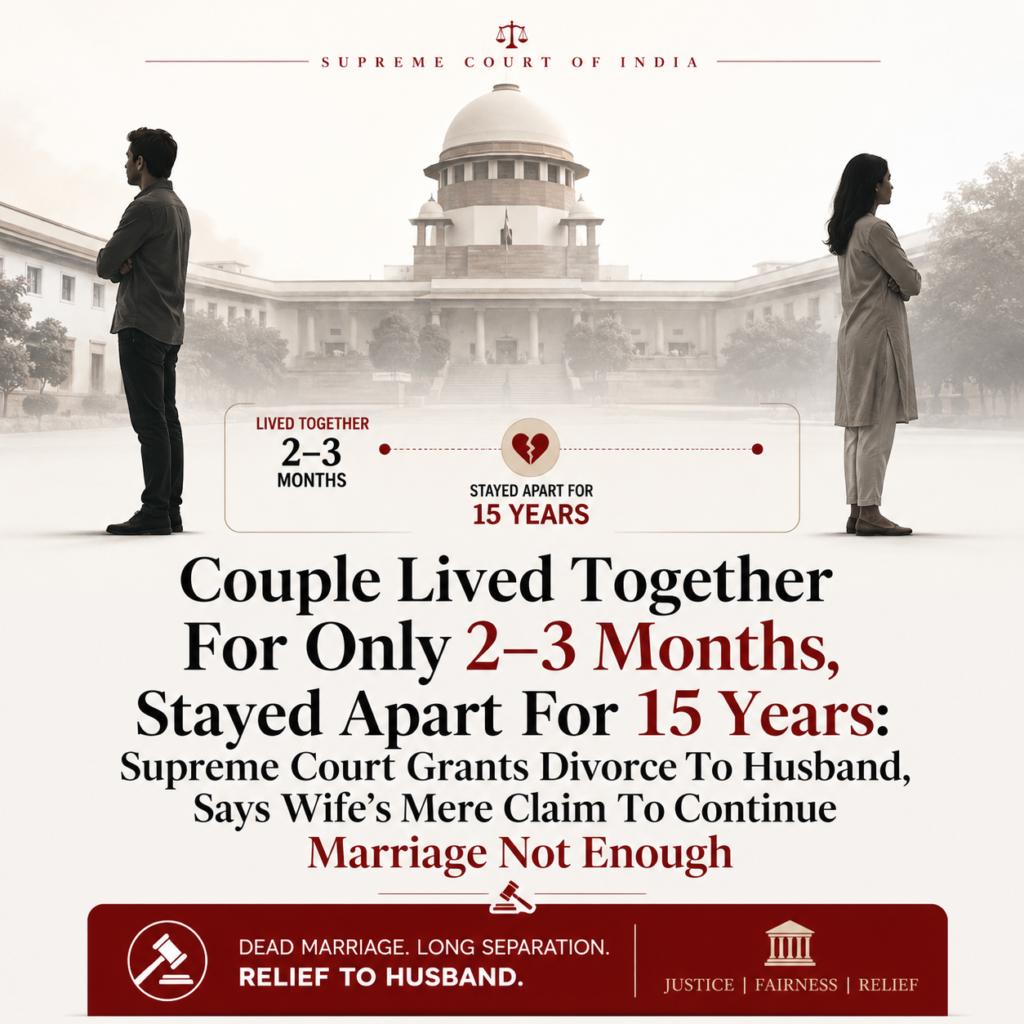
The Supreme Court dismissed the wife’s appeal and upheld the decree of divorce granted by the High Court in favour of the husband. The Court held that the finding of cruelty was sustainable, especially in view of the evidence showing absence of meaningful cohabitation, separate sleeping arrangements, denial of conjugal relationship, and prolonged separation of more than 15 years with no possibility of reconciliation.
The Court further held that this was a fit case for dissolution of marriage by exercising powers under Article 142 of the Constitution, as the marriage had become unworkable, emotionally dead, and beyond repair.
Facts
The marriage was solemnised in 2007 as per Hindu rites. No child was born from the wedlock. Both spouses were doctors in government service, but working in different States.
The husband filed a divorce petition in 2009 under Section 13(1)(ia) of the Hindu Marriage Act, 1955, alleging cruelty. The Family Court dismissed the divorce petition, holding that cruelty was not proved. The High Court reversed the Family Court’s decision and granted divorce.
The wife approached the Supreme Court challenging the High Court’s order. She maintained that she did not want dissolution of marriage and wanted to continue the matrimonial relationship. The Court noted, however, that the parties had lived separately for about 15 years, had no children, and mediation before the Supreme Court had also failed.
Issues
The Supreme Court considered the following issues:
- Whether the husband had been subjected to cruelty within the meaning of Section 13(1)(ia) of the Hindu Marriage Act.
- Whether denial of conjugal relations and persistent withdrawal from matrimonial obligations could amount to mental cruelty.
- Whether long separation and absence of reconciliation could justify divorce, even where desertion was not formally pleaded as a statutory ground.
- Whether the Supreme Court could dissolve the marriage under Article 142 on the ground of irretrievable breakdown.
Wife’s Arguments
The wife argued that she had never abandoned the husband and was always ready and willing to resume matrimonial life.
She submitted that the husband could not be allowed to take advantage of his own wrong. She also argued that desertion and irretrievable breakdown were not pleaded in the divorce petition, and therefore divorce could not be granted on those grounds.
She further contended that she had left her government service in Gujarat and started living in Bharatpur to save the marriage, but the husband did not permit her to perform her conjugal duties.
Husband’s Arguments
The husband argued that the wife had never made genuine efforts to save the marriage. He submitted that the parties had lived together for only about two to three months despite a marriage spanning nearly 18 years.
He further argued that the wife had denied sexual relations on several occasions, failed to build companionship or mutual trust, and that the marriage had broken down irretrievably.
He also submitted that there was no chance of reconciliation because the parties had been living separately for more than 15 years.
Analysis Of The Law
The Supreme Court reiterated that there can be no fixed uniform standard for cruelty in matrimonial cases. Each case depends on its own facts, conduct of the parties, relationship dynamics, and the cumulative effect of their behaviour.
The Court referred to the principle that unilateral refusal to have sexual intercourse for a considerable period without physical incapacity or valid reason may amount to mental cruelty.
The Court held that denial of conjugal rights, including persistent refusal of sexual intimacy without reasonable cause, can cause severe emotional distress and undermine the foundation of marriage. It therefore sustained the High Court’s conclusion that cruelty had been made out.
At the same time, the Court rejected one allegation relied upon by the High Court: the incident relating to the wife allegedly insulting the husband before a shopkeeper during a visit connected with the Taj Mahal. The Court held that there was “nothing wrong in wife asking for a Teddy bear.”
Court’s Reasoning
The Supreme Court held that marriage cannot be reduced to a mere contractual arrangement or a one-sided demand for conjugal rights. The Court observed that marriage is a personal and social partnership based on mutual respect, shared expectations, responsibility, care and emotional support.
The Court held that conjugal rights and conjugal duties go together. A party cannot demand the fulfilment of one while abandoning the other. Persistent withdrawal from the foundational aspects of marriage may have legal consequences while assessing mental cruelty.
The Court further held that long separation can become relevant in deciding cruelty. Even if desertion was not specifically pleaded as a ground, the Court can examine the overall conduct of the parties, especially when they have lived apart for a very long time without genuine efforts to restore cohabitation.
The Court clarified that an appellate court may consider subsequent events during the pendency of litigation because an appeal is a continuation of the original proceedings. Prolonged separation, absence of genuine reconciliation, cessation of cohabitation, and emotional alienation may be treated as indicators of mental cruelty under Section 13(1)(ia).
Precedent Analysis
The Supreme Court relied on Samar Ghosh v. Jaya Ghosh, where illustrative instances of mental cruelty were discussed, including unilateral refusal of sexual relations without valid reason and long continuous separation making the matrimonial bond beyond repair.
The Court also referred to Nayan Bhowmick v. Aparna Chakraborty, observing that in matrimonial matters the Court need not sit in judgment over which spouse’s personal approach is correct; rather, refusal to accommodate each other may itself amount to cruelty.
The Court relied on Vikas Kanaujia v. Sarita, where long separation and minimal cohabitation were treated as relevant for dissolution of marriage. It also referred to Shilpa Sailesh v. Varun Sreenivasan, where the Constitution Bench held that the Supreme Court may dissolve a marriage under Article 142 where the marriage is totally unworkable, emotionally dead, and beyond salvation.
The Court also referred to R. Srinivas Kumar v. R. Shametha, where dissolution was granted on the ground of irretrievable breakdown after long separation.
Court’s Ultimate Holding
The Supreme Court held that the High Court was right in granting divorce.
The Court noted that the parties had lived separately for over 15 years, reconciliation efforts had failed, there were no children from the marriage, and both spouses were financially independent doctors in government service.
The Court also observed that prolonged matrimonial litigation only keeps the marriage alive on paper. In strong words, the Court stated that prolonged litigation in a dead relationship results in frustration, psychological emptiness and denial of a free and independent environment.
The Court therefore held that the relationship should come to an end and dissolved the marriage by exercising powers under Article 142.
Conclusion
The Supreme Court dismissed the wife’s appeal and confirmed the divorce.
The ruling is significant because it reiterates that mental cruelty in matrimonial law is not limited to physical violence or explicit abuse. Persistent denial of conjugal relations, emotional withdrawal, long separation, lack of reconciliation, and a marriage surviving only on paper can together justify dissolution.
The key message is clear: courts may preserve the sanctity of marriage where the relationship still has life, but they will not force parties to remain bound in a marriage that has become stale, frozen, and emotionally dead.
Also Read: Arbitration Limitation Clock Starts After Section 33 Order, Not Original Award: Supreme Court