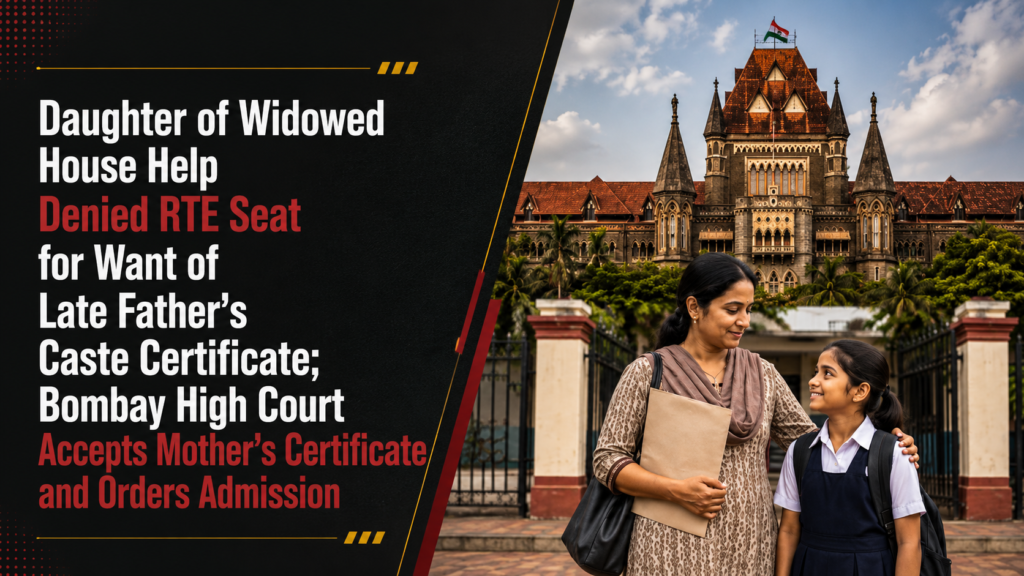
Single Mother Produced Her Nomadic Tribe Certificate but School Insisted on Deceased Father’s Certificate; Bombay High Court Calls Approach Arbitrary and Grants RTE Admission
Facts
- Ranjana Yogesh Jadhav is a 35-year-old single mother who works as a house help.
- Her daughter, Arohee Yogesh Jadhav, was born from her marriage with Yogesh Jagan Jadhav.
- Arohee’s father died on 7 December 2021. Since then, the petitioner has been solely responsible for the child’s upbringing.
- The petitioner and her deceased husband belonged to the Dhangar community, recognised as Nomadic Tribe (C).
- The petitioner applied for Arohee’s admission under the Right of Children to Free and Compulsory Education Act, 2009. Aditya English Medium School, Pune, was allotted to the child.
- The petitioner produced her own caste certificate issued by the competent authority.
- The Taluka Level Scrutiny Committee rejected Arohee’s admission because the caste certificate of her deceased father was not produced.
- The petitioner explained that the father had died before obtaining a caste certificate. She also produced his School Leaving Certificate, which recorded his caste as Dhangar.
- On 30 April 2026, the Education Officer, acting as the First Appellate Authority, dismissed the petitioner’s appeal.
- On 21 May 2026, the Deputy Director of Education, Pune, acting as the Second Appellate Authority, affirmed the rejection.
- The petitioner approached the Bombay High Court under Article 227 of the Constitution, challenging the denial of her daughter’s RTE admission.
- During the proceedings, the High Court directed the State to verify the deceased father’s School Leaving Certificate. The concerned school confirmed its authenticity from the official register.
Issues
- Whether RTE admission could be rejected merely because the caste certificate of the child’s deceased father was unavailable.
- Whether the valid caste certificate of the child’s mother could be accepted where the mother was the sole surviving parent and natural guardian.
- Whether it is an inflexible rule that a child must always take and prove only the father’s caste.
- Whether the authorities’ insistence on the father’s caste certificate violated the child’s fundamental right to free and compulsory education.
- Whether rigid application of documentary requirements infringed the petitioner’s right to equality and reflected a patriarchal approach.
- Whether the mother’s caste certificate, supported by the deceased father’s verified School Leaving Certificate, sufficiently established the child’s eligibility.
Petitioner’s Arguments
- The authorities adopted a hyper-technical approach by insisting on the caste certificate of the child’s deceased father.
- The father had died before obtaining a caste certificate. The petitioner could not be expected to produce a document that never existed.
- The petitioner was the child’s sole parent and possessed a valid caste certificate showing that she belonged to the Dhangar community, recognised as Nomadic Tribe (C).
- The deceased father’s School Leaving Certificate also recorded his caste as Dhangar.
- The child had already been found otherwise eligible for admission under the RTE quota and had been allotted Aditya English Medium School.
- Refusing to consider the mother’s caste certificate merely because the father’s certificate was unavailable was arbitrary and discriminatory.
- The approach of the authorities reflected the assumption that a child’s identity and caste could be recognised only through the father.
- Such an approach violated the child’s dignity and fundamental right to free and compulsory education.
- The petitioner relied on X.Y.Z. v. State of Maharashtra, where the Bombay High Court disapproved a technical approach by State authorities when it affected a child’s constitutional rights.
Respondents’ Arguments
- The State argued that the authorities had examined the application according to the applicable admission norms.
- Since the father’s caste certificate was not produced, the authorities treated the application as deficient.
- The rejection was therefore defended as a consequence of non-compliance with the required documentary procedure.
Analysis of the Law
Right to free and compulsory education
- The RTE Act gives effect to the constitutionally guaranteed right of children to free and compulsory education.
- Authorities administering RTE admissions must consider applications in a manner consistent with constitutional equality, dignity and the child’s right to education.
- A procedural requirement cannot be applied mechanically when compliance is impossible and sufficient alternative evidence is available.
Mother as the natural guardian
- Where the father is dead, absent from the child’s life or has failed to discharge parental responsibilities, the mother is recognised as the child’s natural guardian.
- The authorities must therefore recognise the mother’s legal status and cannot insist that every aspect of the child’s eligibility be proved exclusively through the father.
Determination of a child’s caste
- It is not an immutable rule that a child must always take the caste of the father.
- In appropriate circumstances, a child may take the mother’s caste, particularly where the child was raised by the mother and experienced the same social disadvantages and discrimination.
- Determination of caste is not controlled by a conclusive paternal presumption. The relevant family circumstances and supporting evidence must be considered.
Substantive equality over technical procedure
- Equality does not mean blindly applying the same documentary requirement regardless of a person’s circumstances.
- The petitioner was a widowed single mother who could not produce a caste certificate that her deceased husband had never obtained.
- Rejecting the application without considering the mother’s valid certificate and the father’s School Leaving Certificate sacrificed substantive equality to procedural rigidity.
- The authorities were required to adopt a practical and constitutionally sensitive approach.
Precedent Analysis
- X.Y.Z. and Another v. State of Maharashtra and Others, Writ Petition No. 15528 of 2025
- A Division Bench of the Bombay High Court disapproved a pedantic and excessively technical approach by State authorities where their decision affected a child’s constitutional rights.
- Administrative formalities cannot be enforced without considering their consequences for the child.
- The decision supported the petitioner’s argument that RTE authorities were required to examine her daughter’s application through the lens of dignity, equality and the right to education.
- Githa Hariharan and Another v. Reserve Bank of India and Another, AIR 1999 SC 1149
- The Supreme Court interpreted the law on natural guardianship in a manner consistent with constitutional equality.
- A mother can act as the child’s natural guardian where the father is dead, absent or not discharging parental responsibilities.
- The expression concerning the father’s absence is not confined only to his physical death; it also covers circumstances where he is not available to care for the child.
- In the present case, the father had died and the petitioner was unquestionably the sole parent and natural guardian.
- Rameshbhai Dabhai Naika v. State of Gujarat, (2012) 3 SCC 400
- The Supreme Court held that the caste of a child born from an inter-caste marriage or a marriage between a tribal and non-tribal person is a question of fact.
- There may be a presumption that the child takes the father’s caste, but that presumption is neither conclusive nor irrebuttable.
- Evidence may show that the child was raised by the mother and suffered the same social disadvantages as the mother’s community.
- The judgment establishes that caste cannot invariably be determined by looking only at the father’s status.
- Dr. Sonal Pratapsingh Vahanwala v. Deputy District Collector (Encroachment), Dharavi Division, Mumbai and Others, 2022 SCC OnLine Bom 628
- The case concerned a child adopted by a single mother belonging to a Scheduled Caste.
- The Bombay High Court held that the adopted child could take the caste of the mother.
- The Court observed that such a child stood on a stronger footing because the biological parents’ caste might not even be known.
- The decision supported the principle that a child’s caste identity is not permanently or exclusively tied to the father.
Court’s Reasoning
- The father’s death, the petitioner’s status as a single parent and her valid Dhangar caste certificate were undisputed.
- Arohee had already been found otherwise eligible for admission under the RTE quota and had been allotted a school.
- The only reason for rejection was the petitioner’s inability to produce the caste certificate of the deceased father.
- The authorities failed to examine the matter from the perspective of the child’s fundamental right to free and compulsory education.
- They treated the case like a routine administrative matter rather than considering the practical impossibility confronting a widowed mother.
- The insistence that the father’s caste certificate alone could establish the child’s eligibility represented a narrow and patriarchal understanding of parenthood and identity.
- The mother’s valid caste certificate established that she belonged to the Dhangar community.
- Additionally, the deceased father’s School Leaving Certificate recorded that he was also Dhangar.
- At the High Court’s direction, the Headmaster of Jijamata Secondary and Higher Secondary School, Sindkhed Raja, verified that:
- Yogesh Jadhav had studied in the school; and
- His School Leaving Certificate had been issued from the school’s official register.
- There was therefore no factual dispute regarding the caste of either parent.
- The authorities could not lightly disregard these documents and mechanically demand the father’s caste certificate.
- Constitutional equality and the child’s right to education could not be sacrificed at the altar of procedural rigidity.
- In the circumstances, the authorities ought to have accepted the mother’s caste certificate by treating her as the child’s sole parent.
- The verified School Leaving Certificate of the father provided additional confirmation of the child’s caste eligibility.
Conclusion
The Bombay High Court held that Arohee’s RTE admission could not be rejected merely because her deceased father’s caste certificate was unavailable.
The petitioner was the child’s sole surviving parent and possessed a valid caste certificate showing that she belonged to the Dhangar Nomadic Tribe (C). The father’s verified School Leaving Certificate further confirmed that he belonged to the same community.
The Court held that rigid insistence on the deceased father’s caste certificate violated substantive equality and threatened the child’s fundamental right to free and compulsory education.
The Court accordingly:
- Allowed the writ petition;
- Quashed the orders dated 21 May 2026 and 30 April 2026;
- Directed the authorities to grant Arohee immediate admission without insisting on her father’s caste certificate; and
- Directed that admission be completed on or before 31 July 2026.
Case Details
Case: Ranjana Yogesh Jadhav v. Principal Secretary, School Education Department, State of Maharashtra and Others
Court: High Court of Judicature at Bombay, Civil Appellate Jurisdiction
Case Number: Writ Petition No. 7647 of 2026
CNR: HCBM010270902026
Judge: Justice N.J. Jamadar
Reserved on: 13 July 2026
Pronounced on: 22 July 2026
Result: Petition allowed; appellate orders quashed; immediate RTE admission directed without the deceased father’s caste certificate, on or before 31 July 2026.