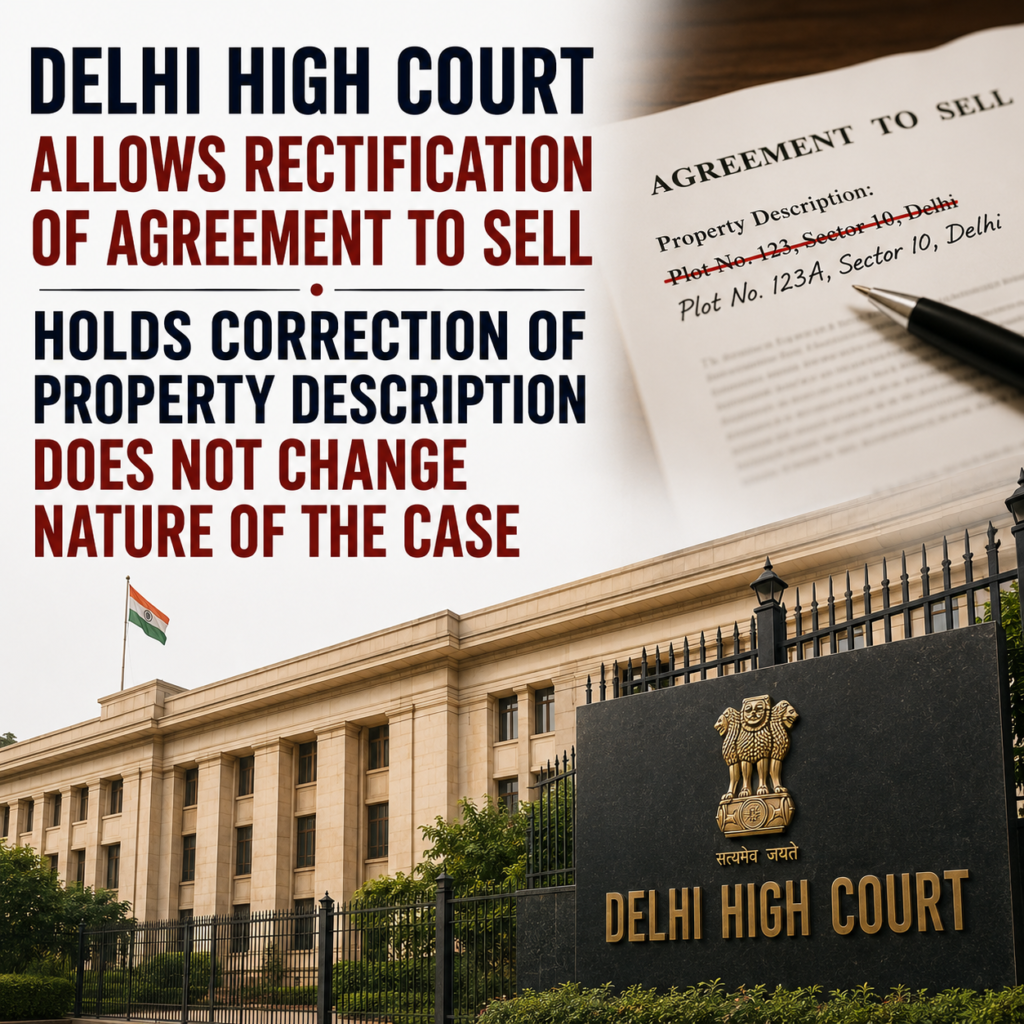
Delhi High Court Allows Plaintiff to Amend Specific Performance Suit, Holds Property Description in Agreement to Sell Can Be Rectified Under Section 26 of Specific Relief Act
Facts
The plaintiff, Pawwan Khanna, filed a suit for specific performance of an Agreement to Sell and GPA dated 5 January 2016, allegedly executed by defendant no. 1, Deepak Bagga, concerning agricultural land situated in Village Jonapur, Tehsil Mehrauli, New Delhi. The plaintiff claimed that he paid the entire sale consideration of ₹4.50 crore to defendant no. 1 on 6 January 2016, comprising ₹4 crore in cash and ₹50 lakh through RTGS.
The original plaint described the property as 8 bighas and 32 biswas in Mustatil No. 61, Kila Nos. 16/2 and 17/1. The plaintiff later claimed that this description was incorrect because defendant no. 1 was not the owner of Kila No. 17/1. According to the plaintiff, the correct property intended to be sold was 3 bighas and 12 biswas out of 4 bighas and 16 biswas comprising Mustatil No. 60, Khasra No. 20 and Mustatil No. 61, Khasra Nos. 16/3 min, 16/1 min and 16/2 min.
The plaintiff also sought to bring on record a Settlement Agreement dated 24 February 2025, executed between him and Amit Bagga, son/legal heir of deceased defendant no. 1, in criminal proceedings arising from FIR No. 127/2018. The plaintiff relied on this agreement to show the true property description allegedly intended by the parties.
Issues
Whether the Settlement Agreement dated 24 February 2025 could be taken on record as an additional document.
Whether the plaintiff could amend the plaint to correct the property description.
Whether the plaintiff could add a prayer for rectification of the Agreement to Sell under Section 26 of the Specific Relief Act.
Whether the proposed amendment would change the nature of the suit or introduce a new cause of action.
Whether the amendment was barred by limitation or prejudicial to defendant no. 4, who claimed to be a bona fide purchaser.
Plaintiff’s Arguments
The plaintiff argued that the wrong property description in the Agreement to Sell and plaint was the result of mistake/misrepresentation and did not reflect the real intention of the parties.
He submitted that defendant no. 1 owned only 4 bighas and 16 biswas in the corrected khasra numbers, and therefore the property description in the Agreement to Sell and plaint required rectification.
The plaintiff further argued that the amendments were necessary for complete adjudication of the suit, which remained a suit for specific performance. He also sought to incorporate subsequent sale deeds executed from defendant no. 2 to defendant no. 3 and from defendant no. 3 to defendant no. 4, along with prayers for declaring those sale deeds null and void.
Defendants’ Arguments
Defendant no. 4 opposed the amendment, claiming to be a bona fide purchaser under the registered sale deed dated 20 July 2022 and in actual possession of the property.
It was argued that the plaintiff was aware of the correct property description even before filing the suit, as reflected in FIR dated 4 May 2018, and therefore the amendment was delayed, mala fide and dishonest.
Defendant no. 4 contended that changing the property description would amount to filing a fresh suit for specific performance of a different property after several years. It was also argued that rectification under Section 26 of the Specific Relief Act could not be granted where the plaintiff himself alleged misrepresentation and not mutual mistake.
The defendants further argued that the Settlement Agreement was a convenience document and suggested collusion between the plaintiff and the legal heir of defendant no. 1.
Analysis of the Law
The Court held that under Order VII Rule 14(3) CPC, an additional document may be taken on record with leave of the Court. At that stage, the Court is not required to decide the genuineness or evidentiary value of the document; it only has to consider whether sufficient cause exists for not filing it earlier.
Since the Settlement Agreement was executed in 2025, long after the suit was filed in 2018, it could not have been filed along with the plaint. The Court therefore allowed it to be taken on record, while clarifying that its relevance, admissibility and genuineness would be examined at trial.
On amendment, the Court applied Order VI Rule 17 CPC and Section 26 of the Specific Relief Act. It held that rectification of an instrument may be sought where, due to fraud or mutual mistake, the written instrument does not express the real intention of the parties.
Precedent Analysis
The Court relied on Revajeetu Builders and Developers v. Narayanaswamy and Sons, where the Supreme Court laid down factors for deciding amendment applications, including whether the amendment is necessary for adjudication, whether it is bona fide, whether it causes irreparable prejudice, whether it changes the nature of the case, and whether a fresh suit on the amended claim would be time-barred.
The Court also relied on Puran Ram v. Bhaguram, where the Supreme Court held that correction or rectification of the property description in an agreement for sale and in the plaint does not necessarily change the nature of a suit for specific performance, and such amendment can relate back to the date of filing of the suit.
The Court further referred to Md. Islamuddin v. S.S. Kapoor, following the principle that at the stage of taking additional documents on record, the Court does not decide their genuineness or evidentiary value.
Court’s Reasoning
The Court held that the proposed amendment did not amount to setting up a completely new case. The plaintiff’s basic case remained that defendant no. 1 had agreed to sell land to him, received ₹4.50 crore, failed to execute the sale deed, and thereafter transferred the property to others.
The Court rejected defendant no. 4’s objection that the amendment would convert the suit into a fresh suit for a different property. It held that the amendment sought to correct the Mustatil/Khasra details so as to reflect the property allegedly owned by defendant no. 1 and intended to be sold.
The Court also held that a prayer for rectification under Section 26 of the Specific Relief Act could be introduced by amendment at any stage of the proceedings. Compelling the plaintiff to file a separate suit would defeat the purpose of Section 26.
The Court further held that limitation and prejudice objections could not defeat the amendment at this stage because the suit was still at a pre-trial stage, pleadings were not complete, and defendants would have full opportunity to file amended written statements and lead evidence.
Conclusion
The Delhi High Court allowed the plaintiff’s application to place the Settlement Agreement dated 24 February 2025 on record. It also allowed the amendment application to correct the property description, add pleadings and reliefs concerning subsequent sale deeds, and introduce a prayer for rectification of the Agreement to Sell.
However, the plaintiff’s proposed alternative prayer for refund of ₹4.50 crore was rejected as it was not pressed. The Court imposed costs of ₹50,000 on the plaintiff and directed him to file the amended plaint within two weeks. The defendants were granted liberty to file written statements to the amended plaint within the statutory period.
Case: Pawwan Khanna v. Deepak Bagga & Anr.
Court: Delhi High Court
Case Number: CS(OS) 320/2018 with connected interim applications
Judge: Justice Mini Pushkarna
Date: 3 July 2026
Result: Settlement Agreement taken on record; amendment of plaint allowed with ₹50,000 costs; refund prayer rejected as not pressed; amended pleadings directed.