


Court’s decision
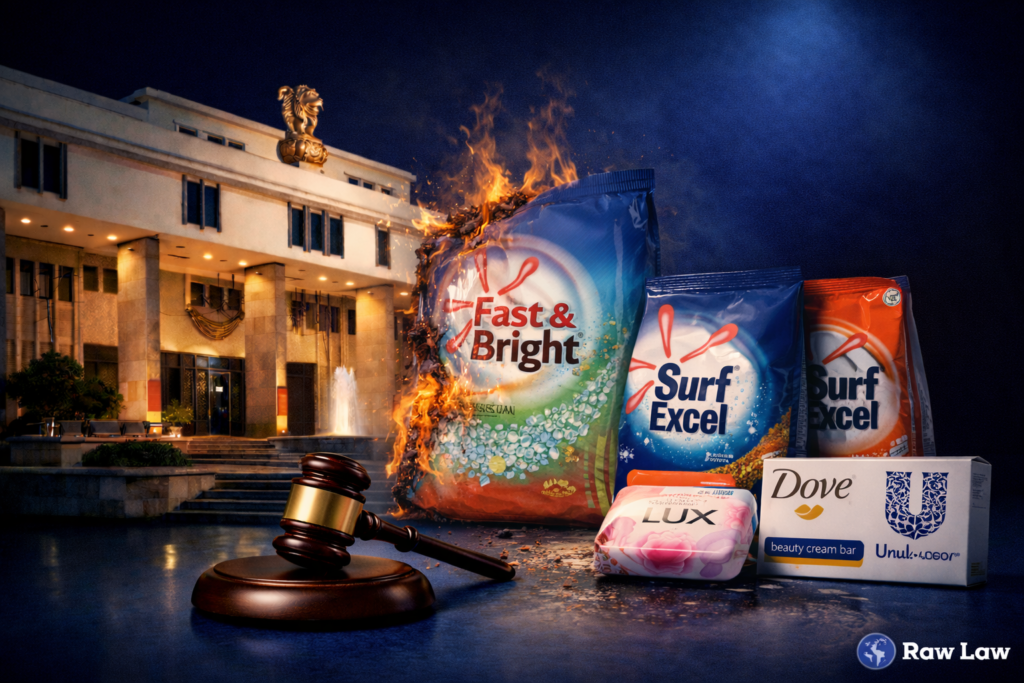
The Delhi High Court decreed a long-pending trademark and copyright infringement suit filed by Hindustan Lever Ltd. and its co-plaintiff, permanently restraining the defendants from manufacturing and selling counterfeit fast-moving consumer goods (FMCG) under well-known brands such as Sunsilk, Clinic Plus, Lakme, Head & Shoulders, Ariel and others.
Justice Tejas Karia held that the defendants had indulged in large-scale counterfeiting of registered trademarks and copyrighted packaging artwork. The Court awarded ₹2,50,000 as damages, directed payment within four weeks, and granted interest at 9% per annum in case of default .
Facts
The plaintiffs, market leaders in FMCG products including soaps, detergents, shampoos, cosmetics, beverages and health products, initiated the suit after conducting multiple police raids at the defendants’ premises on 17.10.2002, 29.01.2003 and 10.05.2003.
As detailed in the tabulated list on pages 2–3 of the judgment, the counterfeit goods included products under iconic marks such as “Fair & Lovely,” “Sunsilk,” “Clinic Plus,” “Lakme,” “Pond’s,” “Lux,” “Surf,” “Rin,” “Head & Shoulders,” “Pantene,” “Ariel,” “Vicks,” and several others.
Search and seizure memos demonstrated recovery of substantial quantities of counterfeit shampoos, creams, detergents and cosmetics, with packaging nearly identical to the plaintiffs’ original artwork.
Issues
The Court framed issues including:
- Whether the plaintiffs were proprietors of the trademarks and artistic works.
- Whether the defendants infringed trademarks and copyright.
- Whether passing off was established.
- Whether the plaintiffs were entitled to damages and interest.
- Whether the suit suffered from mis-joinder or required stay due to criminal proceedings.
Plaintiffs’ arguments
The plaintiffs argued that they had used and registered the marks for decades and enjoyed immense goodwill across India and internationally. The registration details, reproduced in tabular form on pages 11–12, evidenced statutory rights dating back to the 1950s and 1960s.
They submitted that the packaging of counterfeit goods was a near-complete reproduction of their artistic works under Section 2(c) of the Copyright Act, 1957, differing only in inferior printing quality.
Despite repeated criminal raids, the defendants continued infringing activities. The plaintiffs contended that the defendants’ conduct amounted to deliberate counterfeiting, passing off and copyright infringement warranting damages and costs.
Defendants’ position
The defendants initially filed a written statement but later stopped appearing in court. Defendant Nos. 1 and 3 were proceeded ex parte after failing to appear despite notice.
No evidence was led to rebut the plaintiffs’ claims. The defendants did not cross-examine witnesses or challenge documentary evidence of registration, seizures or packaging similarity.
Analysis of the law
The Court examined the plaintiffs’ trademark registrations and copyright ownership. The marks were found to be validly registered under the Trade Marks Act and supported by documentary evidence.
The plaintiffs were also held to be proprietors of the artistic works embodied in product packaging, designed through commissioned artwork and protected under copyright law.
The Court reiterated that registered trademarks are entitled to the highest degree of statutory protection, along with common law rights against passing off.
Precedent analysis
In determining damages, the Court relied on Strix Ltd. v. Maharaja Appliances Ltd. (2023), holding that where defendants fail to contest proceedings or disclose accounts, courts may award notional damages on a reasonable basis.
The plaintiffs also relied on Time Incorporated v. Lokesh Srivastava and Disney Enterprises Inc. v. Dhiraj, which recognized punitive damages in intellectual property infringement cases to deter habitual counterfeiters.
While the Court did not separately quantify punitive damages, it applied principles of deterrence in awarding damages and actual costs.
Court’s reasoning
The Court found that the defendants had indulged in systematic counterfeiting of identical goods using deceptively similar trademarks and identical trade channels.
Consumers were likely to associate counterfeit goods with the plaintiffs, causing dilution of goodwill and erosion of consumer trust. The Court noted that counterfeit products not only harm brand owners but also deceive consumers and cause potential health risks due to inferior quality.
Given the scale of seizures documented in police memos and the defendants’ continued infringement despite raids, the Court concluded that infringement, copyright violation and passing off were fully established.
Conclusion
The Delhi High Court decreed the suit in favour of the plaintiffs, granting permanent injunction against infringement and passing off.
Defendant Nos. 1, 3 and 4 were directed to jointly and severally pay ₹2,50,000 as damages within four weeks, failing which interest at 9% per annum would accrue.
The plaintiffs were also held entitled to actual costs under the Commercial Courts Act, 2015 and Delhi High Court rules .
Implications
This judgment reinforces judicial intolerance toward FMCG counterfeiting and large-scale trademark piracy.
Key takeaways include:
• Registered trademarks enjoy highest statutory and common law protection.
• Reproduction of packaging artwork constitutes copyright infringement.
• Counterfeiting invites damages even in absence of detailed sales data.
• Courts may award actual costs under commercial litigation regime.
• Continued infringement despite raids aggravates liability.
The ruling sends a strong deterrent message to counterfeiters operating in India’s FMCG market.
Case law references
- Strix Ltd. v. Maharaja Appliances Ltd. (2023 SCC OnLine Del 7128) – Notional damages may be awarded where defendants fail to contest proceedings.
- Time Incorporated v. Lokesh Srivastava (2005) – Courts may award punitive damages in trademark infringement cases.
- Disney Enterprises Inc. v. Dhiraj – Emphasized deterrent damages in intellectual property violations.
FAQs
1. Can courts award damages even if the defendant does not appear?
Yes. Courts can grant notional or reasonable damages based on available evidence, especially in ex parte intellectual property cases.
2. Does copying packaging artwork amount to copyright infringement?
Yes. Product packaging artwork qualifies as an artistic work under the Copyright Act, and reproduction constitutes infringement.
3. Can civil suits continue alongside criminal raids in counterfeiting cases?
Yes. The Delhi High Court clarified that pendency of criminal proceedings does not bar civil trademark and copyright suits.