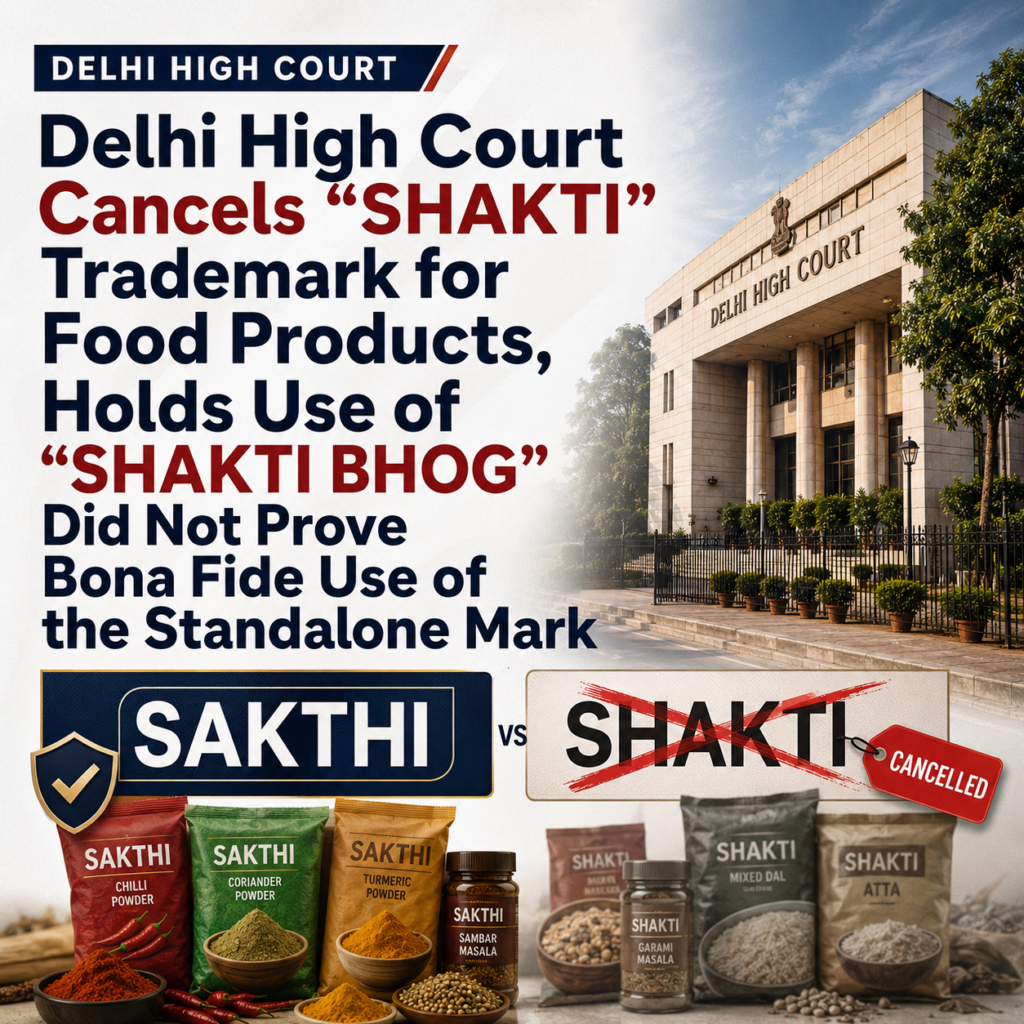
No Invoices, Advertisements or Sales Proof for “SHAKTI”; Delhi High Court Cancels Class 30 Registration
Facts
The petitioner, Mr. P.C. Duraisamy, claimed to have adopted the trademark “SAKTHI” in 1977 for food products such as spices, masala powders, pickles, edible oils, flour and papad.
The petitioner obtained registration of the mark in 1979 with a claimed user date of 2 March 1977. Over time, the petitioner secured several registrations for “SAKTHI” and its variants in Class 30 and other classes.
The petitioner also claimed substantial goodwill, reputation, nationwide sales and international exports under the “SAKTHI” brand.
Respondent No. 1, Kewal Krishan Kumar, applied for registration of the standalone word mark “SHAKTI” in Class 30 on 12 March 1996. The mark was eventually registered on 22 May 2018 under Registration No. 701410.
The petitioner had opposed the application before the Trade Marks Registry. However, the opposition was dismissed on procedural grounds because the petitioner failed to complete the evidentiary requirements.
The petitioner thereafter filed rectification proceedings seeking removal of the “SHAKTI” mark under Sections 47 and 57 of the Trade Marks Act, 1999.
The rectification proceeding was initially filed before the Intellectual Property Appellate Board and was later transferred to the Delhi High Court.
Respondent No. 3 claimed rights through assignment of the “SHAKTI BHOG” family of marks and opposed the petition.
Issues
- Whether the registered trademark “SHAKTI” was liable to be removed under Section 47(1)(a) for lack of bona fide intention to use and absence of actual use.
- Whether the mark was liable to be removed under Section 47(1)(b) for continuous non-use for five years.
- Whether use of the composite mark “SHAKTI BHOG” could be treated as use of the standalone mark “SHAKTI.”
- Whether the marks “SAKTHI” and “SHAKTI” were phonetically, structurally and conceptually similar.
- Whether continued registration of “SHAKTI” was likely to cause confusion among consumers purchasing Class 30 food products.
- Whether Respondent No. 3 had locus standi to oppose the rectification petition on the basis of the assignment deed.
- Whether Respondent No. 3 could rely upon honest and concurrent use under Section 12 of the Trade Marks Act.
- Whether the “SHAKTI” mark had been wrongly entered or wrongly remained on the Register under Section 57(2).
Petitioner’s Arguments
The petitioner argued that “SAKTHI” had been adopted in 1977 and registered in 1979, much before the respondent’s application for “SHAKTI” in 1996.
It submitted that the mark had been continuously used for food products and had acquired substantial goodwill and reputation over several decades.
The petitioner contended that Respondent Nos. 1 and 3 had not produced a single invoice, advertisement or other documentary record demonstrating independent use of the standalone mark “SHAKTI.”
According to the petitioner, the registration was merely a paper registration obtained without any bona fide intention to use the mark.
It was argued that “SHAKTI” was the phonetic equivalent of “SAKTHI” and was registered for similar goods in the same class. Its continued registration was therefore likely to cause confusion and dilute the petitioner’s rights.
The petitioner also relied upon an earlier Trade Marks Registry order dated 26 June 2009 concerning the mark “SAKTHI TOOR DHALL.”
In those proceedings, the opposition filed by Respondent No. 1 was dismissed and the petitioner’s rights over “SAKTHI” were accepted.
The petitioner argued that Respondent No. 1 had failed to challenge that order.
It further submitted that Respondent No. 3 had no locus standi because the assignment deed expressly referred to “SHAKTI BHOG” and did not specifically assign the standalone “SHAKTI” mark.
The petitioner rejected the argument that use of “SHAKTI BHOG” could legally be deemed to amount to use of “SHAKTI.”
It also contended that honest concurrent use could not be claimed without proof of actual use.
Respondent’s Arguments
Respondent No. 3 claimed that the predecessor business had adopted “SHAKTI BHOG” as early as 1975 and had continuously used it for food products.
It relied upon old registrations, advertisements and invoices for the composite mark “SHAKTI BHOG.”
Respondent No. 3 argued that rights in the “SHAKTI BHOG” marks and pending applications had been assigned to it through an assignment deed dated 30 December 2017.
It submitted that the use of the composite mark “SHAKTI BHOG” should be treated as use of the prominent and distinctive element “SHAKTI.”
Reliance was placed upon Sections 15, 17 and 55(2) of the Trade Marks Act.
The respondent argued that “BHOG” was common to the trade or non-distinctive and that the real source-identifying element of the composite mark was “SHAKTI.”
Therefore, use of “SHAKTI BHOG” should amount to use of “SHAKTI.”
It also argued that the petition under Section 47(1)(b) was premature because the mark had been registered in May 2018 and the petition was filed in April 2019, before expiry of the mandatory five-year period.
Respondent No. 3 claimed honest and concurrent use and relied upon Section 12 of the Act.
It further argued that the rival marks were used for different products and that the petitioner had failed to establish actual consumer confusion.
The respondent also challenged the petitioner’s evidence of prior use, contending that the earlier invoices reflected only the trade name “Sakthi Trading Company” rather than trademark use.
Analysis of the Law
Removal for Non-Use Under Section 47(1)(a)
Section 47(1)(a) permits removal of a trademark where it was registered without a bona fide intention that it should be used and where there was no bona fide use up to three months before the rectification application.
The Court found that neither Respondent No. 1 nor Respondent No. 3 produced any documentary evidence demonstrating actual use of the standalone mark “SHAKTI.”
Although evidence was produced for “SHAKTI BHOG,” no invoice, advertisement, packaging or sales record showed use of “SHAKTI” independently.
There was no proof of use:
- before the application dated 12 March 1996;
- between the application and registration;
- after registration on 22 May 2018; or
- during the relevant three-month period before the rectification petition.
The Court held that the petitioner had discharged the initial burden by specifically asserting non-use and by consistently opposing the registration.
The evidentiary burden thereafter shifted to the respondents to establish bona fide intention and use. They failed to do so.
The Court therefore held that Section 47(1)(a) was attracted.
Five-Year Non-Use Under Section 47(1)(b)
Section 47(1)(b) requires continuous non-use for a period of five years from the date the mark is entered on the Register.
The “SHAKTI” mark was registered on 22 May 2018, while the rectification petition was filed on 8 April 2019.
The statutory five-year period had not elapsed.
The Court therefore rejected the petition to the extent it relied upon Section 47(1)(b).
However, this did not defeat the petition because a valid case had been established under Section 47(1)(a).
Use of Composite Mark Versus Standalone Mark
Respondent No. 3 argued that use of “SHAKTI BHOG” should be deemed to be use of “SHAKTI” under Sections 15, 17 and 55.
The Court found the argument legally interesting and potentially plausible in an appropriate case.
However, it held that the interpretation could not be used to overcome the complete absence of factual evidence showing independent use of “SHAKTI.”
The Court emphasised that a legal deeming argument could not be applied in a manner that defeated rights already acquired by another registered and prior user.
The petitioner had a longstanding registration of “SAKTHI,” and the respondent had failed to prove use of “SHAKTI.”
Therefore, the use of “SHAKTI BHOG” could not rescue the standalone registration.
Prior Registration and Prior Use
The petitioner’s original “SAKTHI” registration dated back to 1979 with a claimed user date of 1977.
The Court observed that some early invoices reflected the trade name rather than clear trademark use.
However, an invoice dated 8 January 2010 and subsequent documents demonstrated actual use of “SAKTHI.”
By contrast, there was no evidence of independent use of “SHAKTI” at any stage.
The petitioner was therefore held to be both the prior registrant and the prior proven user of the competing standalone mark.
The judgment also referred to the petitioner’s numerous formative registrations, a list of which was reproduced on pages 18 and 19 of the judgment.
Likelihood of Confusion
The Court compared “SAKTHI” and “SHAKTI” and held that they were:
- phonetically identical;
- structurally almost identical;
- conceptually identical; and
- used for products falling in the same Class 30.
The placement of the letter “H” at a different position did not materially distinguish the marks.
Both words conveyed the same meaning, namely power, energy or ability.
The Court applied the perspective of an average consumer with imperfect recollection and found a clear likelihood of confusion or deception.
Honest and Concurrent Use
Section 12 protects honest and concurrent use in appropriate circumstances.
The Court held that a party claiming this protection must prove actual concurrent and honest use through tangible evidence.
Mere assertion was insufficient.
Because no evidence of standalone use of “SHAKTI” was produced, the respondent could not rely upon Section 12.
Locus of Respondent No. 3
The petitioner argued that Respondent No. 3 was assigned only the “SHAKTI BHOG” mark and not “SHAKTI.”
The Court examined Clause 10 of the assignment deed dated 30 December 2017.
It permitted the assignee to bring itself on record in relation to pending applications for “SHAKTI BHOG” or its variants.
The Court interpreted “variants” broadly enough to include the pending “SHAKTI” application.
Respondent No. 3 was therefore held to have locus standi to oppose the petition.
Rectification Under Section 57(2)
Section 57(2) permits removal of a mark that was entered without sufficient cause or wrongly remains on the Register.
The Court held that continued registration of “SHAKTI” was unjustified because:
- there was no evidence of bona fide use;
- there was no proof of bona fide intention to use;
- the petitioner had earlier and established rights in “SAKTHI”; and
- the rival marks were confusingly similar for the same class of goods.
The mark therefore wrongly remained on the Register.
Precedent Analysis
Rong Thai International Group Co. Ltd. v. Ena Footwear Private Limited
The respondent relied upon this decision to argue that a non-use claim under Section 47(1)(b) cannot be filed before completion of five years from registration.
The Court accepted this proposition and held that the claim under Section 47(1)(b) was premature.
However, the precedent did not affect the independently sustainable claim under Section 47(1)(a).
London Rubber Co. Ltd. v. Durex Products Incorporated
The respondent relied upon this Supreme Court decision concerning honest and concurrent use.
In that case, actual prior use of the mark had been established through evidence.
The Delhi High Court distinguished it because Respondent Nos. 1 and 3 had failed to produce any proof of use of the standalone “SHAKTI” mark.
Without actual use, the doctrine of honest concurrent use could not apply.
Nandhini Deluxe v. Karnataka Co-operative Milk Producers Federation Limited
The respondent relied upon this decision to argue that similarity of marks does not necessarily result in confusion where the goods are different.
The Court distinguished the precedent because both parties in the present case dealt in food products falling within Class 30.
The competing marks were therefore used in the same commercial field, making confusion far more likely.
Sun Pharmaceutical Industries Ltd. v. Cipla Ltd.
This decision was relied upon in support of Respondent No. 3’s standing based on assignment.
The Court accepted that Clause 10 of the assignment deed was sufficiently wide to cover variants and pending applications, including the impugned “SHAKTI” mark.
Earlier Trade Marks Registry Order Dated 26 June 2009
The Court gave substantial weight to the earlier opposition decision concerning “SAKTHI TOOR DHALL.”
The Registrar had accepted the petitioner’s prior and continuous rights in “SAKTHI” and rejected Respondent No. 1’s opposition.
Neither Respondent No. 1 nor Respondent No. 3 challenged that order.
The unchallenged decision weighed against their present claim.
Court’s Reasoning
The Court found that the central weakness in the respondents’ case was the complete absence of evidence of actual use of “SHAKTI.”
The respondents had produced material relating to “SHAKTI BHOG,” but the registered mark under challenge was the standalone word “SHAKTI.”
Registration alone could not establish bona fide use.
The Court found it significant that:
- the application had been filed in 1996;
- registration was obtained only in 2018;
- the rectification petition was filed in 2019; and
- no proof of use was produced for any period before or after registration.
The respondents also failed to demonstrate a bona fide intention to use the mark independently.
The Court accepted that the legal interpretation based on Sections 15, 17 and 55 was intellectually attractive.
However, such interpretation could not replace missing evidence or create fictional use where no standalone use had occurred.
The petitioner, on the other hand, had longstanding registrations, substantial use and an earlier favourable opposition order.
The Court also found the marks “SAKTHI” and “SHAKTI” indistinguishable in ordinary pronunciation and meaning.
Since both were connected with Class 30 food products, the risk of consumer confusion was real.
The Court therefore held that the “SHAKTI” registration could not remain on the Register.
Conclusion
The Delhi High Court allowed the rectification petition.
It held that the registered trademark “SHAKTI” was liable to be removed under Section 47(1)(a) because Respondent Nos. 1 and 3 failed to establish any bona fide intention to use or actual use of the standalone mark.
The claim under Section 47(1)(b) was rejected as premature because five years had not elapsed from the date of registration.
The Court further held that the registration wrongly remained on the Register within the meaning of Section 57(2).
The Trade Marks Registry was directed to cancel and remove the “SHAKTI” mark registered under No. 701410 in Class 30 within four weeks.
No order as to costs was passed.
Case: Mr. P.C. Duraisamy v. Kewal Krishan Kumar & Others
Court: High Court of Delhi at New Delhi
Case Number: C.O. (COMM.IPD-TM) 180 of 2022
Judge: Justice Tushar Rao Gedela
Date: 24 June 2026
Result: Rectification petition allowed; registration of the standalone “SHAKTI” trademark in Class 30 ordered to be cancelled and removed from the Register within four weeks.