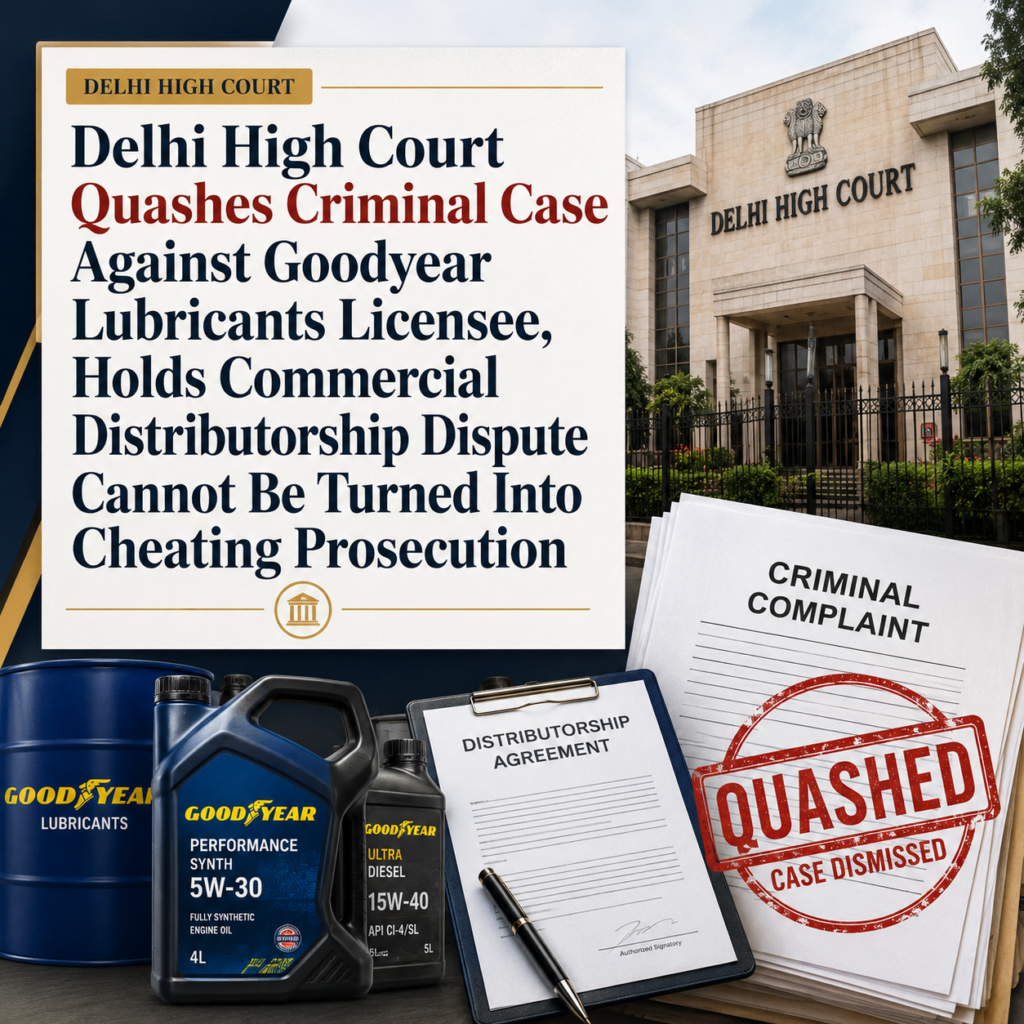
Delhi High Court Quashes Cheating FIR Against Goodyear Lubricants Licensee, Holds Distributor Dispute Was Civil and Commercial
Facts
Assurance International Limited filed a petition under Section 482 of the Code of Criminal Procedure seeking quashing of FIR No. 294/2022 registered at Police Station Hazrat Nizamuddin under Sections 406, 420 and 506 of the Indian Penal Code.
The FIR arose from a complaint filed by Ajit Singh, a partner of M/s Dass Automobiles. The complainant alleged that Assurance International Limited, operating under the brand “Goodyear Lubricants,” approached him for appointment as a distributor of lubricant products in New Delhi.
According to the complainant, the company represented that it was associated with the internationally reputed Goodyear brand and that its products met international quality standards. Relying on these representations, the complainant placed orders worth approximately ₹1.75 crore between January 2021 and March 2022.
The complainant alleged that customers later complained about the quality of the lubricants and claimed that the products were inferior, mixed with water and made from reused substances. He further alleged that:
- his distributorship was terminated after he sought replacement and refund;
- an invoice for ₹4,33,970 was raised without delivery of goods;
- approximately ₹18.33 lakh was due towards credit notes;
- stock worth ₹20 lakh became dead stock; and
- approximately ₹23 lakh remained unrecovered from customers.
During investigation, the complainant also alleged that the initial product packaging carried the United States flag and did not disclose the place of manufacture, thereby creating the impression that the products were manufactured in the United States.
The petitioner company denied the allegations and maintained that it was an authorised licensee of The Goodyear Tire & Rubber Company, USA, under a trademark licence agreement dated 9 April 2020.
During the pendency of the petition, the police filed a charge sheet under Sections 406, 420, 120-B and 34 IPC against the company and several of its officials.
Issues
- Whether the High Court could quash the FIR after filing of the charge sheet.
- Whether the availability of a remedy of discharge before the Trial Court barred the petition under Section 482 CrPC.
- Whether the petitioner had falsely represented itself as associated with Goodyear USA.
- Whether allegations concerning product quality and API standards disclosed dishonest intention from the inception of the transaction.
- Whether disputes concerning credit notes, stock, refunds and settlement of accounts constituted criminal breach of trust.
- Whether the ingredients of cheating under Section 420 IPC were established.
- Whether the ingredients of criminal breach of trust under Section 406 IPC were established.
- Whether criminal conspiracy under Section 120-B IPC could survive when the substantive offences were not made out.
- Whether filing repeated complaints before different authorities amounted to forum shopping and abuse of criminal process.
Petitioner’s Arguments
The petitioner argued that the FIR was a misuse of criminal law arising from a purely commercial dispute following termination of the complainant’s distributorship.
It submitted that the allegations principally related to:
- supply of allegedly defective goods;
- adjustment of credit notes;
- replacement and refund claims;
- outstanding payments;
- reconciliation of accounts; and
- termination of the distributorship.
These matters, according to the petitioner, could give rise to civil or contractual remedies but not criminal prosecution.
The petitioner further argued that no dishonest or fraudulent intention existed at the inception of the transaction. The parties had conducted business for nearly 15 months, during which the complainant placed more than 40 purchase orders and received goods worth approximately ₹1.75 crore.
The company had also provided promotional schemes, credit notes, manpower support and business incentives. Such prolonged commercial dealings were inconsistent with an allegation of deception from the beginning.
Regarding the Goodyear association, the petitioner relied on:
- the trademark licence agreement dated 9 April 2020;
- an authorisation letter issued by Goodyear USA;
- the response furnished by Goodyear India;
- documents filed before the Trademark Registry; and
- verification obtained from the Trademark Registry.
The petitioner also relied on the laboratory report, which found that the lubricant samples conformed to applicable Indian Standards and were synthetic-based products.
It argued that Section 406 IPC was inapplicable because there was no entrustment of property followed by dishonest misappropriation.
The petitioner further alleged that the complainant had approached several authorities and police stations in Delhi and Haryana on the same allegations, demonstrating forum shopping and mala fide use of the criminal process.
Respondents’ Arguments
The State argued that investigation had been completed and sufficient material had been collected to support offences under Sections 406, 420, 120-B and 34 IPC.
It submitted that since the charge sheet had already been filed, the petitioner should raise its contentions before the Trial Court at the stage of charge or discharge.
The complainant argued that the petitioner had induced him to enter the distributorship arrangement by falsely representing that:
- the products were backed by Goodyear USA;
- Goodyear USA provided technical support and product development;
- the lubricants complied with API specifications; and
- the products met international quality standards.
He submitted that the petitioner failed to produce complete material demonstrating technical approval, API compliance or foreign financial transactions corresponding to the alleged collaboration with Goodyear USA.
The complainant argued that the laboratory report only established compliance with Indian Standards and did not verify conformity with API specifications.
He also denied that the proceedings involved impermissible forum shopping and submitted that the material transactions and supply of goods took place in Delhi.
Analysis of the Law
The Court reiterated that the inherent power under Section 482 CrPC must be exercised cautiously. However, the Court may intervene where continuation of criminal proceedings would amount to abuse of process or where the allegations, even if accepted in their entirety, do not disclose the commission of an offence.
The Court held that filing of a charge sheet does not extinguish the High Court’s jurisdiction under Section 482 CrPC.
The FIR and charge sheet may be examined together to determine whether:
- the necessary ingredients of the alleged offences are disclosed;
- the materials collected during investigation support the allegations; or
- continuation of prosecution would amount to abuse of process.
The remedy of discharge before the Trial Court is not equivalent to the jurisdiction under Section 482. A petition for quashing permits a wider challenge, including one based on abuse of process, mala fides and documents that may not form part of the charge sheet.
Cheating
For Section 420 IPC, the prosecution must establish:
- deception;
- dishonest or fraudulent inducement;
- delivery of property because of such inducement; and
- dishonest intention from the inception of the transaction.
A subsequent breach of contract, failure to honour a commercial assurance or dispute over quality does not by itself constitute cheating.
Criminal breach of trust
For Section 406 IPC, there must be:
- entrustment of property or dominion over property; and
- dishonest misappropriation, conversion, use or disposal contrary to law or contract.
A dispute regarding outstanding amounts, credit notes or reconciliation of commercial accounts does not automatically amount to criminal breach of trust.
Criminal conspiracy
An offence under Section 120-B IPC requires an agreement between two or more persons to commit an illegal act.
Where the underlying substantive offences are not established and no specific agreement or overt act is alleged, the charge of conspiracy cannot survive.
Precedent Analysis
State of Haryana v. Bhajan Lal, 1992 Supp (1) SCC 335
The Supreme Court identified illustrative categories in which criminal proceedings may be quashed, including where:
- the allegations do not constitute an offence;
- the materials do not disclose commission of a cognizable offence;
- the allegations are absurd or inherently improbable; or
- the proceedings are maliciously instituted for an ulterior purpose.
The Court found the present case to fall within the principles governing abuse of criminal process.
Indian Oil Corporation v. NEPC India Ltd., (2006) 6 SCC 736
The Supreme Court held that criminal proceedings may be quashed where the complaint does not disclose an offence or where criminal law has been used to exert pressure in a civil or commercial dispute.
The Court cautioned against giving criminal colour to contractual disagreements while also emphasising that legitimate prosecution should not be stifled.
Mahmood Ali v. State of Uttar Pradesh, 2023 SCC OnLine SC 950
The Supreme Court held that where proceedings appear vexatious or motivated, the Court may examine the surrounding circumstances and read between the lines to prevent abuse of criminal law.
Abhishek v. State of Madhya Pradesh, 2023 SCC OnLine SC 1083
The decision reaffirmed the power of the High Court to intervene where criminal provisions are being misused in disputes lacking essential criminal ingredients.
Shaileshbhai Ranchhodbhai Patel v. State of Gujarat, 2024 SCC OnLine SC 5569
The Supreme Court held that filing of a charge sheet is not by itself a ground to refuse quashing.
The High Court may quash the FIR and charge sheet where, read together and accepted as true, they do not disclose an offence or continuation of proceedings would constitute abuse of process.
Mukesh v. State of Uttar Pradesh
The Supreme Court clarified that a petition seeking quashing does not become infructuous merely because a charge sheet has been filed.
The remedy of discharge is narrower than a petition under Section 482 CrPC, particularly because abuse of process and external unimpeachable documents may be considered in quashing proceedings.
Court’s Reasoning
The Court found that the allegation that Assurance International had falsely represented its association with Goodyear USA was contradicted by the investigation material itself.
The record included:
- an authorisation letter dated 7 February 2022 from Goodyear USA;
- a trademark licence agreement dated 9 April 2020;
- confirmation by Goodyear India that its parent company had granted a trademark licence to Assurance International;
- an affidavit filed by Goodyear USA before the Trademark Registry; and
- verification by the Trademark Registry of the licensing arrangement.
The licence authorised the petitioner to manufacture, promote, distribute and sell Goodyear-branded lubricants and related products in India and other territories.
Therefore, the allegation that the petitioner had illegally used the Goodyear name or falsely portrayed an association with Goodyear USA was not supported by the charge-sheet material.
Regarding the allegation of defective products, the Court noted that samples seized during investigation were examined by Shri Ram Laboratory, Noida.
The laboratory found that:
- the products were synthetic-based;
- they complied with applicable Indian Standards;
- water content was within permissible limits; and
- there was no scientific parameter to determine whether the products were reused.
API compliance could not be conclusively verified because the relevant API guidelines had not been supplied. However, this did not establish that the products were spurious, inherently substandard or supplied with dishonest intention.
The Court held that any dispute over whether the products fully conformed to API specifications or international quality assurances concerned contractual warranties and quality standards. Such issues were primarily civil and commercial.
The complainant had continued placing substantial orders from January 2021 until February 2022, and approximately 1,12,206 litres of lubricants were supplied. The Court considered this prolonged course of dealing inconsistent with the claim that the products were persistently defective and the transaction fraudulent from inception.
The claims relating to credit notes, dead stock, market dues, refunds and replacement were also found to concern reconciliation of commercial accounts.
The charge sheet itself recorded that:
- the complainant did not permit proper inspection of the alleged dead stock by opening the cartons; and
- he failed to provide particulars of customers who had allegedly withheld payments due to product defects.
The petitioner had offered a full and final settlement after verification of claims when terminating the distributorship.
The Court therefore found no entrustment or dishonest misappropriation necessary to constitute criminal breach of trust.
The allegation that the packaging created an impression of manufacture in the United States was also weakened by the welcome email dated 9 January 2021, which expressly informed the complainant that the products would be manufactured at facilities in Mumbai and Haryana.
Even assuming some commercial representation concerning technical support or collaboration was inaccurate, the Court held that this would not establish dishonest intention at the inception of the distributorship.
The Court further found that the complainant had approached multiple authorities in Delhi and Haryana on the same allegations. The complaint transferred to Gurugram was withdrawn only after registration of the Delhi FIR.
This repeated pursuit of parallel proceedings on the same cause of action was characterised as forum shopping and an attempt to use criminal prosecution for collateral purposes.
Since the ingredients of Sections 406 and 420 IPC were not made out, the charge of conspiracy under Section 120-B IPC also failed. No specific agreement or overt act was attributed to the individual company officials, who appeared to have been implicated merely because of the positions they held.
Conclusion
The Delhi High Court held that the dispute arose from a commercial distributorship arrangement involving supply of goods, alleged quality defects, credit notes, pricing, termination and settlement of accounts.
The investigation material itself established that Assurance International Limited was an authorised Goodyear USA trademark licensee and that the tested products complied with applicable Indian Standards.
There was no material showing dishonest or fraudulent intention from the inception of the transaction, no entrustment followed by misappropriation, and no specific criminal conspiracy.
The Court further held that filing repeated complaints before different authorities amounted to forum shopping and abuse of the criminal justice process.
FIR No. 294/2022 and all consequential proceedings, including the charge sheet, were quashed. The petition was allowed, and all pending applications were disposed of.
Case: Assurance International Limited v. State of NCT of Delhi and Another
Court: High Court of Delhi at New Delhi
Case Number: CRL.M.C. 5867/2022 with connected applications
Judge: Justice Amit Mahajan
Date: 1 July 2026
Result: Petition allowed; FIR under Sections 406, 420 and 506 IPC and all consequential proceedings quashed.