


Court’s decision
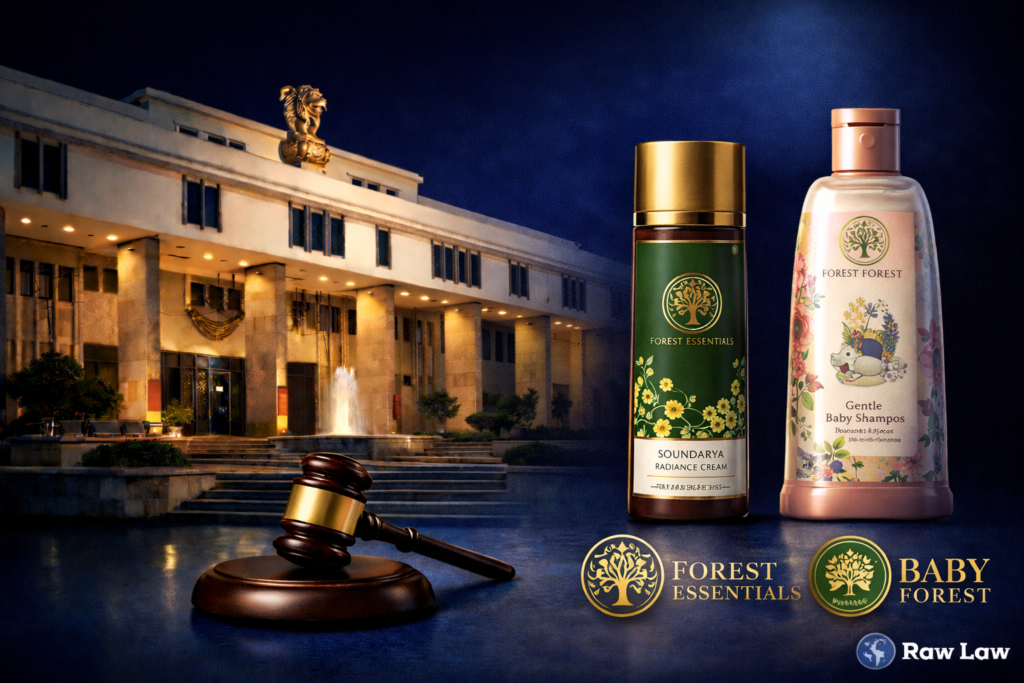
The Delhi High Court dismissed an appeal challenging the refusal of interim injunction against the use of the marks “BABY FOREST” and “BABY FOREST–SOHAM OF AYURVEDA”.
The Division Bench upheld the Single Judge’s order declining interim relief, holding that “FOREST ESSENTIALS” is a composite mark and the appellant cannot claim exclusive rights over the word “FOREST”. The Court found no prima facie case of deceptive similarity warranting injunction and refused to interfere with the discretionary order under the settled appellate standard .
Facts
The appellant, a well-known ayurvedic skincare brand, claimed continuous use of the trademark “FOREST ESSENTIALS” since 2000 and asserted substantial goodwill and turnover, including a baby care range marketed under variations such as “FOREST ESSENTIALS BABY”.
In 2023, it discovered that the respondent, operating under the name “Baby Forest Ayurveda Private Limited”, was selling baby care products under the marks “BABY FOREST” and “BABY FOREST–SOHAM OF AYURVEDA”.
The appellant alleged trademark infringement and passing off, seeking interim injunction under Order XXXIX Rules 1 and 2 of the Code of Civil Procedure. The Single Judge declined relief, prompting the present appeal.
Issues
The principal issues before the Division Bench were:
- Whether “BABY FOREST” is deceptively similar to “FOREST ESSENTIALS” or its baby care variants.
- Whether the appellant can claim monopoly over the word “FOREST”.
- Whether the Single Judge erred in applying the anti-dissection rule and initial interest confusion test.
- Whether appellate interference with a discretionary interim order was warranted.
Petitioner’s arguments
The appellant argued that “FOREST” is the dominant feature of its trademark and has acquired secondary meaning due to long-standing use and market reputation. It contended that both parties deal in ayurvedic baby care products, increasing the likelihood of confusion.
Reliance was placed on instances of alleged actual confusion, including hotel correspondence, social media queries, and predictive Google search results. The appellant also emphasized that even momentary confusion satisfies the test of infringement and that sophisticated consumers are not immune to deception.
It asserted that the respondents’ conduct, including rebranding and initial use of other similar expressions, reflected dishonest adoption.
Respondent’s arguments
The respondents contended that their mark “BABY FOREST” is a registered trademark and is structurally, visually and phonetically distinct from “FOREST ESSENTIALS”.
They argued that “FOREST ESSENTIALS” is a composite mark and the appellant cannot dissect it to claim exclusivity over “FOREST”. The word “FOREST” was described as generic or commonly used in the cosmetic and ayurvedic trade.
It was further submitted that the appellant’s baby care range is limited, whereas the respondents operate exclusively in the baby care segment. The respondents denied dishonest intent and submitted that the appellate court should not substitute its discretion for that of the Single Judge.
Analysis of the law
The Court reiterated foundational principles under trademark law distinguishing infringement and passing off. It referred to the anti-dissection rule, under which composite marks must be assessed as a whole rather than dissected into components.
The Court also referred to the dominant feature test but observed that neither “forest” nor “essentials” independently constituted a dominant feature in the appellant’s mark.
It relied on settled jurisprudence that dictionary words require stringent proof of secondary meaning before exclusive rights can be asserted. The Court also cited the appellate restraint principle governing interference with discretionary interim orders.
Precedent analysis
The Bench relied upon the Supreme Court’s decision in Wander Ltd. v. Antox India Pvt. Ltd., emphasizing that appellate courts should not interfere with discretionary orders unless perverse or arbitrary.
It also discussed the Supreme Court’s reasoning in Pernod Ricard India Pvt. Ltd. v. Karanveer Singh Chhabra, clarifying the anti-dissection principle and composite mark analysis.
While acknowledging the Division Bench ruling in Under Armour Inc. v. Anish Agarwal, which recognized that even transient confusion may suffice for infringement, the Court held that on facts, deceptive similarity was not established.
Court’s reasoning
The Court observed that “FOREST ESSENTIALS” is a composite expression, and the appellant had itself claimed uniqueness in the juxtaposition of “forest” and “essentials” at the time of registration.
“FOREST” being a dictionary word, the appellant could not prima facie claim monopoly without compelling evidence of secondary meaning specific to baby care products.
Applying the test of an average consumer with imperfect recollection, the Court held that “FOREST ESSENTIALS” and “BABY FOREST” are structurally and conceptually different.
The alleged evidence of confusion, including emails and search engine results, was considered insufficient at the interim stage. The Court found no mala fide adoption and held that balance of convenience did not favour injunction.
Conclusion
The Division Bench dismissed the appeal and upheld the refusal of interim injunction. It clarified that its observations were prima facie and would not affect final adjudication of the suit .
Implications
This ruling reinforces key principles in trademark jurisprudence:
• Composite marks must be assessed as a whole.
• Dictionary words demand strict proof of acquired distinctiveness.
• Registration of a composite mark does not grant monopoly over each component.
• Appellate courts will exercise restraint in interfering with interim orders.
For luxury and niche markets, the judgment also reflects judicial sensitivity to consumer sophistication and evolving purchasing behaviour in trademark disputes.
Case law references
- Wander Ltd. v. Antox India Pvt. Ltd. – Appellate courts must not interfere with discretionary interim orders unless perverse.
- Pernod Ricard India Pvt. Ltd. v. Karanveer Singh Chhabra – Explained anti-dissection rule and distinction between infringement and passing off.
- Under Armour Inc. v. Anish Agarwal – Even momentary confusion may satisfy infringement test.
- Cadila Health Care Ltd. v. Cadila Pharmaceuticals Ltd. – Laid down parameters for determining deceptive similarity in passing off actions.
FAQs
1. Can a company claim exclusive rights over a dictionary word in a trademark?
Only if it proves that the word has acquired a secondary meaning exclusively associated with its goods.
2. What is the anti-dissection rule in trademark law?
It requires courts to assess composite trademarks as a whole rather than dissecting them into individual components.
3. When will an appellate court interfere with refusal of interim injunction?
Only if the order is arbitrary, perverse, or ignores settled legal principles.