


1. Court’s decision
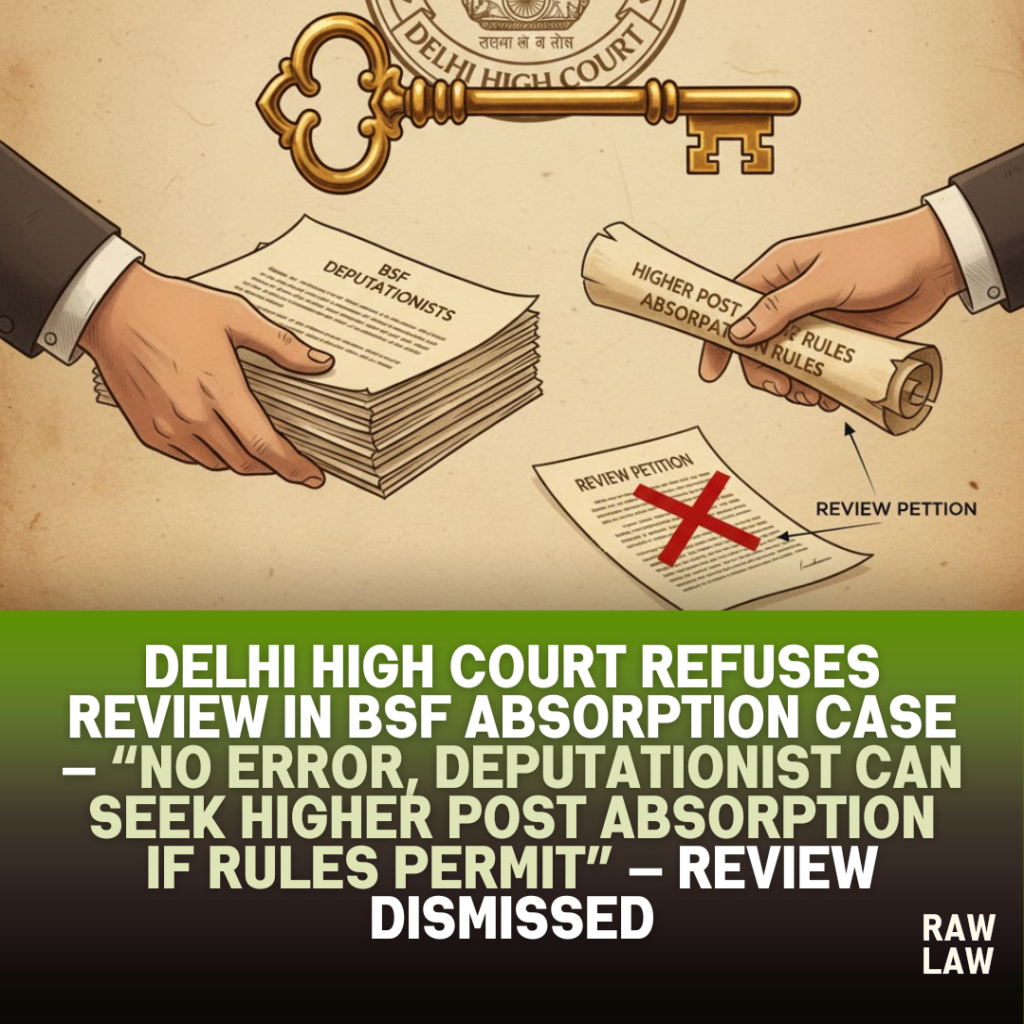
The Delhi High Court has dismissed a review petition challenging a 2019 judgment directing reconsideration of an Air Force officer’s application for permanent absorption to a senior aviation post in the Border Security Force. The review applicants argued that the earlier judgment failed to rule on whether an officer serving on deputation to a lower post could be absorbed directly to a higher post. The Court held that although the issue was earlier raised but not expressly answered, no ground for review was made out because the legal position—read with recruitment rules and government memoranda—clearly permitted deputationists to apply for absorption where the rules so provide. Consequently, the review petition and connected applications were dismissed.
2. Facts
The officer at the centre of the dispute was a Group Captain in the Air Force who had joined the Border Security Force Air Wing as Commandant/Pilot on deputation in February 2014. In June 2016, the BSF advertised seven vacancies for the post of Captain/Pilot (DIG). In June 2017, he applied for appointment on permanent absorption basis. His application was rejected on the ground that he was serving on deputation and could not be absorbed into a higher post. He challenged the rejection in a writ petition, where the High Court directed the BSF to consider his application and pass consequential orders. The BSF then filed a review petition arguing that the Court had not adjudicated a core legal issue relating to deputation, absorption, and eligibility for a higher post.
3. Issues
The principal issue was whether the original judgment suffered from an omission constituting an error on the face of the record, warranting review. This turned on whether a deputationist serving on a lower post is ineligible for absorption to a higher post under the BSF Recruitment Rules. The Court further examined:
(1) Whether the distinction between deputation and absorption under government memoranda justified rejecting the officer’s candidature.
(2) Whether earlier Supreme Court guidance on review jurisdiction, particularly regarding points urged but not addressed, applied.
(3) Whether recruitment rules for aviation cadres in the BSF permitted absorption irrespective of whether the officer was initially deputed in a lower grade.
(4) Whether the original decision correctly treated officers of equivalent rank (Group Captain categories) as indistinguishable for recruitment purposes.
4. Petitioners’ arguments
The review applicants contended that the Court overlooked a crucial point: an officer deputed as Commandant/Pilot could not be absorbed into the higher post of Captain/Pilot unless first absorbed in the lower post. They argued that the recruitment rules contemplated absorption only of officers already holding analogous posts. Reliance was placed on a 2010 Office Memorandum distinguishing deputation from absorption. The applicants also argued that the earlier judgment erred in equating different categories of Group Captain ranks, and that no claim to “negative equality” could arise from alleged appointments of other officers. They emphasised that the omission to rule on the deputation-vs-absorption issue mandated review, relying on Supreme Court precedent.
5. Respondent’s arguments
The respondents contended that the officer’s application was fully maintainable because the BSF Recruitment Rules expressly permitted filling the Captain/Pilot post through promotion or, failing that, through deputation or absorption. They argued that absorption did not require prior absorption into the lower post and that the officer met all eligibility conditions. They submitted that the rejection of the application reflected a misunderstanding by the BSF itself, not a legal mandate. They further argued that the review was an attempt to re-argue the case under the guise of correction, contrary to the limited scope of review jurisdiction. The earlier judgment, they stressed, neither contained an apparent error nor ignored any decisive legal principle.
6. Analysis of the law
The Court examined the Office Memoranda governing deputation and absorption. The 2010 OM clarified that:
• “Absorption” is a valid recruitment mode for permanent appointment;
• “Deputation including short-term contract” allows temporary service followed by mandatory reversion;
• An officer on deputation may apply for a higher post if the rules permit.
The Court noted that the BSF Recruitment Rules for aviation posts allowed filling the Captain/Pilot post by promotion, failing which by deputation (including short-term contract) or absorption. This structure unambiguously enabled deputationists to apply for absorption to the higher post if they possessed the requisite qualifications. The Court also emphasised that review lies only when an error apparent on the record is shown—not when parties merely disagree with the reasoning. The review applicants’ argument rested on misinterpretation of the rules, not a judicial oversight.
7. Precedent analysis
The review petition relied on Mohd. Akram Ansari v. Chief Election Officer (2008), where the Supreme Court held that a review may lie if an argued point was overlooked. The High Court acknowledged the principle but held it inapplicable because the original judgment’s reasoning, read as a whole, had already addressed the classification issue by treating eligible officers uniformly. The earlier judgment also drew from Union of India v. Atul Shukla (2014), which held that different categories of similarly placed officers (such as Group Captain (Select) and Group Captain (Time Scale)) cannot be arbitrarily differentiated. The Court reaffirmed that negative equality cannot be claimed, citing the principle echoed in Fuljit Kaur. Reviewing these authorities, the Court held that no conflict or omission justified reopening the case.
8. Court’s reasoning
The Court found that the review applicants misunderstood the recruitment rules. The officer was not required to be absorbed as Commandant/Pilot before applying for absorption as Captain/Pilot. The advertisement for Captain/Pilot did not distinguish between deputationists and non-deputationists from the Armed Forces. The decision-makers who processed his application incorrectly assumed that only absorbed officers could seek the higher post. The Court held that such a misconception could not form the basis for review. It reiterated that review is not an appeal. The Bench concluded that no apparent error existed and that the challenge was merely an attempt to re-litigate unsuccessfully decided issues.
9. Conclusion
The Court concluded that no grounds existed for reviewing the original 2019 judgment. It held that deputationists are eligible to seek absorption to higher posts when recruitment rules permit, and that no procedural or legal omission occurred in the earlier judgment. The review petition and accompanying applications were therefore dismissed. The Court also clarified that the recruitment rules, when correctly interpreted, supported the officer’s eligibility.
10. Implications
This ruling significantly clarifies appointment pathways for defence and paramilitary aviation cadres. It confirms that deputation does not bar eligible officers from seeking higher posts through absorption, provided recruitment rules enable such appointments. The decision safeguards mobility between armed forces and paramilitary aviation units, ensuring that technical qualifications, not formalistic distinctions, drive selection. It also reinforces the strict limits of review jurisdiction: disagreements with reasoning cannot be reframed as omissions. The ruling reaffirms equality principles in service law and clarifies that internal administrative misinterpretations cannot override statutory recruitment modes.
CASE LAW REFERENCES
1. Mohd. Akram Ansari v. Chief Election Officer (2008) 2 SCC 95
Holding: Review may lie when a point urged but not decided appears omitted.
Application: Court held omission not established; principle did not aid review.
2. Union of India v. Atul Shukla (2014) 10 SCC 432
Holding: Arbitrary classifications between similarly ranked officers unsustainable.
Application: Earlier bench applied this reasoning; review court reaffirmed it.
3. Fuljit Kaur v. State of Punjab (2010) 11 SCC 455
Holding: Negative equality cannot be claimed.
Application: Review applicants’ reliance rejected.
SEO-FRIENDLY FAQs
1. Can a deputationist apply for absorption to a higher post in a paramilitary force?
Yes. The Court held that deputation does not bar an officer from applying for absorption to a higher post if the recruitment rules expressly permit that mode.
2. When can a review petition be entertained in service matters?
Only when there is an error apparent on the face of the record or a point pressed but not addressed. Mere disagreement with reasoning is not a ground.
3. Why was the review petition dismissed?
Because the alleged omission was not an error; the recruitment rules supported eligibility, and the review applicants misinterpreted legal principles.