

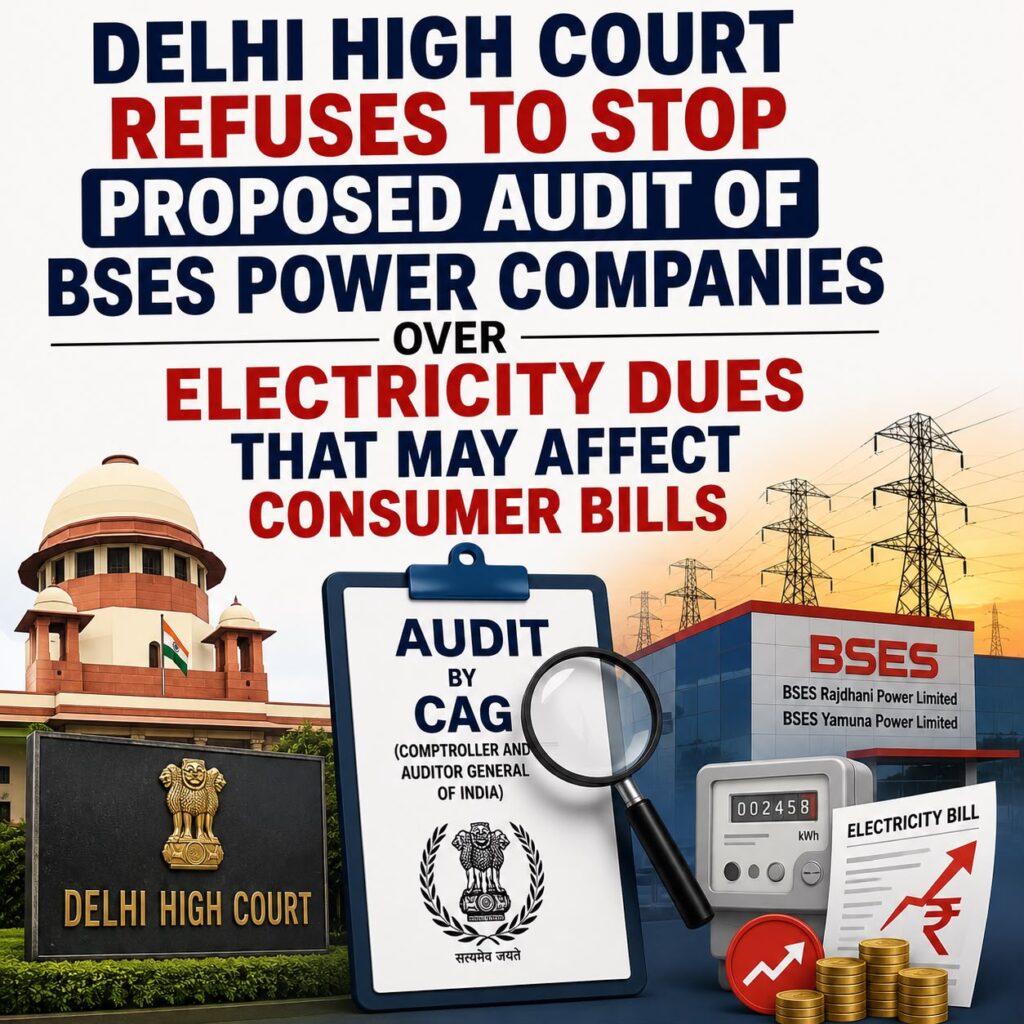
Delhi High Court Refuses to Stop Proposed CAG Audit of BSES Companies at Show-Cause Stage
Facts
BSES Rajdhani Power Limited and BSES Yamuna Power Limited are electricity distribution companies operating in Delhi under licences granted by the Delhi Electricity Regulatory Commission.
The dispute arose from a notice dated 6 June 2026 issued by the Government of the National Capital Territory of Delhi under Section 20(3) of the Comptroller and Auditor General (Duties, Powers and Conditions of Service) Act, 1971.
Through the notice, the Government proposed entrusting an audit of the two distribution companies to the Comptroller and Auditor General of India and called upon them to submit a written response and appear for a hearing.
The proposed audit was linked to the accumulation and non-recovery of large regulatory assets. Regulatory assets broadly represent approved revenue shortfalls that electricity distribution companies are permitted to recover from consumers through future tariffs or surcharges.
The Supreme Court had earlier directed electricity regulatory commissions to conduct a strict and intensive audit into the circumstances in which distribution companies continued for years without recovering these regulatory assets.
The Delhi Electricity Regulatory Commission initially approached the CAG to undertake the audit. The Appellate Tribunal for Electricity later set aside an earlier approval for a CAG audit and directed the appointment of a Chartered Accountant.
Thereafter, the Delhi Government issued the fresh notice under Section 20(3) of the CAG Act, giving BSES an opportunity to be heard before a final decision was taken.
BSES approached the Delhi High Court seeking cancellation of this notice.
Issues
- Whether a writ petition could be maintained against a notice that merely called upon BSES to respond before a final decision on the proposed CAG audit.
- Whether the Supreme Court’s directions concerning the audit of regulatory assets permitted examination of the accounts and financial conduct of the BSES distribution companies.
- Whether the proposed audit could legally be conducted by the CAG.
- Whether the fresh notice was barred by the Delhi High Court’s earlier ruling in the URJA case, which had quashed a previous attempt to subject BSES companies to a CAG audit.
- Whether the notice conflicted with the orders passed by the Appellate Tribunal for Electricity directing the appointment of a Chartered Accountant.
Petitioner’s Arguments
BSES argued that the notice was illegal, without jurisdiction and issued in disregard of binding court orders.
The companies contended that the proposed CAG audit had already been rejected in earlier proceedings and could not be revived through a fresh notice.
They relied upon the Delhi High Court’s earlier decision in the URJA case, where a Division Bench had quashed the Delhi Government’s direction for a CAG audit of the distribution companies.
According to BSES, electricity tariff determination and scrutiny of regulatory assets fell exclusively within the jurisdiction of the Delhi Electricity Regulatory Commission.
The Delhi Government could not use a CAG audit as a parallel mechanism to reopen tariff orders or interfere with matters already decided by the regulator.
BSES also argued that the Supreme Court’s direction for a strict and intensive audit was aimed at examining regulatory failure by the DERC and not at conducting a general audit of the distribution companies.
It was submitted that the Supreme Court had focused on the circumstances that led to the creation and prolonged continuation of regulatory assets, including failures by the regulatory commission to ensure their timely recovery.
The companies further argued that the Appellate Tribunal for Electricity had already quashed the earlier proposal for a CAG audit and directed the DERC to appoint a Chartered Accountant.
Those orders remained binding unless stayed or set aside by the Supreme Court.
BSES alleged that the fresh notice was intended to delay the liquidation and recovery of regulatory assets that had already been approved in tariff orders.
It also argued that Section 20(3) of the CAG Act merely prescribed a hearing procedure and did not create an independent power to order an audit.
Respondent’s Arguments
The Delhi Government argued that the writ petition was premature because the challenged document was merely a show-cause notice.
The notice did not order an audit or record any final finding against BSES. It only invited the companies to submit their objections and appear for a hearing before a final decision was taken.
The Government submitted that courts ordinarily do not interfere with show-cause notices unless the authority issuing the notice completely lacks jurisdiction.
It argued that the proposed audit was necessary in public interest and was consistent with the Supreme Court’s judgment on regulatory assets.
According to the Government, the accumulation of regulatory assets directly affects electricity consumers because the amounts are ultimately recovered through tariffs and surcharges.
The respondents contended that the audit was required to examine the actual financial condition of the companies, their expenditure, inter-company advances, related-party transactions and the use of funds recovered through the regulatory process.
They argued that the Supreme Court’s directions were broad enough to include examination of the records, accounts and financial conduct of the distribution companies.
The Government further submitted that the earlier URJA judgment arose in a different factual and legal context.
The fresh audit was not an attempt by the Government to interfere with tariff fixation. It was being proposed pursuant to the Supreme Court’s subsequent directions concerning regulatory assets.
The respondents also emphasised that BSES was now being given an opportunity of hearing under Section 20(3), which had been absent in the earlier audit process.
Analysis of the Law
The High Court first considered the settled law governing judicial interference with show-cause notices.
A notice that merely asks a party to explain its position ordinarily does not create a cause of action because it does not finally determine rights or impose any adverse consequence.
A writ petition against such a notice is generally premature.
Courts may interfere at the notice stage only in exceptional circumstances, such as where:
- the notice is issued by an authority having no jurisdiction;
- the proceedings are fundamentally illegal;
- the notice is manifestly perverse; or
- the proposed action is expressly barred by law.
The Court then examined Section 20 of the CAG Act.
Section 20 permits the entrustment of audit of certain bodies or authorities to the CAG where such audit is considered necessary in public interest. Section 20(3) requires the concerned body or authority to be given a reasonable opportunity to make representations before the audit is formally entrusted.
The notice issued to BSES was therefore part of the statutory hearing process and not a final order directing an audit.
The Court also analysed the Supreme Court’s judgment concerning regulatory assets.
It held that the direction for a strict and intensive audit of the circumstances in which distribution companies continued without recovery of regulatory assets was sufficiently broad.
The audit could include examination of the companies’ financial records, accounts, conduct and operational circumstances.
The Supreme Court’s direction could not be interpreted as limiting the audit exclusively to the functioning of the regulatory commission.
The High Court further held that the Supreme Court had not specified that the audit must be conducted only by a Chartered Accountant.
There was no express prohibition against entrusting the audit to the CAG, provided the statutory requirements of the CAG Act were strictly followed.
Precedent Analysis
The High Court relied upon Union of India v. Kunisetty Satyanarayana.
In that case, the Supreme Court held that writ jurisdiction should not ordinarily be exercised against a mere charge-sheet or show-cause notice because such a notice does not itself infringe any right.
The Court may ultimately drop the proceedings after considering the response. Therefore, judicial intervention before a final decision is ordinarily premature.
The High Court also referred to Secretary, Ministry of Defence v. Prabhash Chandra Mirdha, where the Supreme Court reiterated that a show-cause notice or charge-sheet should not ordinarily be quashed unless it was issued by an authority lacking jurisdiction.
The principal precedent relied upon by BSES was the earlier Delhi High Court decision in the URJA litigation.
In that case, the Division Bench had quashed the Delhi Government’s direction for a CAG audit of BSES companies.
The earlier Court had held that tariff regulation and scrutiny of distribution companies fell within the specialised jurisdiction of the DERC and that a parallel audit initiated by the Government would not serve a meaningful public purpose.
The present Court distinguished that ruling.
It found that:
- the earlier audit was not proposed pursuant to the Supreme Court’s later regulatory-assets judgment;
- the present audit process had been initiated to comply with the Supreme Court’s directions;
- the DERC itself had initiated the audit process;
- the purpose was not to replace or interfere with tariff determination;
- BSES had now been given an opportunity of hearing; and
- the proposed audit had a direct public-interest connection because regulatory assets affect electricity consumers.
The URJA judgment therefore did not create a permanent or absolute prohibition against every CAG audit of the distribution companies.
Court’s Reasoning
The High Court found that the challenged notice merely invited BSES to submit a response and attend a hearing.
It neither ordered the audit nor recorded any adverse findings against the companies.
The notice therefore did not presently affect any legal right or liability.
The Court rejected BSES’s argument that the Supreme Court had directed only an audit of the DERC.
The Supreme Court had ordered an examination of the circumstances in which distribution companies continued without recovering regulatory assets.
Understanding those circumstances could reasonably require scrutiny of the companies’ records, finances and conduct.
The Court also held that the absence of an express reference to the CAG in the Supreme Court’s judgment did not bar a CAG audit.
The choice of auditor remained open, subject to compliance with the governing statute.
On the Appellate Tribunal’s earlier orders, the High Court noted that the DERC had challenged those orders before the Supreme Court.
Questions concerning compliance with the timelines fixed by the Tribunal or the appointment of a Chartered Accountant could be raised through appropriate proceedings elsewhere.
Those disputes did not justify quashing the fresh statutory notice at the threshold.
The High Court further held that the URJA judgment was materially distinguishable.
The earlier case involved a Government-initiated parallel audit in the context of tariff regulation. The present proposal arose from the Supreme Court’s later direction for an intensive audit into the accumulation of regulatory assets.
The proposed audit was prima facie connected with public interest because the recovery of regulatory assets ultimately affects consumers through electricity tariffs.
The Court therefore concluded that the notice was not without jurisdiction and that BSES must first submit its objections before the competent authority.
Conclusion
The Delhi High Court dismissed the writ petition as premature.
It held that the notice dated 6 June 2026 was only a show-cause notice issued to provide BSES Rajdhani Power Limited and BSES Yamuna Power Limited an opportunity of hearing before any final decision on the proposed CAG audit.
The Court clarified that:
- the Supreme Court’s regulatory-assets judgment does not prohibit an audit of the BSES companies;
- the audit may include examination of their accounts, financial position and conduct;
- the audit may be entrusted to the CAG if the requirements of the CAG Act are followed;
- the earlier URJA judgment does not impose an absolute bar on a CAG audit in the present circumstances; and
- the competent authority must independently consider all objections raised by BSES before taking a final decision.
The Court also clarified that its observations were confined to the legality of the notice and should not influence the authority’s final decision on whether the audit should actually be entrusted to the CAG.
All rights and objections concerning the Appellate Tribunal’s orders, the Supreme Court proceedings and the timelines for liquidation of regulatory assets were kept open.
Case Details
Case: BSES Rajdhani Power Limited & Another v. Government of NCT of Delhi & Others
Court: Delhi High Court
Case Number: W.P.(C) 8283 of 2026
Judge: Justice Tejas Karia
Date of Decision: 22 June 2026
Result: Challenge to proposed CAG-audit notice dismissed as premature

READ ALSO: Selling Medicines Below MRP Is Legal, But Misleading Discount Advertising Is Not: Kerala High Court