


Court’s Decision
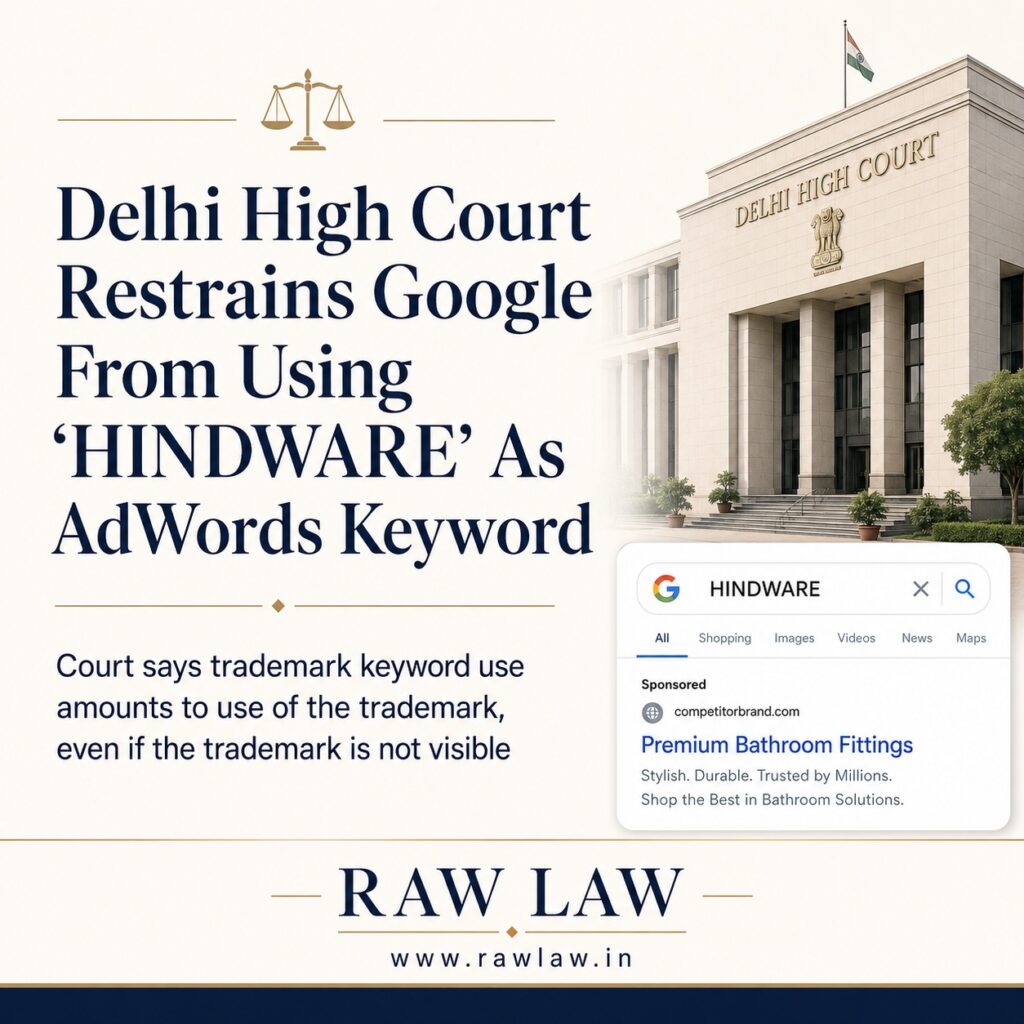
The Delhi High Court decreed both commercial suits in favour of the plaintiff and against Google LLC and Google India. The Court passed a permanent injunction restraining Google from using “HINDWARE,” “HINDWARE SANITARYWARE,” “HINDWARE SANITARY,” “HINDWARE SANITARYWARE INDIA,” or any combination thereof as advertising keywords, AdWords, or in any manner amounting to infringement.
The Court also awarded nominal damages of ₹30,00,000, payable jointly and severally by Google LLC and Google India, along with actual costs of litigation. The suit was also decreed against the website developer in terms of the settlement agreement entered with the plaintiff.
Facts
The plaintiff is engaged in the sanitaryware business and sells its products under the registered mark “HINDWARE.” The judgment records that the plaintiff had been using the mark since 1991 and had substantial market presence, sales, service centres, boutiques, shops, and institutional partners across India. The mark had also earlier been recognised as a well-known mark by the Delhi High Court.
The dispute arose when the plaintiff discovered that competitors in the sanitaryware market were using Google’s AdWords Programme by purchasing “HINDWARE” or related terms as keywords. As a result, when internet users searched for HINDWARE-related terms, sponsored links of competing brands appeared prominently on Google search results.
During the proceedings, the disputes with the competing advertisers were settled. The remaining contest was therefore between the plaintiff and Google India/Google LLC, concerning Google’s role in permitting, suggesting, auctioning, and monetising the plaintiff’s registered trademark as a keyword.
Issues
The Court considered whether the use of a registered trademark as a Google Ads keyword amounts to “use” of the mark under the Trade Marks Act, 1999.
It also examined whether Google itself could be held liable for such use, or whether only the advertiser choosing the keyword would be responsible.
The Court further considered whether Google could claim protection as an intermediary under Section 79 of the Information Technology Act, 2000, and whether damages and costs should be awarded.
Plaintiff’s Arguments
The plaintiff argued that HINDWARE was a registered and well-known mark with substantial goodwill and reputation. It contended that Google was commercially exploiting the mark by offering, suggesting, auctioning and selling it as a keyword to direct competitors without authorisation.
It was submitted that use of a trademark as a keyword amounted to use “in advertising” under Section 29(6) of the Trade Marks Act. According to the plaintiff, Google’s AdWords Programme was not a neutral platform because Google actively suggested keywords, conducted bidding, ranked advertisements, and earned revenue when users clicked on sponsored links.
The plaintiff further argued that Google could not hide behind intermediary protection under Section 79 of the IT Act because it was not merely hosting third-party information but actively participating in monetising the trademark.
Google’s Arguments
Google argued that keywords are backend triggers and are not visible to consumers. Therefore, according to Google, use of a trademark as a keyword could not amount to trademark use or infringement.
Google also contended that advertisers independently choose keywords and that Google merely provides an advertising platform. It argued that sponsored results are clearly labelled, and therefore there was no likelihood of confusion.
Google further claimed protection as an intermediary under Section 79 of the IT Act. It submitted that the advertisements and keywords were third-party data and that any liability, if at all, should fall on advertisers and not Google.
Analysis of Law
The Court rejected Google’s argument that invisible use cannot amount to trademark use. It held that Section 2(2)(c) of the Trade Marks Act uses wide language and includes use of a mark not only physically but also “in any other relation whatsoever” to goods.
The Court held that use of a trademark as a keyword to trigger advertisements is use of the trademark “in advertising” within the meaning of Section 29(6)(d). The Court specifically observed that it is not necessary for the registered trademark to physically appear in the advertisement. If the trademark is used in the process of advertising, such as by using it as a keyword, it still amounts to use of the mark.
The Court further held that Google was not merely a passive platform. It noted that Google’s Keyword Planner Tool actively suggests popular terms, including trademarked terms, to advertisers; Google conducts auction/bidding on those terms; and Google earns revenue when users click on the advertisement triggered by such keywords.
Precedent Analysis
The Court relied heavily on the Delhi High Court’s earlier rulings in Google LLC v. DRS Logistics and connected cases, where it had been held that the use of trademarks as keywords may amount to trademark use and that Google’s role in the Ads Programme cannot always be treated as passive.
The Court also referred to decisions concerning meta-tags and invisible use of trademarks, including cases where courts held that hidden use of another’s mark to divert internet traffic can constitute trademark infringement or passing off.
The Court referred to Pernod Ricard India Pvt. Ltd. v. Karanveer Singh Chhabra to emphasise that coined and distinctive marks command stronger protection. Since HINDWARE was a coined mark with no dictionary meaning, the Court held that it deserved a higher degree of protection.
Court’s Reasoning
The Court held that Google’s conduct went beyond merely providing advertising space. It found that Google actively suggested, offered, auctioned and monetised trademarked terms as keywords. Therefore, the use of HINDWARE as a keyword was not merely internal use by advertisers but also commercial use by Google.
The Court rejected Google’s argument that such keyword bidding promotes fair competition. It reasoned that fair competition allows rivals to compete on the strength of their own marks and products, but does not justify selling another’s registered trademark to competitors.
The Court observed that Google’s AdWords Policy effectively converts a source-specific search into a general search. For example, when a consumer searches for a coined trademark like HINDWARE, the consumer is looking for that specific brand. Google’s sale of that mark as a keyword to competitors diverts the user by monetising the advertising value of the trademark.
The Court held:
“Clearly, two wrongs do not make a right.”
This was stated while rejecting Google’s argument that the plaintiff had also used a competitor’s mark in another proceeding. The Court held that the legality of Google’s policy had to be assessed independently.
The Court ultimately concluded that Google’s conduct amounted to infringement under Section 29(8) of the Trade Marks Act because it took unfair advantage of the plaintiff’s trademark and was contrary to honest practices in industrial or commercial matters.
Section 79 IT Act Defence
The Court rejected Google’s safe harbour defence under Section 79 of the IT Act.
It held that Section 79 protects intermediaries only in respect of third-party information, data or communication links made available or hosted by them, subject to the statutory conditions. However, Google’s conduct in conducting auctions and selling use of the plaintiff’s trademark as a keyword was not protected under Section 79.
The Court held that Google was not entitled to claim immunity because it actively participated in monetising trademarked terms through its Ads Programme. It noted that Google was not merely a passive intermediary but operated an advertising business with control over the keyword advertising mechanism.
Conclusion
The Delhi High Court granted permanent injunction against Google LLC and Google India from using or permitting use of HINDWARE and related terms as advertising keywords or AdWords in a manner amounting to infringement.
The Court awarded ₹30 lakh as nominal damages, holding that although actual loss had not been quantified, infringement had been established. The Court also awarded actual costs to the plaintiff, to be computed as per the Delhi High Court Rules and IPD Rules.
The judgment is significant because it recognises that invisible keyword use in online advertising can still amount to trademark use and that search engine platforms may be liable where they actively monetise another’s registered trademark.
Key Takeaway
A registered trademark cannot be auctioned as an advertising keyword to competitors merely because the keyword is invisible to users. If a search platform actively suggests, sells and monetises a trademark to trigger competitor ads, such conduct can amount to trademark infringement. Safe harbour protection under the IT Act may not apply where the platform is an active commercial participant rather than a passive intermediary.