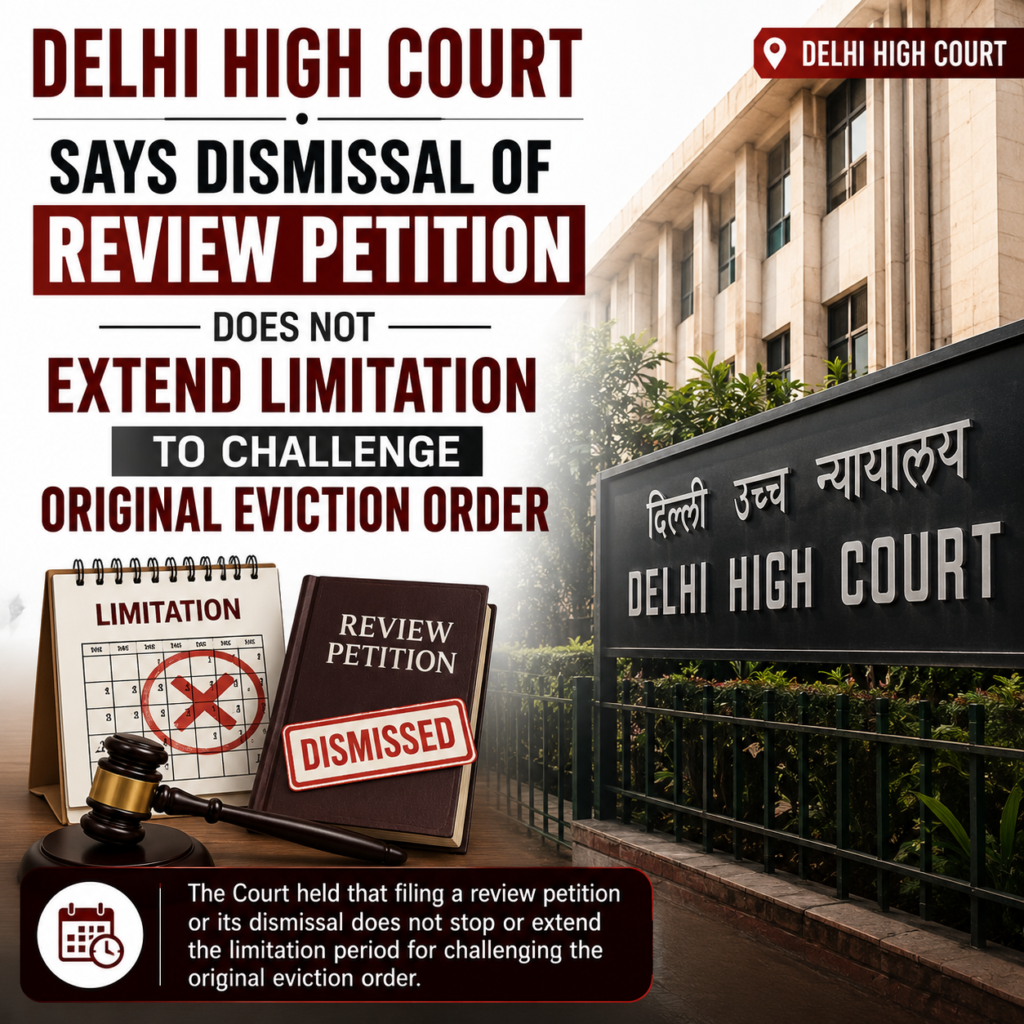
Delhi High Court Refuses to Condone Delay in Tenant’s Revision Against Eviction Order, Says Review Dismissal Does Not Extend Limitation for Challenging Original Eviction Judgment
Facts
The petitioner, Rajinder Kumar Gupta, filed a rent control revision under Section 25B(8) of the Delhi Rent Control Act, 1958, challenging an eviction judgment dated 6 July 2020 passed by the Rent Controller, South, Saket Courts, Delhi.
The eviction order had been passed in favour of the original landlady, Sushila Devi Jain, in respect of Shop bearing Private No. 2, premises No. 12/3, Yusuf Sarai, Main Market, New Delhi, measuring 10 x 45 feet.
The landlady had sought eviction on the ground of bona fide requirement for settling her grandson, Shubham Jain, who had completed BBA and CA and required space to start his own professional office. The Rent Controller held that the ingredients of Section 14(1)(e) of the Delhi Rent Control Act were satisfied and passed the eviction order.
Instead of directly filing a revision against the eviction judgment, the petitioner filed a review petition before the Rent Controller on 27 July 2020. The review petition was dismissed on 25 September 2025. The petitioner thereafter filed an appeal before the Rent Control Tribunal against dismissal of the review petition, but withdrew it on 27 March 2026 with liberty to pursue appropriate remedy. The present revision was filed on 24 March 2026, along with an application seeking condonation of delay of 388 days.
Issues
- Whether the delay in filing the revision petition against the eviction judgment dated 6 July 2020 deserved to be condoned.
- Whether time spent in pursuing the review petition before the Rent Controller could be excluded while computing limitation.
- Whether time spent in pursuing an appeal before the Rent Control Tribunal against dismissal of the review petition could be excluded under Section 14 of the Limitation Act, 1963.
- Whether dismissal of a review petition extends or renews limitation for challenging the original eviction judgment.
Petitioner’s Arguments
The petitioner argued that there was no intentional or deliberate delay in filing the revision petition.
He submitted that the eviction judgment was passed during the COVID-19 period and that he was entitled to exclusion of limitation in terms of the Supreme Court’s orders in In Re: Cognizance for Extension of Limitation.
The petitioner further argued that he had filed the review petition within time and had diligently pursued that remedy. According to him, subsequent facts had come to light after the eviction judgment, including documents relating to Shubham Jain’s alleged business activities and alternate accommodation.
He also argued that during the pendency of the review proceedings, the original landlady died, her Will was disputed, and other persons claiming to be superior landlords had initiated proceedings. These subsequent events, according to the petitioner, affected the executability and validity of the eviction order.
The petitioner further submitted that the appeal before the Rent Control Tribunal was pursued under bona fide legal advice and that he should not be penalized for approaching the wrong forum.
Respondent’s Arguments
The respondent opposed the condonation application and argued that the petitioner had adopted dilatory tactics to delay execution of the eviction order.
It was submitted that the petitioner continued to occupy the premises despite the eviction order and without paying market rent after expiry of the statutory period.
The respondent argued that the review proceedings were deliberately prolonged by filing multiple applications and raising objections. It was further submitted that there was no stay of the eviction judgment during the pendency of the review petition.
The respondent also argued that the appeal before the Rent Control Tribunal was not pursued in good faith. On the first date itself, the Tribunal had raised the issue of maintainability, yet the petitioner continued with the appeal instead of filing the proper revision.
According to the respondent, Section 14 of the Limitation Act could not help the petitioner because the appeal before the Tribunal was against the review dismissal order dated 25 September 2025, whereas the present revision challenged the original eviction judgment dated 6 July 2020. Therefore, both proceedings were not for the same relief.
Analysis of the Law
The Court held that limitation for filing a revision under Section 25B(8) of the Delhi Rent Control Act is three years.
The Court accepted that, due to the Supreme Court’s COVID limitation orders, the period from 15 March 2020 to 28 February 2022 had to be excluded. Therefore, limitation for challenging the eviction judgment dated 6 July 2020 began on 1 March 2022 and expired on 28 February 2025.
The Court also held that the petitioner’s review petition could not be treated as mala fide merely because it was eventually dismissed after nearly five years. Since review is a remedy available under Section 25B(9) of the Delhi Rent Control Act, the Court granted the petitioner benefit of the period during which the review petition was pending, up to 25 September 2025.
However, the Court held that after dismissal of the review petition, the petitioner should have immediately challenged the original eviction judgment. Instead, he filed an appeal before the Rent Control Tribunal against the review dismissal order. That appeal did not amount to pursuing the same relief as the present challenge to the original eviction judgment.
Precedent Analysis
The Court relied on DSR Steel Pvt. Ltd. v. State of Rajasthan, (2012) 6 SCC 782, where the Supreme Court explained that if a review petition is dismissed, there is no merger of the original order with the review dismissal order. A party aggrieved by the original order must challenge the original order within limitation. Time spent in pursuing review may be considered for condonation, but dismissal of review does not create a fresh limitation period.
The Court also considered In Re: Cognizance for Extension of Limitation, under which the Supreme Court extended limitation due to the COVID-19 pandemic.
The Court referred to Jai Prakash v. Jean Conea on limitation for filing a revision under Section 25B(8) of the Delhi Rent Control Act.
The Court also relied on Yeswant Deorao Deshmukh v. Walchand Ramchand Kothari, where the Supreme Court held that Section 14 of the Limitation Act applies only where the earlier proceeding was for the same relief. If the earlier proceeding sought a different relief, the benefit of exclusion cannot be granted.
Court’s Reasoning
The Court held that the review petition was filed within limitation and that the petitioner could receive benefit of the period during which it remained pending. Therefore, the period from 1 March 2025 to 25 September 2025 was excluded.
However, the Court found that even after excluding the review period, the present revision challenging the original eviction judgment was still time-barred by 180 days.
The Court held that once the review petition was dismissed on 25 September 2025, the petitioner was required to promptly challenge the original eviction judgment dated 6 July 2020. He failed to do so.
The Court rejected the petitioner’s reliance on Section 14 of the Limitation Act for the time spent before the Rent Control Tribunal. The appeal before the Tribunal challenged the review dismissal order dated 25 September 2025, whereas the present revision sought to challenge the original eviction judgment dated 6 July 2020. Therefore, the two proceedings were not for the same relief.
The Court also noted that the Rent Control Tribunal had raised the maintainability issue on the very first date, yet the petitioner continued pursuing the appeal. This weakened the plea that the petitioner acted in good faith.
Conclusion
The Delhi High Court dismissed the petitioner’s application seeking condonation of delay in challenging the eviction judgment dated 6 July 2020.
The Court held that dismissal of a review petition does not extend limitation for challenging the original eviction order. It further held that Section 14 of the Limitation Act could not be invoked because the appeal before the Rent Control Tribunal was not for the same relief as the present revision against the original eviction judgment.
However, the Court did not finally dispose of the entire revision petition. It directed that the matter be listed on 24 August 2026 only with respect to the remaining prayers challenging the review dismissal order dated 25 September 2025 and the execution order dated 14 March 2026.
Case Details
Case: Rajinder Kumar Gupta v. Sushila Devi Jain (Since Deceased) Through LR Sh. Devender Kumar Jain
Court: Delhi High Court
Case Number: RC.REV. 101/2026, CM APPL. 20127/2026, CM APPL. 20128/2026, CM APPL. 20129/2026, CM APPL. 24388/2026
Judge: Justice Amit Sharma
Date: 6 July 2026
Result: Delay condonation application dismissed; challenge to eviction judgment dated 6 July 2020 held time-barred; matter listed for remaining prayers.