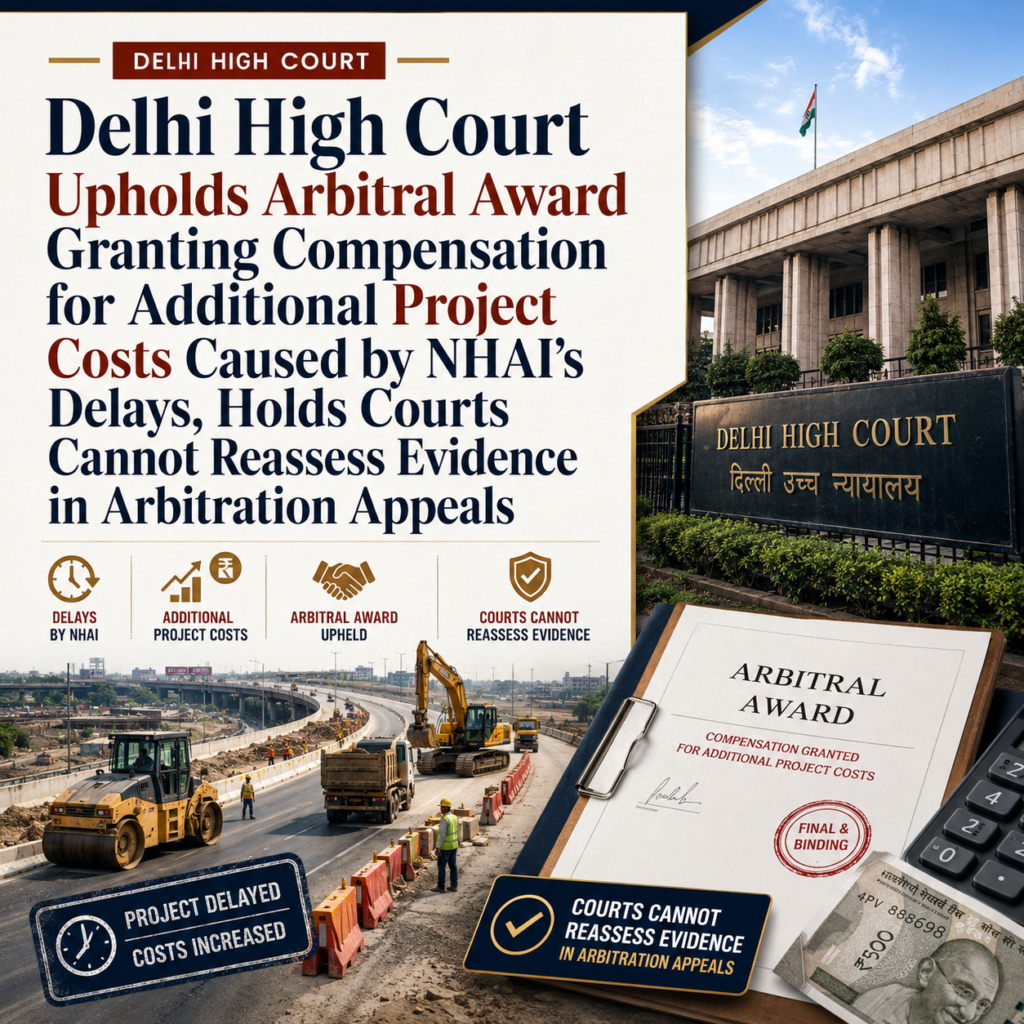
Delhi High Court Refuses to Reassess Arbitral Award Granting Additional Mobilisation, Prolongation Costs and Compensation for Lost Bonus Opportunity
Facts
The National Highways Authority of India awarded a contract dated 25 May 2001 to M/s Unitech–NCC Joint Venture for widening and upgrading a two-lane stretch of National Highway-5 between Visakhapatnam and Ichapuram in Andhra Pradesh.
The work was scheduled to commence on 8 June 2001 and be completed by 7 February 2004. However, the project was ultimately completed on 20 March 2005.
Disputes arose concerning delays, fragmented handing over of the project site and the resulting financial consequences. The contractor invoked arbitration, and a three-member Arbitral Tribunal rendered its award on 16 May 2011.
The present appeal was confined to the following claims:
- Claim No. 3: Additional mobilisation and deployment of plant and machinery caused by NHAI’s failure to hand over the site as contemplated under the contract. Against a claim of approximately ₹17.23 crore, the Tribunal awarded ₹3.59 crore.
- Claim No. 4(a): Idling and prolongation costs relating to machinery and workforce. The Tribunal awarded approximately ₹3.29 crore.
- Claim No. 4(b): Idling of materials. No amount was awarded.
- Claim No. 4(c): Idle overheads and establishment costs. The Tribunal awarded approximately ₹1.70 crore.
- Claim No. 7: Compensation relating to loss of the opportunity to earn contractual bonus, quantified at approximately ₹3.87 crore, but adjusted against Claim No. 3 to avoid duplication.
NHAI challenged the award under Section 34 of the Arbitration and Conciliation Act, 1996. On 30 May 2025, a Single Judge of the Delhi High Court dismissed the petition and upheld the award.
NHAI then filed the present appeal under Section 37 of the Arbitration Act.
Issues
- Whether the Single Judge had committed an error in refusing to set aside the arbitral award concerning Claim Nos. 3, 4 and 7.
- Whether the Tribunal had awarded damages without sufficient evidence of actual loss.
- Whether the amounts awarded for additional mobilisation and prolongation costs were speculative, overlapping or unsupported by contemporaneous records.
- Whether the Tribunal could award compensation for loss of the opportunity to earn a contractual bonus despite clauses restricting payment of bonus after extension of the contract period.
- Whether the delay of approximately eight months in pronouncing the Section 34 judgment rendered it invalid.
- Whether the objections raised by NHAI could be examined without impermissibly reassessing evidence under Section 37.
Petitioner’s Arguments
NHAI argued that the Tribunal had awarded substantial compensation despite the contractor’s failure to prove actual additional expenditure or actual idling of machinery.
It contended that the claims were primarily based upon computer-generated worksheets, paper calculations and hypothetical assumptions rather than reliable accounting material.
Claim No. 3
NHAI submitted that:
- the contractor failed to prove actual expenditure on additional machinery;
- the Tribunal incorrectly relied upon Annexure-A filed by NHAI only on a “without prejudice” basis;
- the calculation was submitted merely to demonstrate defects in the contractor’s methodology and was not an admission;
- the Chartered Accountant’s certificate was unreliable and had itself been partly rejected by the Tribunal; and
- it was commercially implausible that the contractor would incur expenditure comparable to the bonus it expected to earn.
Claim No. 4
NHAI argued that:
- there was no evidence showing that machinery or labour had actually remained idle;
- the claim was based on “deemed idling” rather than proven loss;
- Claim No. 4 overlapped with Claim No. 3 because the contractor simultaneously claimed compensation for additional machinery and idling of machinery;
- the Tribunal provided inadequate reasoning while reducing the alleged idling period from twelve months to ten months; and
- the award for overheads under Claim No. 4(c) was based on a comparison of differing computational methods without proper reasoning.
Claim No. 7
NHAI contended that:
- Clause 47.3 prohibited payment of bonus where the contract period had been extended;
- only actual costs caused by delay could be recovered under the contract;
- the Tribunal had effectively rewritten the contractual bargain by invoking Section 73 of the Indian Contract Act;
- the contractor had not satisfied the condition of early completion necessary for bonus; and
- the Tribunal’s treatment of the bonus claim was inconsistent with its rejection of the contractor’s claim for loss of profit.
NHAI also argued that the Single Judge pronounced the judgment approximately eight months after reserving it, which allegedly affected proper appreciation of the arguments.
Respondent’s Arguments
The contractor submitted that the scope of interference under Section 37 was extremely narrow and did not permit reassessment of evidence or substitution of the Court’s view for a plausible view taken by the Tribunal.
Claim No. 3
The contractor argued that:
- NHAI had failed to hand over the site in the agreed manner;
- the land was made available in numerous fragmented stretches, forcing simultaneous work at scattered locations;
- the fragmented site conditions required deployment of additional machinery;
- the Monthly Progress Reports constituted contemporaneous evidence of actual deployment; and
- the Tribunal substantially reduced the claim from ₹17.23 crore to ₹3.59 crore after independently evaluating the material.
Claim No. 4
It was submitted that:
- the Monthly Progress Reports established the machinery retained at the site;
- prolongation required continued deployment of minimum contractual resources, workforce and establishment;
- machinery costs were calculated using hire charges prescribed in the Ministry of Road Transport and Highways Data Book;
- Claim No. 3 concerned machinery deployed beyond the minimum contractual requirement, while Claim No. 4 concerned the cost of retaining minimum resources during prolongation; and
- the two claims therefore did not overlap.
Claim No. 7
The contractor argued that the claim was not for contractual bonus as such. It was for compensation for being deprived of the opportunity to earn the bonus because of delays attributable to NHAI.
It further submitted that the Tribunal adjusted Claim No. 7 against Claim No. 3, thereby preventing double recovery and effectively neutralising any separate monetary benefit under Claim No. 7.
Analysis of the Law
The High Court reiterated that the scope of interference under Section 37 is even narrower than that available under Section 34.
A court hearing a Section 37 appeal cannot:
- independently reassess the merits of the award;
- reappreciate oral or documentary evidence;
- substitute its interpretation of the contract for a plausible interpretation adopted by the Tribunal; or
- interfere merely because another view appears preferable.
The inquiry is confined to whether the Section 34 Court:
- exceeded or failed to exercise its jurisdiction;
- applied an incorrect legal standard;
- overlooked patent illegality;
- upheld a perverse finding; or
- failed to identify a jurisdictional defect.
Interpretation of contractual terms, assessment of evidence and quantification of damages ordinarily fall within the Tribunal’s domain.
The Court also held that delay in pronouncing a judgment, though undesirable, does not by itself invalidate the decision. The party challenging the judgment must demonstrate actual prejudice or show that the delay affected the reasoning.
Precedent Analysis
MMTC Ltd. v. Vedanta Ltd.
The Supreme Court held that interference under Section 37 cannot travel beyond the restrictions imposed by Section 34. The appellate court cannot independently reassess the merits of the award.
Punjab State Civil Supplies Corporation Ltd. v. Sanman Rice Mills
The Court reiterated that a Section 37 appeal is supervisory rather than a regular merits appeal. The appellate court only examines whether the Section 34 Court acted within its jurisdiction.
UHL Power Co. Ltd. v. State of Himachal Pradesh
The Supreme Court held that the jurisdiction under Section 34 is narrow, and the jurisdiction under Section 37 is even more circumscribed. Courts cannot reappreciate contractual interpretation and factual findings returned by the Tribunal.
McDermott International Inc. v. Burn Standard Co. Ltd.
The Court relied upon this decision for the principle that judicial intervention in arbitral awards must remain minimal.
Interpretation of contractual provisions, correspondence and the conduct of parties is primarily entrusted to the arbitrator.
Ssangyong Engineering & Construction Co. Ltd. v. NHAI and NHAI v. M. Hakeem
These authorities were relied upon to reaffirm the restricted grounds on which an arbitral award may be disturbed.
Kailash Nath Associates v. DDA
NHAI relied upon this judgment for the proposition that damages cannot be granted without proof of loss.
The High Court distinguished it because the Tribunal had relied upon contemporaneous project records to establish both the breach and its financial consequences.
Anil Rai v. State of Bihar
NHAI relied on this decision concerning delay in pronouncement of judgments.
The Court held that the decision did not establish that delay alone invalidates a judgment. No actual prejudice was demonstrated in the present case.
Jaiprakash Hyundai Consortium v. Satluj Jal Vidyut Nigam Ltd.
NHAI relied upon this authority to challenge damages based solely on worksheets and unsupported calculations.
The Court distinguished it because the present award was also based upon Monthly Progress Reports, contractual records, the Engineer’s correspondence and benchmark machinery rates.
Court’s Reasoning
Claim No. 3: Additional mobilisation of machinery
The Tribunal had found that the project site was not handed over in the staged and coordinated manner contemplated under the contract.
The Engineer’s letter dated 5 December 2003 showed that land had been made available in numerous fragmented stretches across the project. This compelled the contractor to work simultaneously at scattered locations.
Annexure-I to the contract prescribed the baseline machinery necessary for timely completion. The Tribunal found that the fragmented work fronts required machinery beyond this minimum deployment.
The Monthly Progress Reports recorded the machinery actually deployed. These reports were contemporaneous documents maintained during execution of the project, and NHAI failed to establish that they were unreliable.
The Tribunal did not accept the contractor’s calculation in full. It rejected the contractor’s worksheets, used deployment data placed on record by NHAI and reduced the claim from approximately ₹17.23 crore to ₹3.59 crore.
It also excluded components such as petroleum, oil and lubricants while determining the admissible amount.
The Court therefore held that:
- NHAI’s breach was supported by documentary evidence;
- the causal connection between fragmented site availability and additional machinery was reasonably established;
- the damages were conservatively quantified; and
- the Tribunal’s view was plausible rather than perverse.
Claim No. 4: Prolongation and idling costs
The Court accepted the Tribunal’s distinction between Claim Nos. 3 and 4.
Claim No. 3 concerned machinery deployed beyond the contractual baseline to work at multiple fragmented locations.
Claim No. 4 concerned the cost of maintaining minimum machinery, workforce and site establishment during the prolonged execution period.
The Tribunal restricted the claim to ten months instead of the twelve months sought by the contractor. It relied upon:
- Monthly Progress Reports;
- the value and progress of work;
- minimum resource requirements under the contract; and
- machinery hire charges contained in the Ministry of Road Transport and Highways Data Book.
The reference to “idling” was understood as reflecting the contractor’s inability to utilise the deployed machinery and manpower optimally because of disruption and prolongation caused by NHAI.
The Court held that the claim was not wholly hypothetical and that the Tribunal had adopted an objective method of assessment.
The objections raised by NHAI would have required the Court to reassess the duration of delay, machinery deployment and competing calculations, which was impermissible under Section 37.
Claim No. 7: Loss of opportunity to earn bonus
The Court held that the Tribunal had not awarded the bonus as a direct contractual entitlement under the bonus clause.
Instead, it treated the claim as compensation for loss of the opportunity to earn a specifically quantifiable contractual incentive due to NHAI’s breach.
The Tribunal found that:
- the Engineer had extended the contractual completion date to 20 April 2005;
- the contractor substantially completed the works before that extended date; and
- NHAI’s breaches had deprived the contractor of the opportunity to earn the incentive.
The Court distinguished between:
- enforcement of a bonus clause; and
- damages for loss caused by breach that prevented a party from earning the bonus.
It held that such loss could, on a plausible interpretation, fall within Section 73 of the Indian Contract Act.
The Tribunal also adjusted the amount under Claim No. 7 against Claim No. 3, ensuring that the contractor did not receive double compensation.
Accordingly, no separate additional monetary benefit effectively arose from Claim No. 7.
Delay in pronouncing the Section 34 judgment
The Court rejected NHAI’s argument based on the eight-month delay.
The Single Judge’s judgment reflected consideration of the material and contained reasons dealing with the claims. NHAI did not show that the delay had caused prejudice or affected the outcome.
Conclusion
The Delhi High Court held that NHAI’s challenge required a fresh examination of the evidence, machinery deployment records, contractual interpretation and quantification of damages.
Such an exercise was beyond the limited appellate jurisdiction under Section 37 of the Arbitration and Conciliation Act.
The Tribunal’s findings concerning additional mobilisation, prolongation costs and loss of the opportunity to earn bonus were based upon contemporaneous contractual records and represented plausible views.
The Single Judge had correctly declined to interfere under Section 34.
The appeal was therefore dismissed.
Case: National Highways Authority of India v. M/s Unitech–NCC JV
Court: Delhi High Court
Case Number: FAO (OS) (COMM) No. 131 of 2025 with CM Application No. 51730 of 2025
Judge: Justice Anil Kshetrapal and Justice Amit Mahajan
Date: 1 July 2026
Result: Appeal dismissed; arbitral award and the Single Judge’s refusal to set it aside upheld.